QUESTION IMAGE
Question
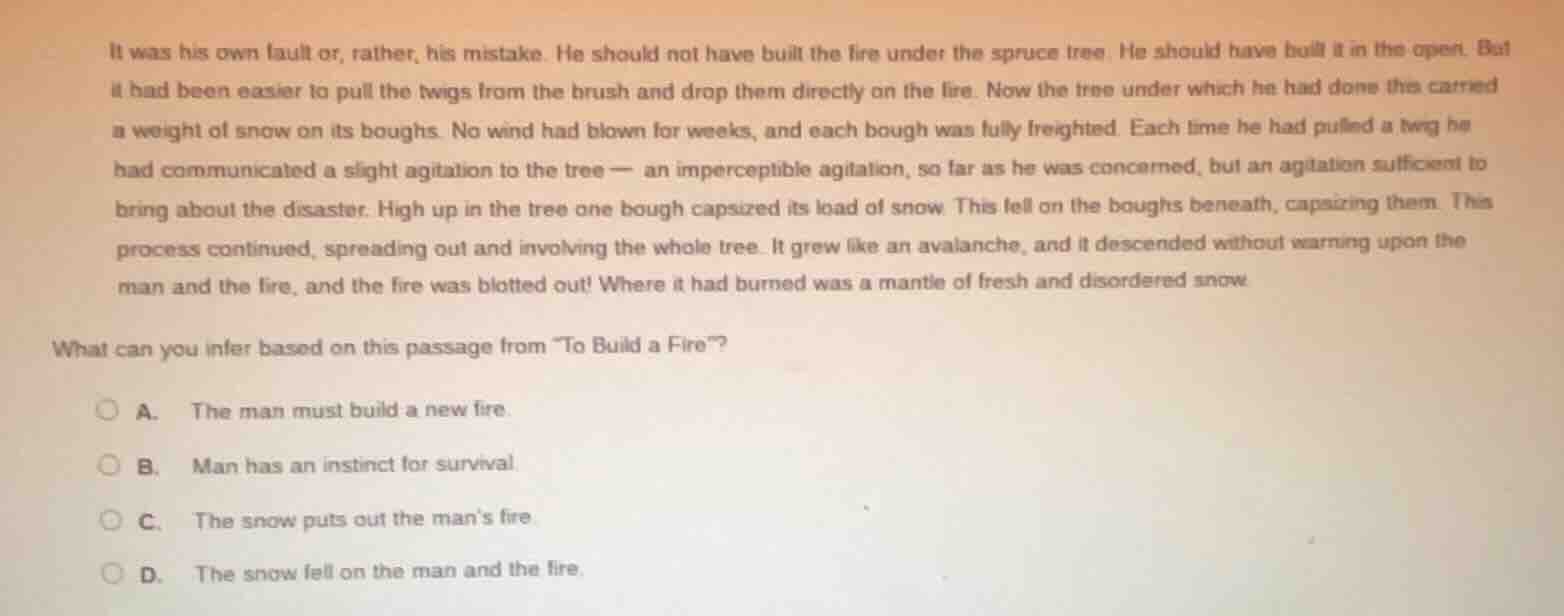
it was his own fault or, rather, his mistake. he should not have built the fire under the spruce tree. he should have built it in the open. but it had been easier to pull the twigs from the brush and drop them directly on the fire. now the tree under which he had done this carried a weight of snow on its boughs. no wind had blown for weeks, and each bough was fully freighted. each time he had pulled a twig he had communicated a slight agitation to the tree — an imperceptible agitation, so far as he was concerned, but an agitation sufficient to bring about the disaster. high up in the tree one bough capsized its load of snow. this fell on the boughs beneath, capsizing them. this process continued, spreading out and involving the whole tree. it grew like an avalanche, and it descended without warning upon the man and the fire, and the fire was blotted out! where it had burned was a mantle of fresh and disordered snow. what can you infer based on this passage from \to build a fire\? a. the man must build a new fire. b. man has an instinct for survival. c. the snow puts out the man’s fire. d. the snow fell on the man and the fire.
First, distinguish between direct statements and inferences. Options C and D are directly stated in the passage ("the fire was blotted out" and "it descended without warning upon the man and the fire"). Option A is not supported as the passage does not state or imply the man must build a new fire. Option B is an inference: the man's action of building a fire (even with a mistake) shows his drive to survive, an instinct for self-preservation not directly stated but implied by his survival-focused behavior.

Snap & solve any problem in the app
Get step-by-step solutions on Sovi AI
Photo-based solutions with guided steps
Explore more problems and detailed explanations
B. Man has an instinct for survival.