QUESTION IMAGE
Question
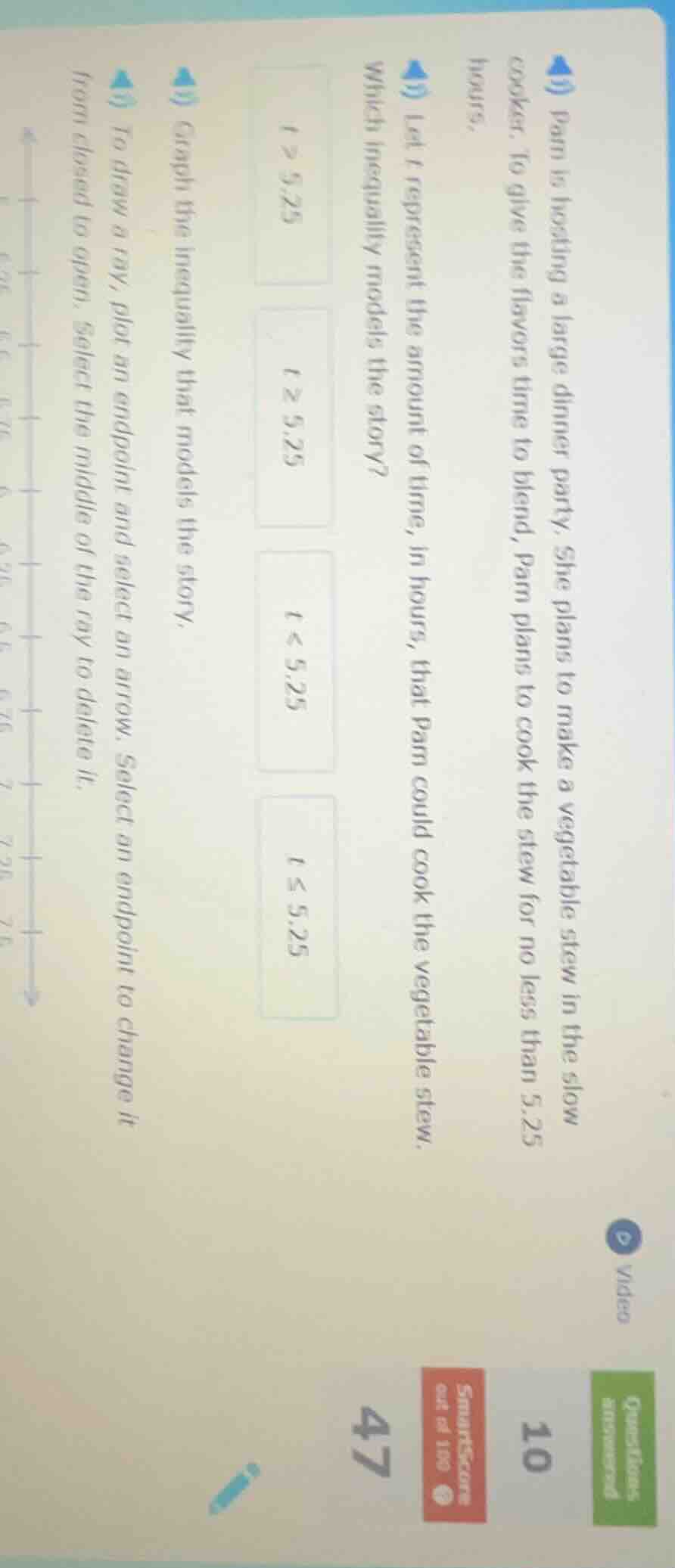
i) pam is hosting a large dinner party. she plans to make a vegetable stew in the slow cooker. to give the flavors time to blend, pam plans to cook the stew for no less than 5.25 hours. ii) let ( t ) represent the amount of time, in hours, that pam could cook the vegetable stew. which inequality models the story? ( t > 5.25 ) ( t geq 5.25 ) ( t < 5.25 ) ( t leq 5.25 ) iii) graph the inequality that models the story. iv) to draw a ray, plot an endpoint and select an arrow. select an endpoint to change it from closed to open. select the middle of the ray to delete it.
Part (i)
Step1: Understand the problem
Pam plans to cook the stew for no less than 5.25 hours. "No less than" means the time \( t \) is greater than or equal to 5.25 hours.
Step2: Analyze the inequalities
- \( t>5.25 \): This means \( t \) is strictly greater than 5.25, but we need "no less than" (which includes 5.25).
- \( t\geq5.25 \): This means \( t \) is greater than or equal to 5.25, which matches "no less than".
- \( t < 5.25 \): This means \( t \) is strictly less than 5.25, which is the opposite of what we need.
- \( t\leq5.25 \): This means \( t \) is less than or equal to 5.25, which is also the opposite.

Snap & solve any problem in the app
Get step-by-step solutions on Sovi AI
Photo-based solutions with guided steps
Explore more problems and detailed explanations
\( t\geq5.25 \)
Part (ii)
To graph \( t\geq5.25 \):
- Plot a closed dot (since the inequality is "greater than or equal to", the endpoint 5.25 is included) at \( t = 5.25 \) on the number line.
- Draw an arrow to the right of 5.25 (since \( t \) can be any value greater than or equal to 5.25, we shade to the right to represent all such values).