QUESTION IMAGE
Question
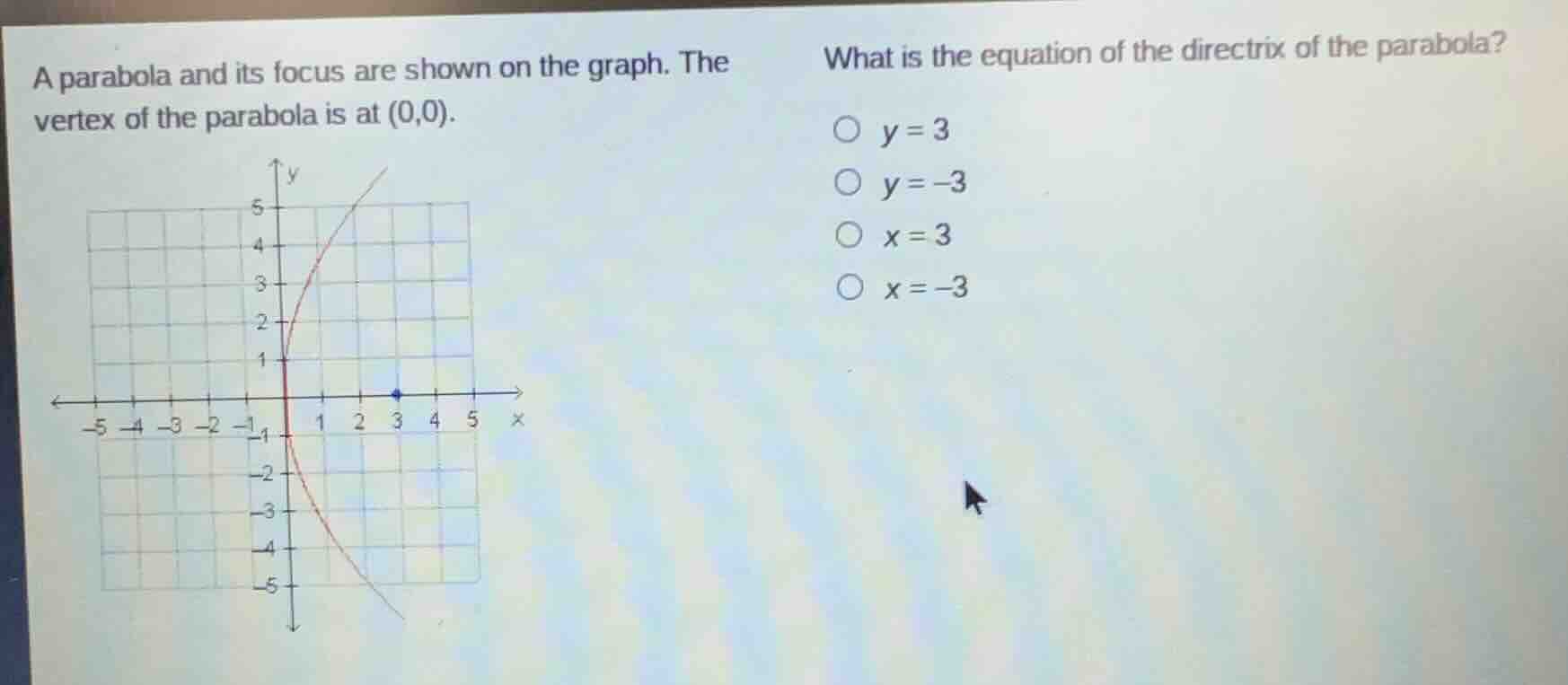
a parabola and its focus are shown on the graph. the vertex of the parabola is at (0,0). what is the equation of the directrix of the parabola? \\(\circ\\ y = 3\\) \\(\circ\\ y = -3\\) \\(\circ\\ x = 3\\) \\(\circ\\ x = -3\\)
Step1: Identify the focus
The focus of the parabola is at \((3, 0)\) (from the graph, the blue dot is at \(x = 3\), \(y = 0\)). The vertex is at \((0, 0)\).
Step2: Determine the direction and distance
For a parabola with vertex at \((0,0)\) and focus at \((p, 0)\) (opening horizontally), the directrix is the line \(x=-p\). Here, the focus is at \((3, 0)\), so \(p = 3\). Wait, no—wait, the parabola in the graph: looking at the graph, the parabola opens to the right? Wait, no, the graph shows the parabola opening to the right? Wait, no, the red curve: when \(x\) increases, \(y\) goes up and down. Wait, actually, the vertex is at \((0,0)\), focus at \((3, 0)\) (since the blue dot is at \((3, 0)\)). So the parabola opens to the right (since focus is to the right of vertex). For a parabola opening horizontally (along x - axis) with vertex \((h,k)=(0,0)\) and focus \((p,0)\), the standard form is \(y^{2}=4px\). The directrix is the line \(x=-p\). Wait, but wait, the focus is at \((3, 0)\), so \(p = 3\)? Wait, no, maybe I got the direction wrong. Wait, the graph: the parabola has a vertex at (0,0), and the focus is at (3,0). So the parabola opens to the right. Then the directrix should be a vertical line? Wait, no—wait, no, if the parabola opens horizontally (along x - axis), the directrix is a vertical line? Wait, no, for a parabola that opens to the right (vertex at (0,0), focus at (p,0)), the directrix is \(x=-p\). But wait, let's check the graph again. Wait, the options are \(y = 3\), \(y=-3\), \(x = 3\), \(x=-3\). Wait, maybe I misidentified the focus. Wait, the blue dot: looking at the x - axis, it's at (3, 0). So focus is (3, 0). Vertex is (0,0). So the distance from vertex to focus is \(p = 3\). For a parabola that opens to the right (horizontal parabola), the directrix is the vertical line \(x=-p\), so \(x=-3\)? Wait, no, that doesn't match. Wait, maybe the parabola opens vertically? Wait, the graph: when \(x = 0\), \(y = 0\), and the parabola goes up and down as \(x\) increases. Wait, maybe the focus is at (0, 3)? No, the blue dot is on the x - axis. Wait, the x - axis is the horizontal axis. So the focus is on the x - axis at (3, 0). So the parabola is a horizontal parabola (opens to the right). Then the directrix is a vertical line \(x=-3\)? But the options include \(x=-3\). Wait, but let's recall the definition of a parabola: the set of points equidistant from the focus and the directrix. Let's take a point on the parabola, say (3, 6) (from the graph, the upper part). The distance from (3, 6) to focus (3, 0) is \(|6 - 0|=6\). The distance from (3, 6) to directrix \(x=-3\) is \(|3-(-3)| = 6\). That works. Wait, but another point: (3, -6). Distance to focus (3,0) is \(|-6 - 0| = 6\), distance to directrix \(x=-3\) is \(|3-(-3)| = 6\). But wait, the options: \(x=-3\) is an option. Wait, but let's check again. Wait, maybe I made a mistake in the direction. Wait, the vertex is (0,0), focus is (3,0). So the parabola opens to the right. The directrix is a vertical line \(x=-3\). So the equation of the directrix is \(x=-3\)? Wait, but let's check the options. The options are \(y = 3\), \(y=-3\), \(x = 3\), \(x=-3\). So \(x=-3\) is an option. Wait, but let's confirm. For a parabola with vertex at (h,k) and focus at (h + p, k) (opening to the right), the directrix is \(x=h - p\). Here, \(h = 0\), \(k = 0\), \(h + p=3\), so \(p = 3\). Then directrix is \(x=0 - 3=-3\). So the directrix is \(x=-3\). Wait, but let's check the graph again. The parabola: when \(x\) is positive, \(y\) is positive and negative, so it's a horizontal parabo…

Snap & solve any problem in the app
Get step-by-step solutions on Sovi AI
Photo-based solutions with guided steps
Explore more problems and detailed explanations
D. \(x = - 3\) (assuming the options are labeled as A. \(y = 3\), B. \(y=-3\), C. \(x = 3\), D. \(x=-3\))