QUESTION IMAGE
Question
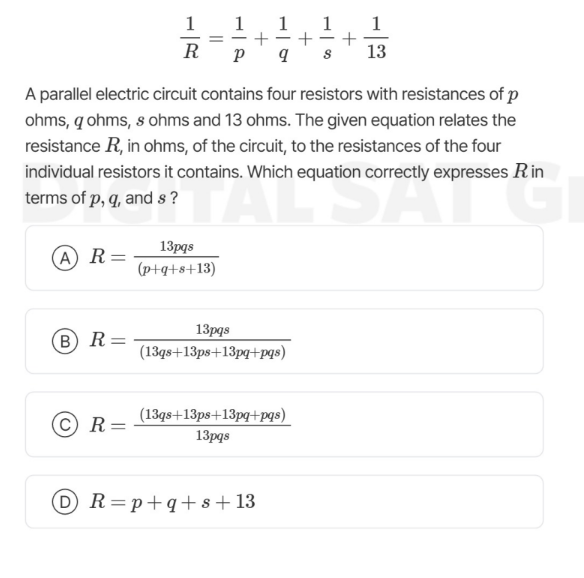
$$\frac{1}{r} = \frac{1}{p} + \frac{1}{q} + \frac{1}{s} + \frac{1}{13}$$
a parallel electric circuit contains four resistors with resistances of $p$ ohms, $q$ ohms, $s$ ohms and 13 ohms. the given equation relates the resistance $r$, in ohms, of the circuit, to the resistances of the four individual resistors it contains. which equation correctly expresses $r$ in terms of $p$, $q$, and $s$?
\\(\boldsymbol{\text{a } r = \frac{13pqs}{(p+q+s+13)}}\\)
\\(\boldsymbol{\text{b } r = \frac{13pqs}{(13qs + 13ps + 13pq + pqs)}}\\)
\\(\boldsymbol{\text{c } r = \frac{(13qs + 13ps + 13pq + pqs)}{13pqs}}\\)
\\(\boldsymbol{\text{d } r = p + q + s + 13}\\)
Step1: Combine fractions on RHS
Find common denominator \(13pqs\):
\(\frac{1}{R} = \frac{13qs}{13pqs} + \frac{13ps}{13pqs} + \frac{13pq}{13pqs} + \frac{pqs}{13pqs}\)
Step2: Sum numerators
\(\frac{1}{R} = \frac{13qs + 13ps + 13pq + pqs}{13pqs}\)
Step3: Take reciprocal
\(R = \frac{13pqs}{13qs + 13ps + 13pq + pqs}\)

Snap & solve any problem in the app
Get step-by-step solutions on Sovi AI
Photo-based solutions with guided steps
Explore more problems and detailed explanations
B. \( R = \frac{13pqs}{(13qs + 13ps + 13pq + pqs)} \)