QUESTION IMAGE
Question
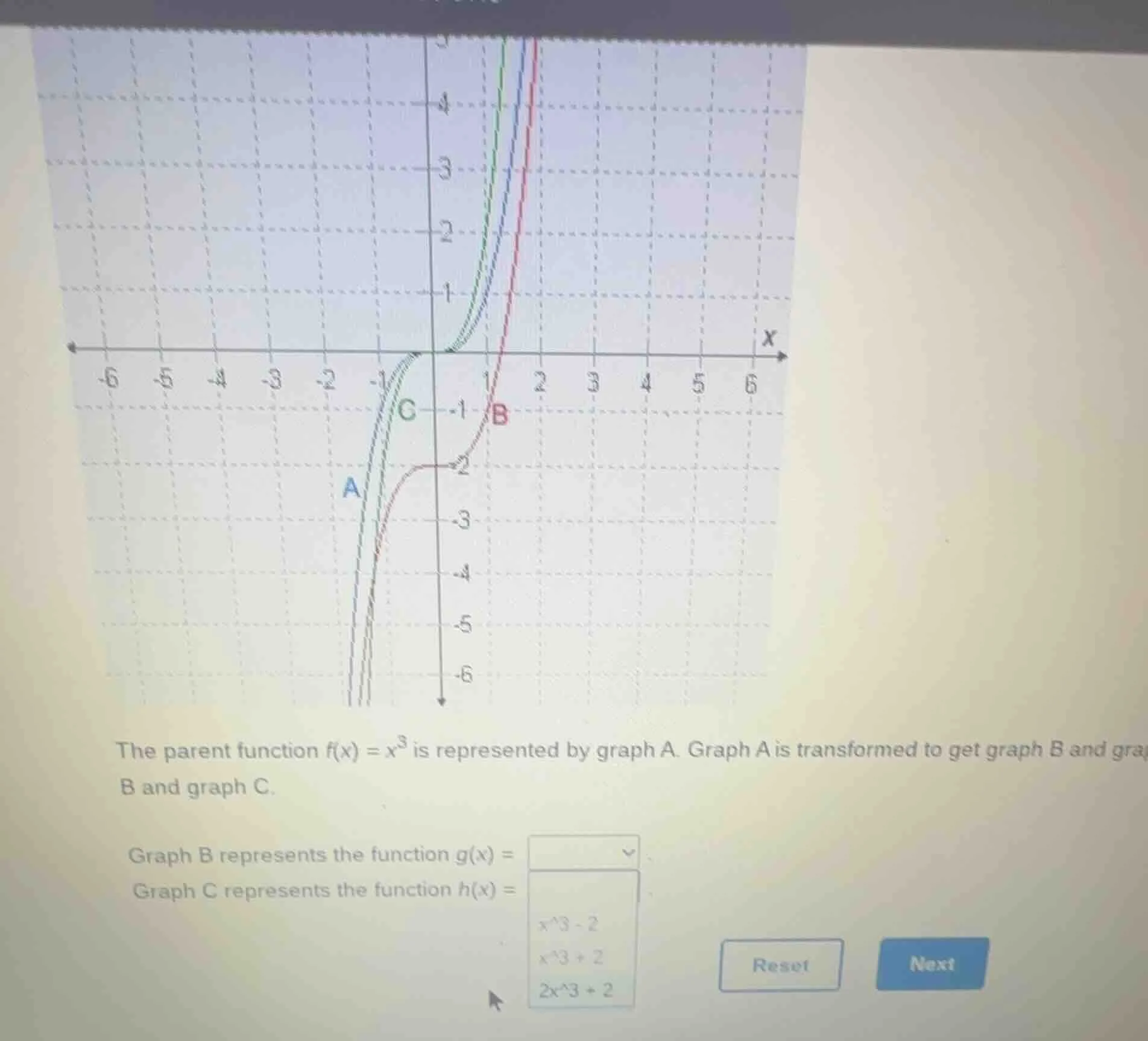
the parent function $f(x) = x^3$ is represented by graph a. graph a is transformed to get graph b and gra b and graph c.
graph b represents the function $g(x) =$
graph c represents the function $h(x) =$
$x^3 - 2$
$x^3 + 2$
$2x^3 + 2$
Step1: Analyze Graph B (Transformation from \( f(x)=x^3 \))
The parent function is \( f(x) = x^3 \). For Graph B, we observe vertical shifts or stretches. Let's check the options. The function for Graph B: when we look at the transformation, if we consider vertical shift or stretch. Let's test the points. For \( f(x)=x^3 \), at \( x = 1 \), \( f(1)=1 \). For Graph B, at \( x = 1 \), the value is \( -2 \)? Wait, no, let's re - evaluate. Wait, the parent function \( f(x)=x^3 \) (Graph A). Graph B: let's see the vertical shift. Wait, the options for Graph B (assuming the dropdown has options, but from the given, for Graph B, let's check the vertical shift. Wait, the options for the functions are \( x^3 - 2 \), \( x^3+2 \), \( 2x^3 + 2 \). Wait, maybe Graph B is a vertical shift. Wait, the parent function \( f(x)=x^3 \). If we take \( g(x)=x^3 - 2 \), it's a vertical shift down by 2 units. Let's check the graph: Graph A is \( f(x)=x^3 \), Graph B: when \( x = 0 \), \( f(0)=0 \), Graph B at \( x = 0 \) is \( - 2 \), so \( g(x)=x^3-2 \) for Graph B.
Step2: Analyze Graph C (Transformation from \( f(x)=x^3 \))
For Graph C, let's check the transformation. The options are \( x^3 - 2 \), \( x^3+2 \), \( 2x^3+2 \). Let's see the vertical stretch and shift. The parent function \( f(x)=x^3 \). Graph C: when \( x = 0 \), \( f(0)=0 \), Graph C at \( x = 0 \) is \( 2 \)? Wait, no, let's check the slope. The function \( h(x)=2x^3 + 2 \): when \( x = 0 \), \( h(0)=2 \), and the graph of \( C \) at \( x = 0 \) is 0? Wait, no, maybe I made a mistake. Wait, the parent function is \( f(x)=x^3 \) (Graph A). Graph C: let's see the vertical stretch. The function \( 2x^3+2 \): the coefficient 2 is a vertical stretch by a factor of 2, and +2 is a vertical shift up by 2. Wait, maybe Graph C is \( 2x^3+2 \). Wait, but let's re - check.
Wait, the problem says "Graph A is transformed to get graph B and graph C". The parent function \( f(x)=x^3 \) is Graph A.
For Graph B: Let's assume the correct function is \( g(x)=x^3 - 2 \) (vertical shift down by 2).
For Graph C: Let's assume the correct function is \( h(x)=2x^3+2 \) (vertical stretch by 2 and shift up by 2). But maybe the options are as follows:
Wait, the user's problem has a dropdown for Graph B and Graph C. From the given, the options for the functions are \( x^3 - 2 \), \( x^3+2 \), \( 2x^3+2 \).
So, Graph B: \( g(x)=x^3 - 2 \)
Graph C: \( h(x)=2x^3+2 \) (assuming the transformation is a vertical stretch and shift)

Snap & solve any problem in the app
Get step-by-step solutions on Sovi AI
Photo-based solutions with guided steps
Explore more problems and detailed explanations
Graph B: \( \boldsymbol{x^3 - 2} \)
Graph C: \( \boldsymbol{2x^3+2} \)
(Note: The answer is based on the analysis of vertical shifts and stretches for the cubic function transformations. The parent function \( f(x)=x^3 \) (Graph A) is transformed: Graph B is a vertical shift down by 2 units (\( g(x)=x^3 - 2 \)) and Graph C is a vertical stretch by a factor of 2 and a vertical shift up by 2 units (\( h(x)=2x^3+2 \)).)