QUESTION IMAGE
Question
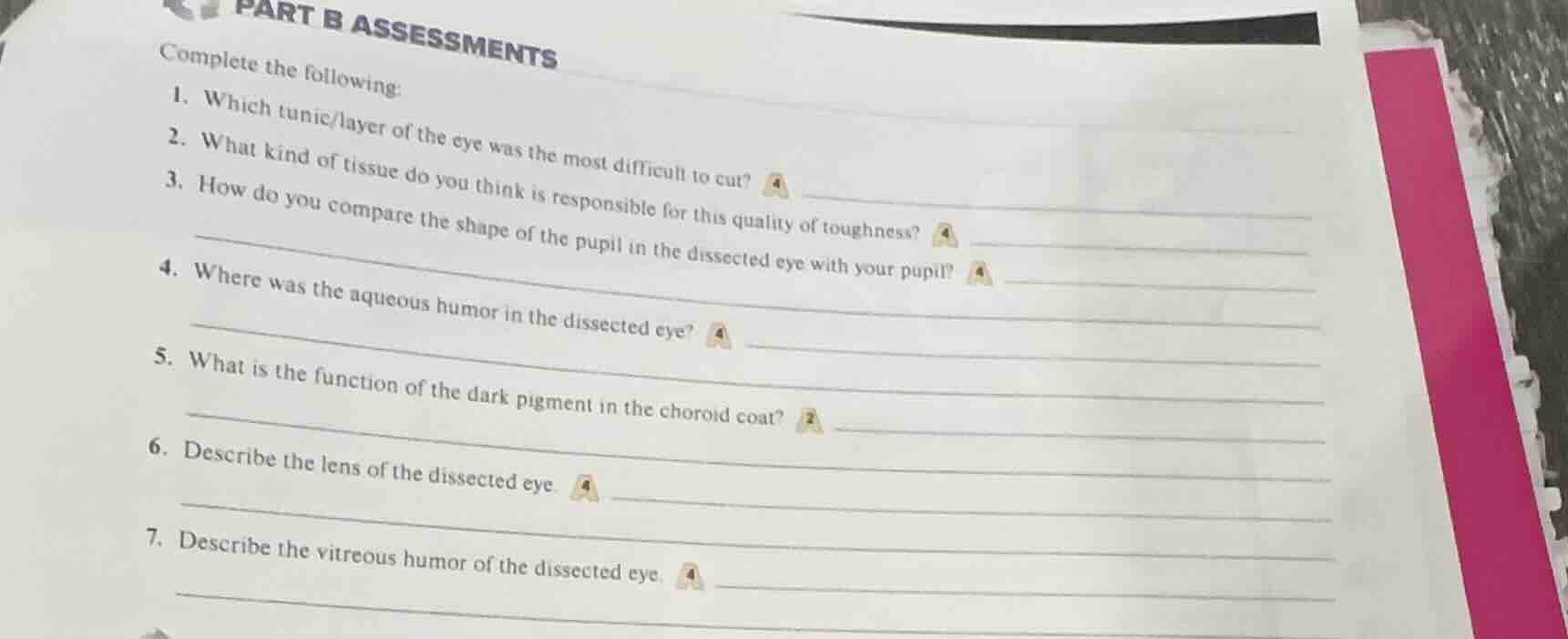
part b assessments
complete the following:
- which tunic/layer of the eye was the most difficult to cut?
- what kind of tissue do you think is responsible for this quality of toughness?
- how do you compare the shape of the pupil in the dissected eye with your pupil?
- where was the aqueous humor in the dissected eye?
- what is the function of the dark pigment in the choroid coat?
- describe the lens of the dissected eye.
- describe the vitreous humor of the dissected eye.
Brief Explanations
- The sclera, the outer fibrous layer of the eye, is the toughest and most difficult to cut due to its dense, fibrous structure.
- Dense fibrous connective tissue, which has tightly packed collagen fibers, gives the tough quality to the hard-to-cut eye layer.
- A dissected animal eye (common for this activity) typically has a round pupil, matching the round shape of a human pupil; some species have different pupil shapes, but standard dissections use animals with round pupils.
- Aqueous humor is found in the anterior chamber, the space between the cornea and the iris/lens, of the dissected eye.
- The dark pigment in the choroid coat absorbs excess light inside the eye, preventing light reflection that would blur visual signals.
- The dissected eye's lens is a clear, biconvex, flexible, and firm structure located behind the iris, responsible for focusing light.
- The vitreous humor of the dissected eye is a thick, gel-like, transparent substance that fills the large posterior cavity of the eye, maintaining eye shape.

Snap & solve any problem in the app
Get step-by-step solutions on Sovi AI
Photo-based solutions with guided steps
Explore more problems and detailed explanations
- The sclera (outer fibrous layer)
- Dense fibrous connective tissue
- The pupil of the dissected eye is typically round, matching the round shape of a human pupil.
- In the anterior chamber (between the cornea and iris/lens)
- It absorbs excess light to prevent blurred vision.
- It is a clear, biconvex, flexible, firm structure behind the iris.
- It is a thick, gel-like, transparent substance filling the eye's posterior cavity.