QUESTION IMAGE
Question
part e
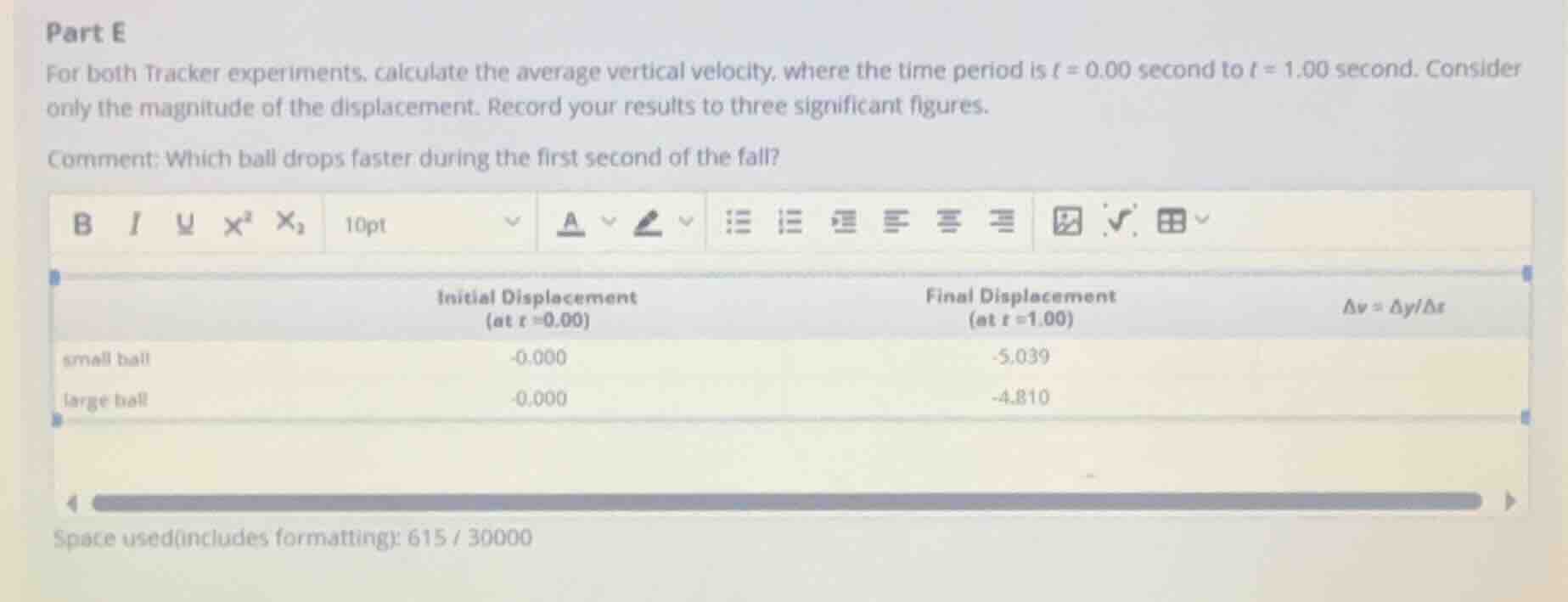
for both tracker experiments, calculate the average vertical velocity, where the time period is t = 0.00 second to t = 1.00 second. consider only the magnitude of the displacement. record your results to three significant figures.
comment: which ball drops faster during the first second of the fall?
initial displacement (at t = 0.00) final displacement (at t = 1.00) δv = δy/δt
small ball -0.000 -5.039
large ball -0.000 -4.810
Step1: Calculate for small ball
The formula for average velocity is $\Delta v = \frac{\Delta y}{\Delta t}$. For the small ball, initial displacement $y_1 = -0.000$, final displacement $y_2 = -5.039$, time $\Delta t = 1.00 - 0.00 = 1.00$ s. So $\Delta y = y_2 - y_1 = -5.039 - (-0.000) = -5.039$. The magnitude is $5.039$. Then $\Delta v = \frac{5.039}{1.00} = 5.039 \approx 5.04$ (to three significant figures).
Step2: Calculate for large ball
For the large ball, initial displacement $y_1 = -0.000$, final displacement $y_2 = -4.810$, time $\Delta t = 1.00$ s. $\Delta y = -4.810 - (-0.000) = -4.810$, magnitude is $4.810$. $\Delta v = \frac{4.810}{1.00} = 4.81$ (to three significant figures).
Step3: Compare velocities
The average vertical velocity of the small ball is $5.04$ m/s (magnitude) and the large ball is $4.81$ m/s (magnitude). Since $5.04 > 4.81$, the small ball drops faster.

Snap & solve any problem in the app
Get step-by-step solutions on Sovi AI
Photo-based solutions with guided steps
Explore more problems and detailed explanations
- Small ball average vertical velocity: $5.04$ m/s
- Large ball average vertical velocity: $4.81$ m/s
- The small ball drops faster during the first second of the fall.