QUESTION IMAGE
Question
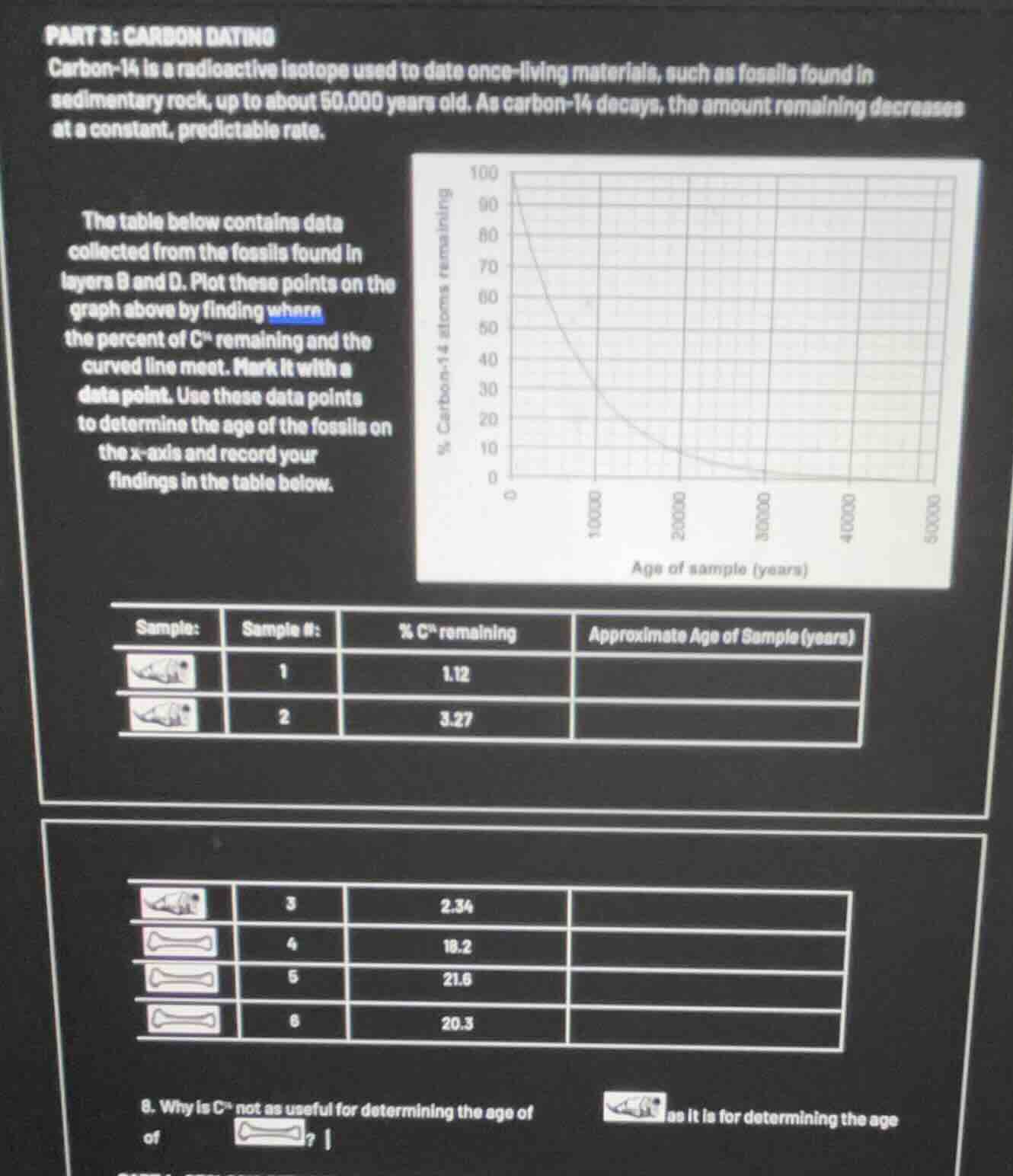
part 3: carbon datingcarbon-14 is a radioactive isotope used to date once-living materials, such as fossils found in sedimentary rock, up to about 50,000 years old. as carbon-14 decays, the amount remaining decreases at a constant, predictable rate.the table below contains data collected from the fossils found in layers b and d. plot these points on the graph above by finding where the percent of c¹⁴ remaining and the curved line meet. mark it with a data point. use these data points to determine the age of the fossils on the x-axis and record your findings in the table below.| sample: | sample #: | % c¹⁴ remaining | approximate age of sample (years) || ---- | ---- | ---- | ---- || fossil icon | 1 | 1.12 | || fossil icon | 2 | 3.27 | || sample: | sample #: | % c¹⁴ remaining | approximate age of sample (years) || ---- | ---- | ---- | ---- || fossil icon | 3 | 2.34 | || bone icon | 4 | 18.2 | || bone icon | 5 | 21.6 | || bone icon | 6 | 20.3 | |8. why is c¹⁴ not as useful for determining the age of fossil icon as it is for determining the age of bone icon?
Step1: Match % C-14 to graph (Sample1)
Locate 1.12% on y-axis, find x-value: 40,000 years
Step2: Match % C-14 to graph (Sample2)
Locate 3.27% on y-axis, find x-value: 35,000 years
Step3: Match % C-14 to graph (Sample3)
Locate 2.34% on y-axis, find x-value: 37,000 years
Step4: Match % C-14 to graph (Sample4)
Locate 18.2% on y-axis, find x-value: 15,000 years
Step5: Match % C-14 to graph (Sample5)
Locate 21.6% on y-axis, find x-value: 14,000 years
Step6: Match % C-14 to graph (Sample6)
Locate 20.3% on y-axis, find x-value: 14,500 years
Step7: Explain C-14 limitation
Carbon-14 has a ~5730-year half-life; after ~50,000 years, nearly all C-14 decays, so it cannot date older (non-young) once-living materials effectively.

Snap & solve any problem in the app
Get step-by-step solutions on Sovi AI
Photo-based solutions with guided steps
Explore more problems and detailed explanations
Completed Age Table:
| Sample | Sample # | % C¹⁴ remaining | Approximate Age of Sample (years) |
|---|---|---|---|
| Fossil 2 | 2 | 3.27 | 35,000 |
| Fossil 3 | 3 | 2.34 | 37,000 |
| Bone 1 | 4 | 18.2 | 15,000 |
| Bone 2 | 5 | 21.6 | 14,000 |
| Bone 3 | 6 | 20.3 | 14,500 |
Question 8 Answer:
Carbon-14 is not as useful for dating older (non-recent) once-living materials (like the older bone sample) because it has a relatively short half-life (~5730 years). After about 50,000 years, so little Carbon-14 remains that it cannot be accurately measured to determine the age of very old samples. It only works effectively for materials up to ~50,000 years old.