QUESTION IMAGE
Question
part 3: detailed interrelationships
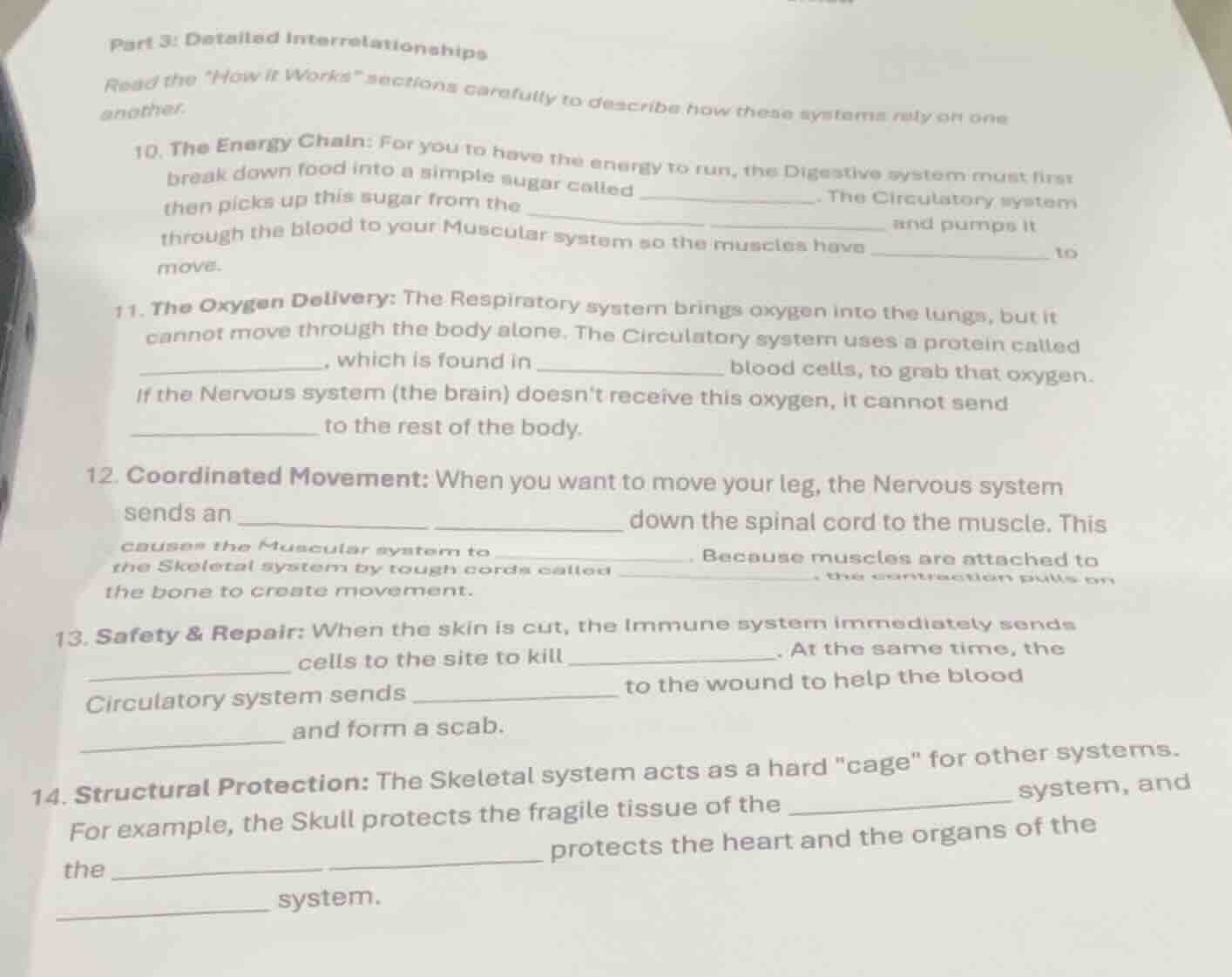
read the \how it works\ sections carefully to describe how these systems rely on one another.
- the energy chain: for you to have the energy to run, the digestive system must first break down food into a simple sugar called _____. the circulatory system then picks up this sugar from the ___ and pumps it through the blood to your muscular system so the muscles have _____ to move.
- the oxygen delivery: the respiratory system brings oxygen into the lungs, but it cannot move through the body alone. the circulatory system uses a protein called _____, which is found in ___ blood cells, to grab that oxygen. if the nervous system (the brain) doesn’t receive this oxygen, it cannot send _____ to the rest of the body.
- coordinated movement: when you want to move your leg, the nervous system sends an _____ ___ down the spinal cord to the muscle. this causes the muscular system to ___. because muscles are attached to the skeletal system by tough cords called _____, the contraction pulls on the bone to create movement.
- safety & repair: when the skin is cut, the immune system immediately sends _____ cells to the site to kill ___. at the same time, the circulatory system sends ___ to the wound to help the blood _____ and form a scab.
- structural protection: the skeletal system acts as a hard \cage\ for other systems. for example, the skull protects the fragile tissue of the _____ system, and the ___ ___ protects the heart and the organs of the _____ system.
Response
Question 10
Brief Explanations
- The digestive system breaks down food into glucose (a simple sugar).
- The circulatory system picks up glucose from the small intestine (where nutrient absorption happens) and pumps it through the blood.
- Muscles need energy (from glucose) to move.
Brief Explanations
- Hemoglobin is the protein in red blood cells that carries oxygen.
- The nervous system (brain) sends signals (like electrical impulses or nerve signals) to the body; without oxygen, it can't send these signals.
Brief Explanations
- The nervous system sends an electrical signal (nerve impulse) down the spinal cord to muscles.
- This signal causes muscles to contract.
- Muscles are attached to bones by tendons.

Snap & solve any problem in the app
Get step-by-step solutions on Sovi AI
Photo-based solutions with guided steps
Explore more problems and detailed explanations
- glucose
- small intestine
- energy