QUESTION IMAGE
Question
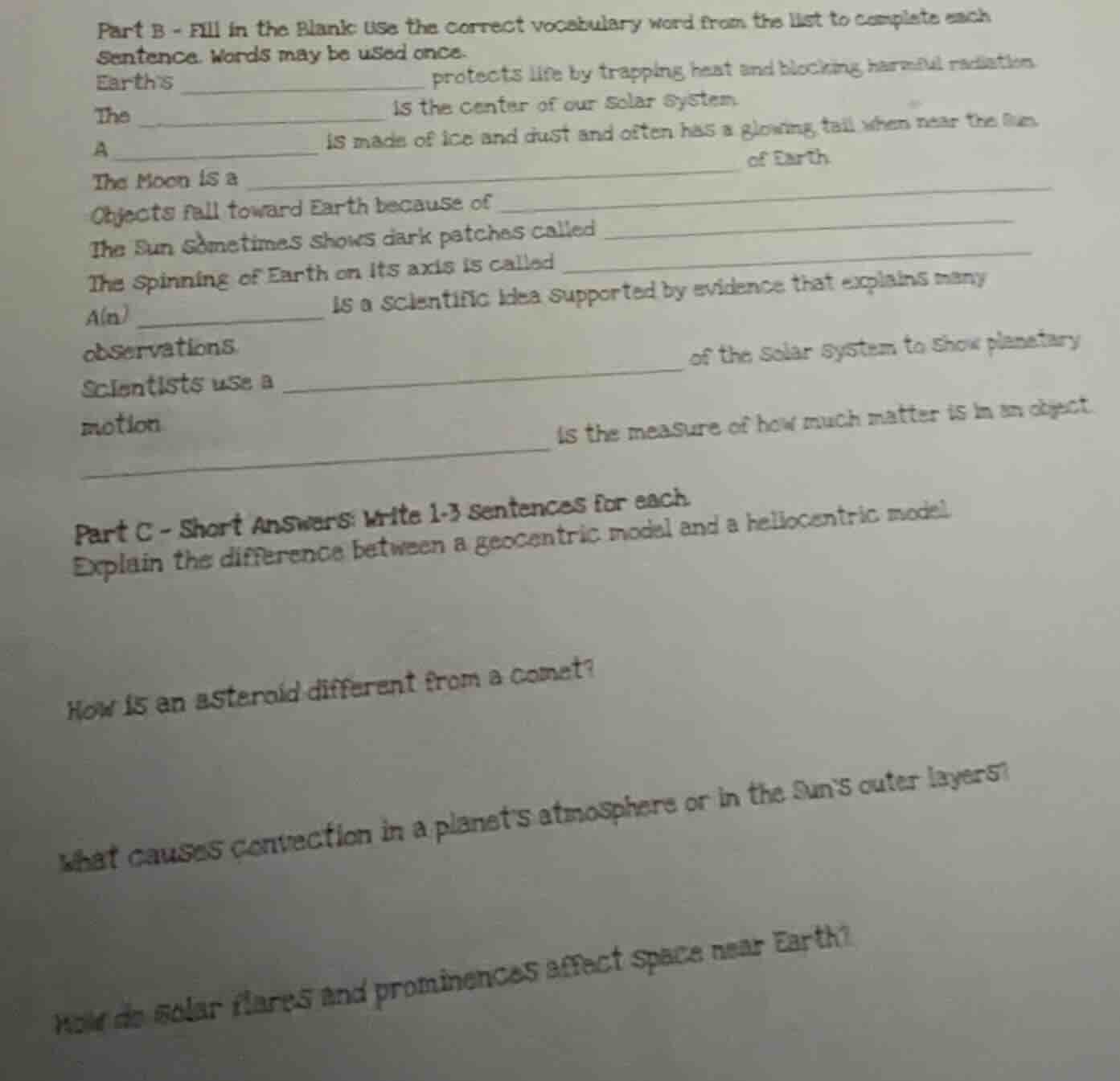
part b - fill in the blank: use the correct vocabulary word from the list to complete each sentence. words may be used once.
earth’s ____________ protects life by trapping heat and blocking harmful radiation.
the ____________ is the center of our solar system.
a ____________ is made of ice and dust and often has a glowing tail when near the sun.
the moon is a ____________ of earth.
objects fall toward earth because of ____________
the sun sometimes shows dark patches called ____________
the spinning of earth on its axis is called ____________
a(n) ____________ is a scientific idea supported by evidence that explains many observations.
scientists use a ____________ of the solar system to show planetary motion.
____________ is the measure of how much matter is in an object.
part c - short answers: write 1 - 3 sentences for each.
explain the difference between a geocentric model and a heliocentric model.
how is an asteroid different from a comet?
what causes convection in a planet’s atmosphere or in the sun’s outer layers?
how do solar flares and prominences affect space near earth?
Part B - Fill in the Blank (assuming a typical solar system vocabulary list with words like atmosphere, Sun, comet, satellite, gravity, sunspots, rotation, theory, model, mass)
- Earth’s \(\boldsymbol{\text{atmosphere}}\) protects life by trapping heat and blocking harmful radiation. (Atmosphere is Earth's gaseous layer with these protective roles.)
- The \(\boldsymbol{\text{Sun}}\) is the center of our solar system. (Heliocentric model has Sun at solar system's center.)
- A \(\boldsymbol{\text{comet}}\) is made of ice and dust and often has a glowing tail when near the Sun. (Comets’ composition and tail formation match this.)
- The Moon is a \(\boldsymbol{\text{satellite}}\) of Earth. (Natural satellite orbiting Earth.)
- Objects fall toward Earth because of \(\boldsymbol{\text{gravity}}\). (Gravity is the force pulling objects to Earth.)
- The Sun sometimes shows dark patches called \(\boldsymbol{\text{sunspots}}\). (Sunspots are cooler, darker areas on the Sun's surface.)
- The spinning of Earth on its axis is called \(\boldsymbol{\text{rotation}}\). (Rotation is the term for spinning on an axis.)
- A(n) \(\boldsymbol{\text{theory}}\) is a scientific idea supported by evidence that explains many observations. (Scientific theory definition.)
- Scientists use a \(\boldsymbol{\text{model}}\) of the Solar System to show planetary motion. (Models represent systems for study.)
- \(\boldsymbol{\text{Mass}}\) is the measure of how much matter is in an object. (Mass definition in physics.)
Part C - Short Answers
- Geocentric vs. Heliocentric Models
A geocentric model (e.g., Ptolemaic) places Earth at the solar system’s center, with celestial bodies orbiting it. A heliocentric model (e.g., Copernican) has the Sun at the center, with planets (including Earth) orbiting the Sun.
- Asteroid vs. Comet
Asteroids are rocky, metallic objects (mostly in the asteroid belt) with no tail. Comets are icy, dusty bodies; when near the Sun, ice vaporizes, creating a glowing tail (coma and tail).
- Convection in Atmospheres/Sun’s Layers
Convection is caused by temperature differences: warmer (less dense) gas/fluid rises, while cooler (denser) material sinks, creating circular currents. In a planet’s atmosphere, solar heating drives this; in the Sun, nuclear fusion - heated plasma convects.
- Solar Flares/Prominences’ Effect on Near - Earth Space
Solar flares release intense energy/radiation, disrupting radio communications and damaging satellites. Prominences (large gas loops) can erupt, sending charged particles toward Earth, causing auroras and geomagnetic storms.

Snap & solve any problem in the app
Get step-by-step solutions on Sovi AI
Photo-based solutions with guided steps
Explore more problems and detailed explanations
Part B - Fill in the Blank (assuming a typical solar system vocabulary list with words like atmosphere, Sun, comet, satellite, gravity, sunspots, rotation, theory, model, mass)
- Earth’s \(\boldsymbol{\text{atmosphere}}\) protects life by trapping heat and blocking harmful radiation. (Atmosphere is Earth's gaseous layer with these protective roles.)
- The \(\boldsymbol{\text{Sun}}\) is the center of our solar system. (Heliocentric model has Sun at solar system's center.)
- A \(\boldsymbol{\text{comet}}\) is made of ice and dust and often has a glowing tail when near the Sun. (Comets’ composition and tail formation match this.)
- The Moon is a \(\boldsymbol{\text{satellite}}\) of Earth. (Natural satellite orbiting Earth.)
- Objects fall toward Earth because of \(\boldsymbol{\text{gravity}}\). (Gravity is the force pulling objects to Earth.)
- The Sun sometimes shows dark patches called \(\boldsymbol{\text{sunspots}}\). (Sunspots are cooler, darker areas on the Sun's surface.)
- The spinning of Earth on its axis is called \(\boldsymbol{\text{rotation}}\). (Rotation is the term for spinning on an axis.)
- A(n) \(\boldsymbol{\text{theory}}\) is a scientific idea supported by evidence that explains many observations. (Scientific theory definition.)
- Scientists use a \(\boldsymbol{\text{model}}\) of the Solar System to show planetary motion. (Models represent systems for study.)
- \(\boldsymbol{\text{Mass}}\) is the measure of how much matter is in an object. (Mass definition in physics.)
Part C - Short Answers
- Geocentric vs. Heliocentric Models
A geocentric model (e.g., Ptolemaic) places Earth at the solar system’s center, with celestial bodies orbiting it. A heliocentric model (e.g., Copernican) has the Sun at the center, with planets (including Earth) orbiting the Sun.
- Asteroid vs. Comet
Asteroids are rocky, metallic objects (mostly in the asteroid belt) with no tail. Comets are icy, dusty bodies; when near the Sun, ice vaporizes, creating a glowing tail (coma and tail).
- Convection in Atmospheres/Sun’s Layers
Convection is caused by temperature differences: warmer (less dense) gas/fluid rises, while cooler (denser) material sinks, creating circular currents. In a planet’s atmosphere, solar heating drives this; in the Sun, nuclear fusion - heated plasma convects.
- Solar Flares/Prominences’ Effect on Near - Earth Space
Solar flares release intense energy/radiation, disrupting radio communications and damaging satellites. Prominences (large gas loops) can erupt, sending charged particles toward Earth, causing auroras and geomagnetic storms.