QUESTION IMAGE
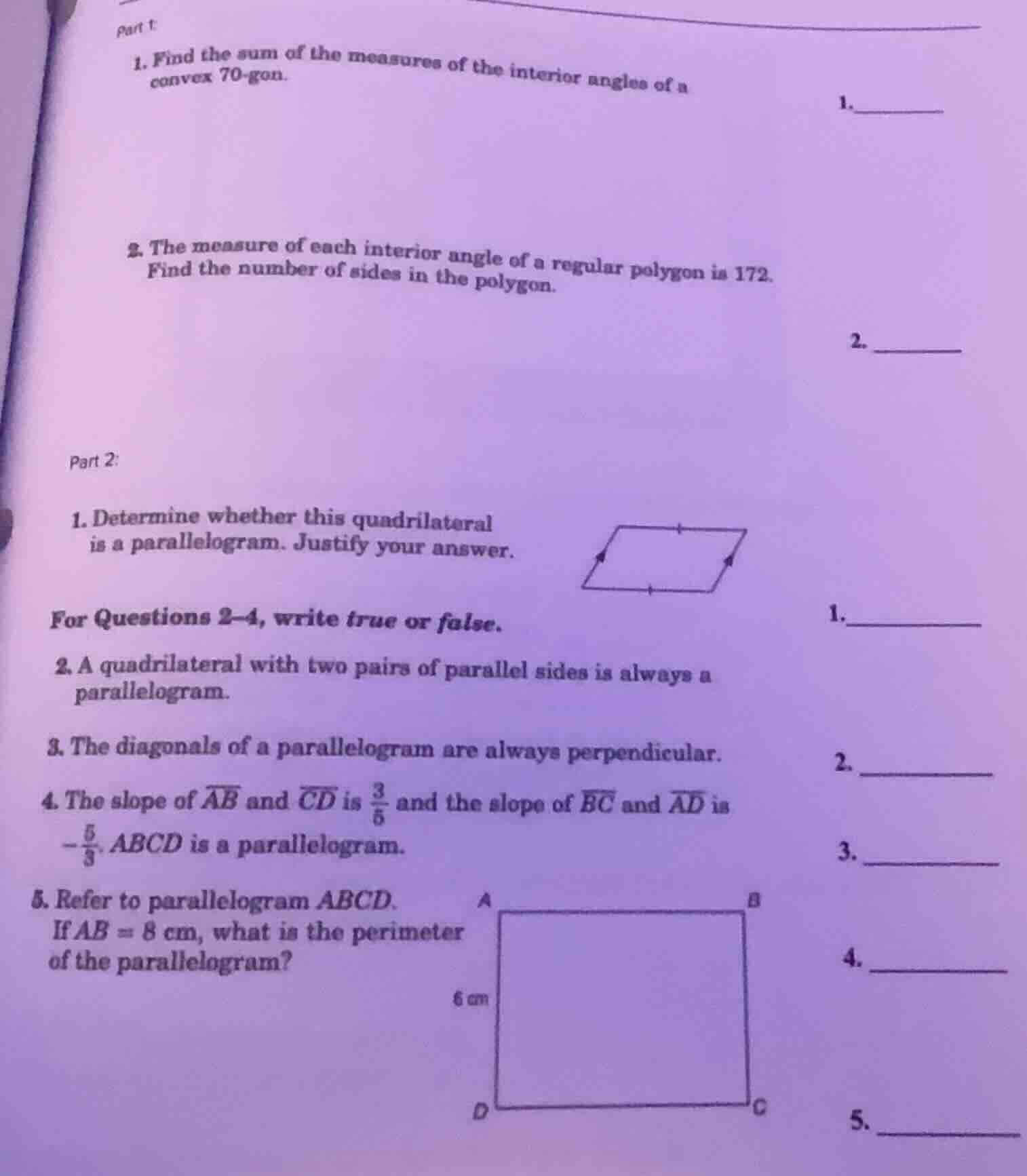
Question
part 1:
- find the sum of the measures of the interior angles of a convex 70 - gon.
- the measure of each interior angle of a regular polygon is 172. find the number of sides in the polygon.
part 2:
- determine whether this quadrilateral is a parallelogram. justify your answer.
for questions 2–4, write true or false.
- a quadrilateral with two pairs of parallel sides is always a parallelogram.
- the diagonals of a parallelogram are always perpendicular.
- the slope of \\(\overline{ab}\\) and \\(\overline{cd}\\) is \\(\frac{3}{5}\\) and the slope of \\(\overline{bc}\\) and \\(\overline{ad}\\) is \\(-\frac{5}{3}\\). \\(abcd\\) is a parallelogram.
- refer to parallelogram \\(abcd\\). if \\(ab = 8\\) cm, what is the perimeter of the parallelogram?
Part 1
1.
Step 1: Recall the formula for the sum of interior angles of a polygon
The formula for the sum of the interior angles of a convex polygon with \( n \) sides is \( S=(n - 2)\times180^{\circ} \).
Step 2: Substitute \( n = 70 \) into the formula
For a 70 - gon, \( n=70 \). So we have \( S=(70 - 2)\times180^{\circ} \).
First, calculate \( 70-2 = 68 \). Then, \( 68\times180^{\circ}=12240^{\circ} \).
Step 1: Recall the formula for the measure of each interior angle of a regular polygon
The measure of each interior angle \( I \) of a regular polygon with \( n \) sides is given by \( I=\frac{(n - 2)\times180^{\circ}}{n} \). We know that \( I = 172^{\circ} \), so we set up the equation \( 172=\frac{(n - 2)\times180}{n} \).
Step 2: Solve the equation for \( n \)
Multiply both sides of the equation by \( n \): \( 172n=(n - 2)\times180 \).
Expand the right - hand side: \( 172n = 180n-360 \).
Subtract \( 172n \) from both sides: \( 0 = 180n-172n - 360 \).
Simplify: \( 0 = 8n-360 \).
Add 360 to both sides: \( 8n=360 \).
Divide both sides by 8: \( n=\frac{360}{8} = 45 \).
To determine if a quadrilateral is a parallelogram, we can use the properties of parallelograms. One of the properties is that if a quadrilateral has one pair of opposite sides that are both congruent and parallel, then it is a parallelogram. From the diagram, we can see that one pair of opposite sides are marked as congruent (the tick marks) and the arrows indicate that they are parallel. So, by the theorem "If one pair of opposite sides of a quadrilateral are both congruent and parallel, then the quadrilateral is a parallelogram", this quadrilateral is a parallelogram.

Snap & solve any problem in the app
Get step-by-step solutions on Sovi AI
Photo-based solutions with guided steps
Explore more problems and detailed explanations
\( 12240^{\circ} \)