QUESTION IMAGE
Question
part f: fossil records
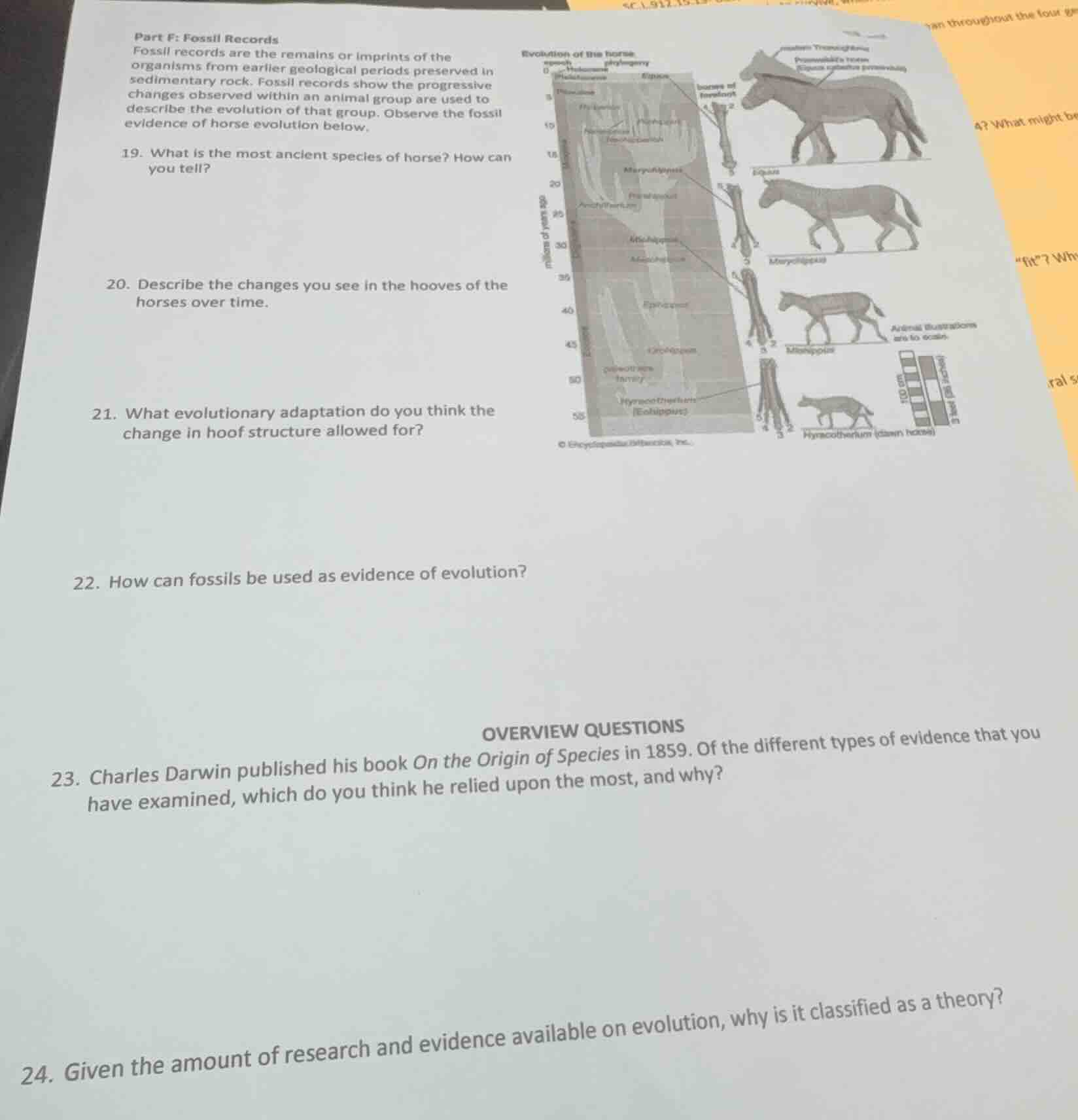
fossil records are the remains or imprints of the organisms from earlier geological periods preserved in sedimentary rock. fossil records show the progressive changes observed within an animal group are used to describe the evolution of that group. observe the fossil evidence of horse evolution below.
- what is the most ancient species of horse? how can you tell?
- describe the changes you see in the hooves of the horses over time.
- what evolutionary adaptation do you think the change in hoof structure allowed for?
- how can fossils be used as evidence of evolution?
overview questions
- charles darwin published his book on the origin of species in 1859. of the different types of evidence that you have examined, which do you think he relied upon the most, and why?
- given the amount of research and evidence available on evolution, why is it classified as a theory?
For Question 19:
The timeline on the graph shows older species at the bottom, with the highest number of millions of years ago. Hyracotherium (dawn horse) is at the bottom, corresponding to ~55 million years ago, making it the most ancient.
For Question 20:
Looking at the limb/hoof structures: the ancient Hyracotherium has 4 distinct toes on its front foot. Over time, the number of toes reduces, bones fuse, and modern horses have a single, large hoof (a modified toe) with supporting fused bones.
For Question 21:
The shift to a single hoof and fused limb bones provided better support and speed for running on open, hard grasslands. This adaptation helped horses escape predators more effectively and travel longer distances to find food.
For Question 22:
Fossils preserve physical traits of ancient organisms. By comparing fossils from different geological time periods, scientists can track progressive physical changes in related species, showing how groups of organisms have modified traits over time to evolve into new forms.
For Question 23:
Darwin relied most heavily on fossil evidence and observations of comparative anatomy (physical traits of living organisms). Fossils showed him the existence of extinct species with traits linking to modern ones, and comparative anatomy revealed shared physical features that suggested common ancestry. These were the most direct, observable forms of evidence available to him in 1859, before modern genetics.
For Question 24:
In science, a "theory" is a well-supported, comprehensive explanation for a natural phenomenon that is backed by vast amounts of consistent evidence (including fossils, genetics, and observational data). Evolution is classified as a theory because it explains the diversity of life on Earth, is supported by decades of research across multiple scientific fields, and can be used to make testable predictions.

Snap & solve any problem in the app
Get step-by-step solutions on Sovi AI
Photo-based solutions with guided steps
Explore more problems and detailed explanations
- The most ancient horse species is Hyracotherium (dawn horse). It is the oldest because it is positioned at the bottom of the timeline, corresponding to ~55 million years ago, the earliest time point shown.
- Ancient horses (like Hyracotherium) had 4 distinct toes on their front feet. Over time, the number of toes decreased, limb bones fused, and modern horses evolved a single, large, solid hoof.
- The hoof structure change allowed for faster, more efficient running on open grasslands, helping horses escape predators and travel farther to find food.
- Fossils show physical traits of ancient organisms; by comparing fossils from different time periods, scientists can track progressive changes in species, proving that groups of organisms evolve over time.
- Darwin relied most on fossil evidence and comparative anatomy. These were the most accessible, observable forms of evidence in 1859, showing links between extinct and modern species, and shared traits suggesting common ancestry.
- In science, a theory is a well-supported, evidence-based explanation for natural phenomena. Evolution is a theory because it is backed by overwhelming, consistent evidence across multiple fields, explains the diversity of life, and can make testable predictions.