QUESTION IMAGE
Question
part 3: refer to the models from parts 1 and 2 to answer questions 9-14. you can simply circle the type of electromagnetic radiation in the question
- which has a higher frequency - x-rays or uv rays?
- which has a higher frequency - orange light or violet light?
- which has a longer wavelength - radio waves or microwaves?
- which has a longer wavelength - blue light or yellow light?
- which has more energy - infrared waves or red light?
- which has a greater speed - red light or green light?
part 4: read the box below and use the information you read to answer the remaining questions.
read: electrons exist in a cloud surrounding the nucleus. this cloud is subdivided into different shells/levels based on the amount of energy each has. the first energy level has the lowest amount of energy. this is the level closest to the nucleus. the further from the nucleus, the more energy the electrons in those shells have. electrons exist in a ground state. this is their lowest energy state. however, electrons can absorb energy and when they obtain a certain amount, they become in their excited state and can jump to the next energy level. as they release energy, they fall back in energy level to their ground state. electrons can absorb radiant energy to do this. this means that when they go from excited to ground, the energy they release is in the form of light. the spectrum of light that can be released from an excited atom of an element is known as its emission spectrum. the amount of energy emitted determines the color of light given off.
- would an electron closer or further from the nucleus have more energy?
- would an electron in a ground state or an excited state have more energy?
- consider if an atom of an element was heated. it absorbs this energy. what state would it leave?
- what state would it move to?
- the atom begins to lose energy. this released energy is in the form of light. would an atom that releases blue light have absorbed more or less energy than an atom that releases red light? explain your reasoning.
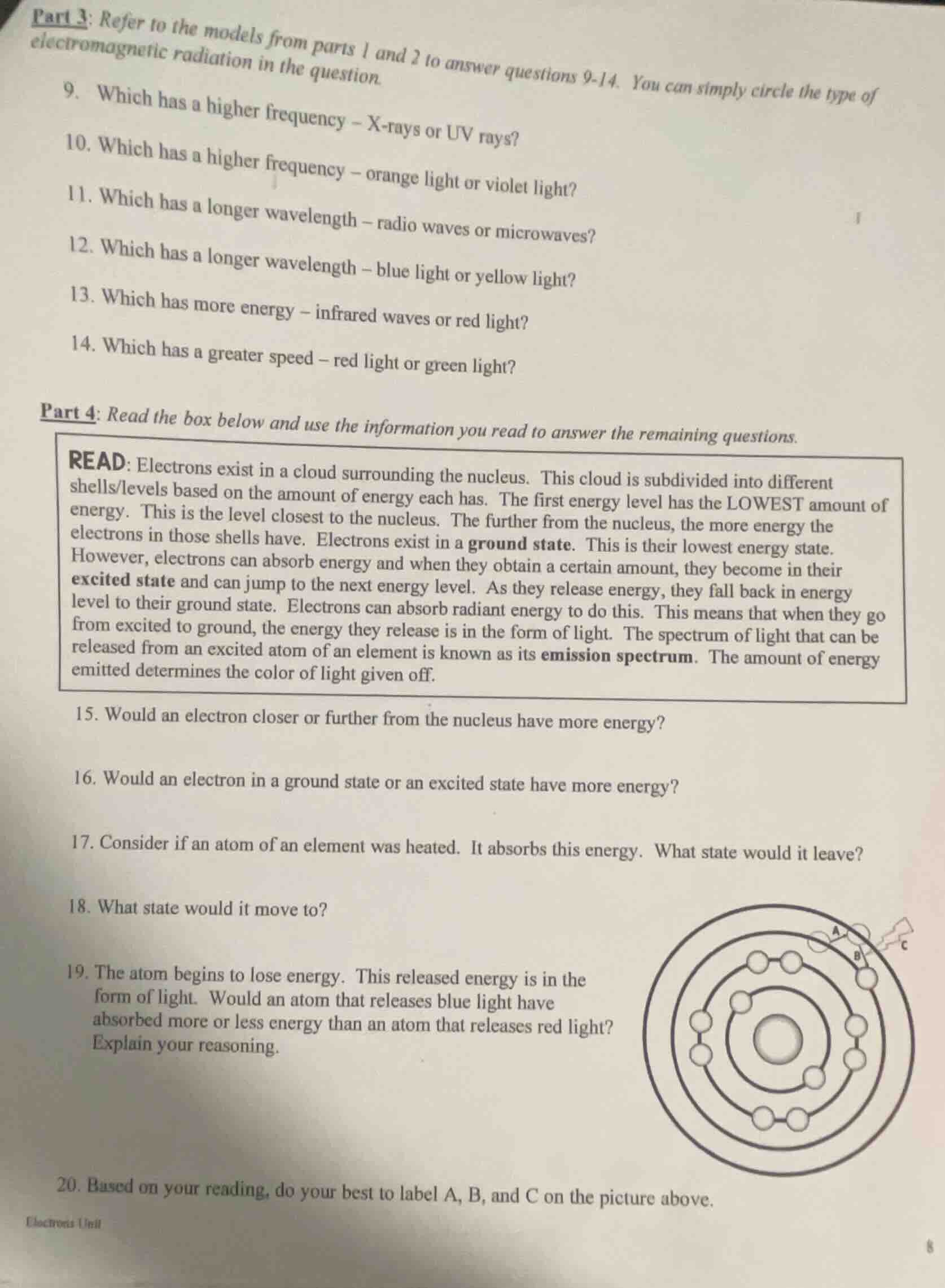
- based on your reading, do your best to label a, b, and c on the picture above.
Questions 9-14 (Electromagnetic Spectrum):
These rely on the properties of the electromagnetic spectrum, where frequency increases and wavelength decreases from radio waves to gamma rays; energy is proportional to frequency ($E=h
u$), and all electromagnetic waves travel at the same speed in a vacuum.
- X-rays have higher frequency than UV rays.
- Violet light has higher frequency than orange light.
- Radio waves have longer wavelength than microwaves.
- Yellow light has longer wavelength than blue light.
- Red light has higher energy than infrared waves (higher frequency).
- All visible light travels at the same speed in a vacuum.
Questions 15-20 (Electron Energy States):
These use the provided text about electron energy levels, ground/excited states, and energy emission.
- Electrons further from the nucleus have more energy (stated directly).
- Excited state electrons have more energy (they absorb energy to reach this state).
- Heating an atom makes electrons leave their ground state.
- Electrons move to an excited state when absorbing energy.
- Blue light has higher energy than red light, so the atom emitting blue light absorbed more energy (energy emitted equals energy absorbed).
- The diagram shows an electron moving from a higher to lower energy level: C is the excited state, B is the energy release (light), A is the ground state.

Snap & solve any problem in the app
Get step-by-step solutions on Sovi AI
Photo-based solutions with guided steps
Explore more problems and detailed explanations
- X-rays
- Violet light
- Radio waves
- Yellow light
- Red light
- They have the same speed (in a vacuum)
- Further from the nucleus
- Excited state
- Ground state
- Excited state
- More energy; Blue light has higher energy than red light, so the atom must have absorbed more energy to emit the higher-energy blue light.
- A: Ground state (lower energy level), B: Emitted energy/light, C: Excited state (higher energy level)