QUESTION IMAGE
Question
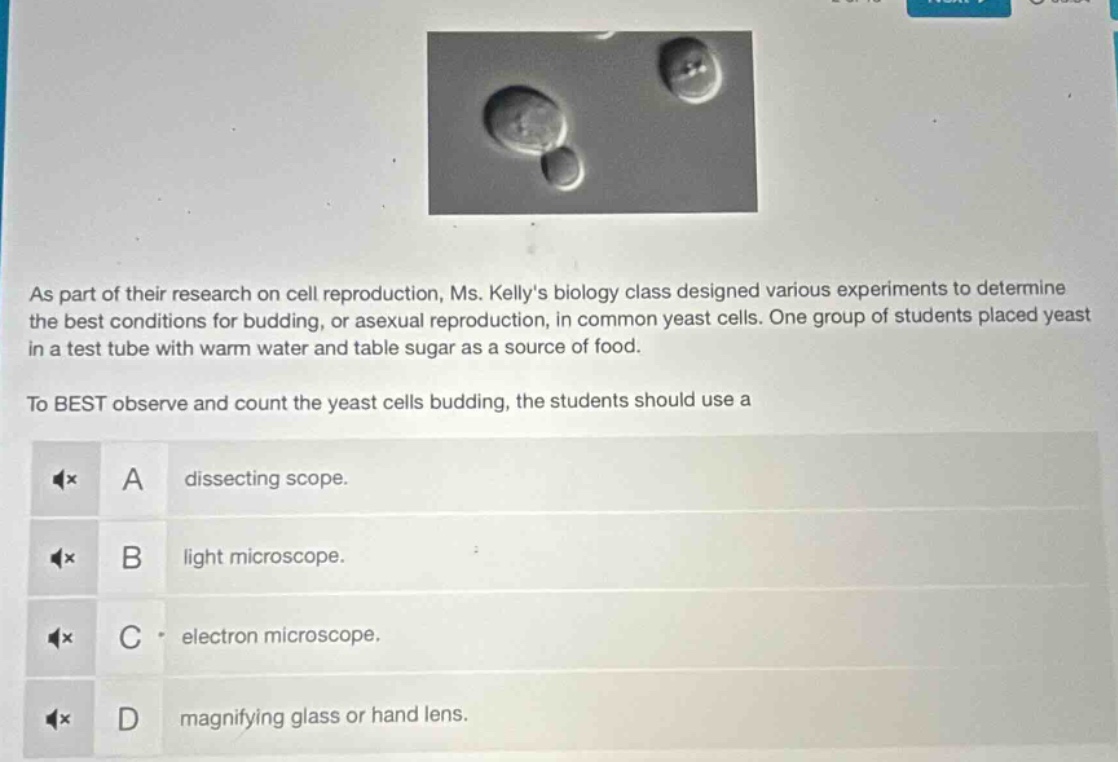
as part of their research on cell reproduction, ms. kellys biology class designed various experiments to determine the best conditions for budding, or asexual reproduction, in common yeast cells. one group of students placed yeast in a test tube with warm water and table sugar as a source of food. to best observe and count the yeast cells budding, the students should use a a dissecting scope. b light microscope. c electron microscope. d magnifying glass or hand lens.
Brief Explanations
To observe yeast cell budding, we analyze the tools:
- A dissecting scope (A) is for larger specimens, not cells.
- A light microscope (B) is suitable for observing single cells (like yeast) and their budding, as it provides enough magnification (typically 40x–1000x) for cellular details.
- An electron microscope (C) is used for ultra - detailed, high - magnification (e.g., nanoscale) work and is not needed for basic yeast cell observation in a classroom.
- A magnifying glass/hand lens (D) has too low magnification to see individual yeast cells or budding.
So the best tool is a light microscope.

Snap & solve any problem in the app
Get step-by-step solutions on Sovi AI
Photo-based solutions with guided steps
Explore more problems and detailed explanations
B. light microscope.