QUESTION IMAGE
Question
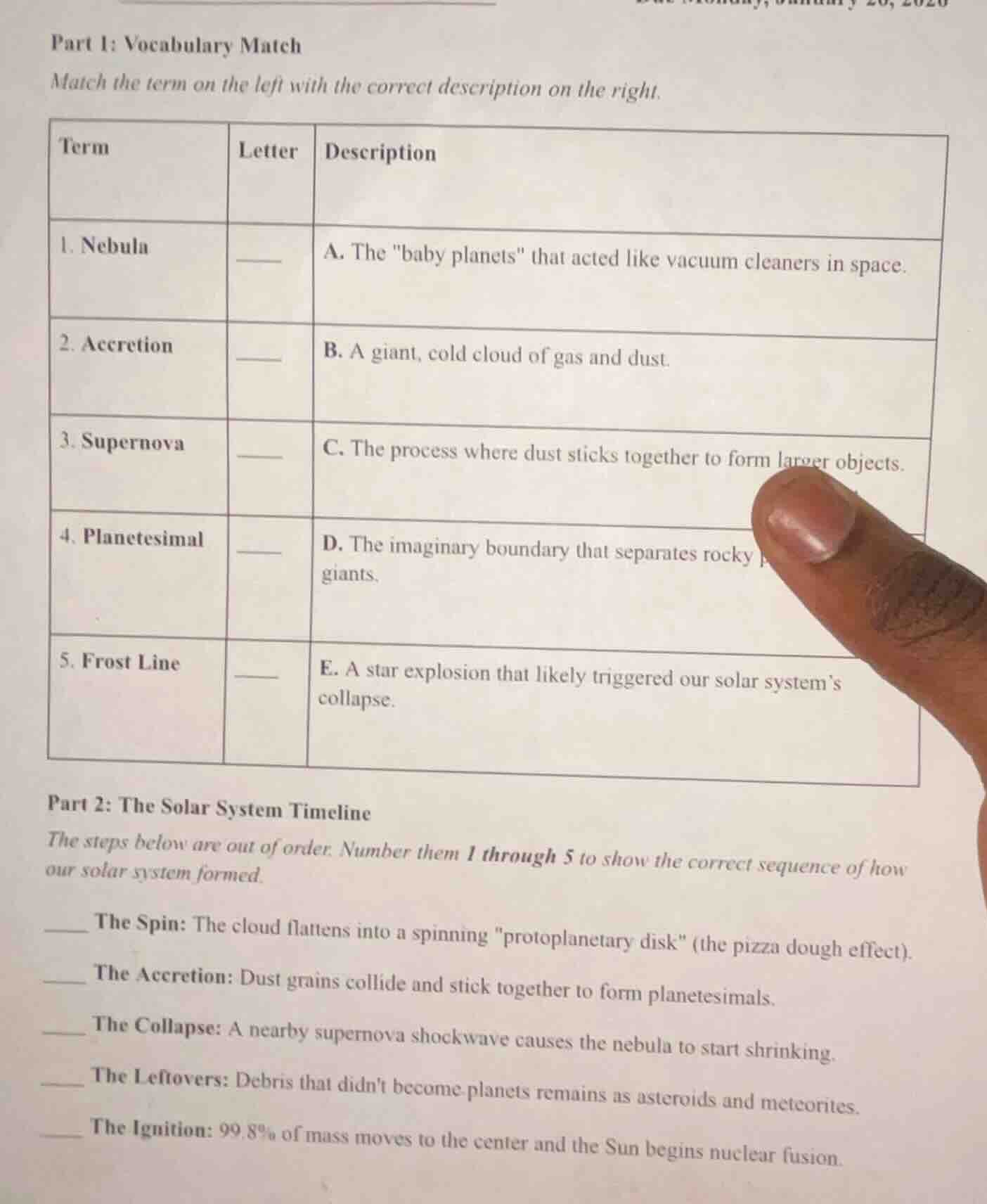
part 1: vocabulary match
match the term on the left with the correct description on the right.
| term | letter | description |
|---|---|---|
| 2. accretion | _____ | b. a giant, cold cloud of gas and dust. |
| 3. supernova | _____ | c. the process where dust sticks together to form larger objects. |
| 4. planetesimal | _____ | d. the imaginary boundary that separates rocky giants. |
| 5. frost line | _____ | e. a star explosion that likely triggered our solar system’s collapse. |
part 2: the solar system timeline
the steps below are out of order. number them 1 through 5 to show the correct sequence of how our solar system formed.
____ the spin: the cloud flattens into a spinning \protoplanetary disk\ (the pizza dough effect).
____ the accretion: dust grains collide and stick together to form planetesimals.
____ the collapse: a nearby supernova shockwave causes the nebula to start shrinking.
____ the leftovers: debris that didnt become planets remains as asteroids and meteorites.
____ the ignition: 99.8% of mass moves to the center and the sun begins nuclear fusion.
Part 1: Vocabulary Match
1. Nebula
- A nebula is defined as a giant, cold cloud of gas and dust. So it matches with description B.
2. Accretion
- Accretion refers to the process where dust sticks together to form larger objects. So it matches with description C.
3. Supernova
- A supernova is a star explosion, and it is thought to have triggered our solar system's collapse. So it matches with description E.
4. Planetesimal
- Planetesimals are like "baby planets" that acted as vacuum cleaners in space (collecting matter). So it matches with description A.
5. Frost Line
- The Frost Line is the imaginary boundary that separates rocky planets from gas giants. So it matches with description D.
Part 2: The Solar System Timeline
To determine the correct sequence, we analyze the formation process of the solar system:
- The Collapse: A nearby supernova shockwave causes the nebula to start shrinking. This is the initial trigger, so it is step 1.
- The Spin: After the nebula starts shrinking, the cloud flattens into a spinning "protoplanetary disk". So this is step 2.
- The Accretion: Dust grains collide and stick together to form planetesimals. This happens after the disk forms, so it is step 3.
- The Ignition: 99.8% of mass moves to the center and the Sun begins nuclear fusion. This occurs after planetesimals start forming and mass accumulates at the center, so it is step 4.
- The Leftovers: Debris that didn't become planets remains as asteroids and meteorites. This is the final step, so it is step 5.
Part 1 Answers:
- Nebula: B
- Accretion: C
- Supernova: E
- Planetesimal: A
- Frost Line: D
Part 2 Answers (Order of steps):
- The Spin: 2
- The Accretion: 3
- The Collapse: 1
- The Leftovers: 5
- The Ignition: 4

Snap & solve any problem in the app
Get step-by-step solutions on Sovi AI
Photo-based solutions with guided steps
Explore more problems and detailed explanations
Part 1: Vocabulary Match
1. Nebula
- A nebula is defined as a giant, cold cloud of gas and dust. So it matches with description B.
2. Accretion
- Accretion refers to the process where dust sticks together to form larger objects. So it matches with description C.
3. Supernova
- A supernova is a star explosion, and it is thought to have triggered our solar system's collapse. So it matches with description E.
4. Planetesimal
- Planetesimals are like "baby planets" that acted as vacuum cleaners in space (collecting matter). So it matches with description A.
5. Frost Line
- The Frost Line is the imaginary boundary that separates rocky planets from gas giants. So it matches with description D.
Part 2: The Solar System Timeline
To determine the correct sequence, we analyze the formation process of the solar system:
- The Collapse: A nearby supernova shockwave causes the nebula to start shrinking. This is the initial trigger, so it is step 1.
- The Spin: After the nebula starts shrinking, the cloud flattens into a spinning "protoplanetary disk". So this is step 2.
- The Accretion: Dust grains collide and stick together to form planetesimals. This happens after the disk forms, so it is step 3.
- The Ignition: 99.8% of mass moves to the center and the Sun begins nuclear fusion. This occurs after planetesimals start forming and mass accumulates at the center, so it is step 4.
- The Leftovers: Debris that didn't become planets remains as asteroids and meteorites. This is the final step, so it is step 5.
Part 1 Answers:
- Nebula: B
- Accretion: C
- Supernova: E
- Planetesimal: A
- Frost Line: D
Part 2 Answers (Order of steps):
- The Spin: 2
- The Accretion: 3
- The Collapse: 1
- The Leftovers: 5
- The Ignition: 4