QUESTION IMAGE
Question
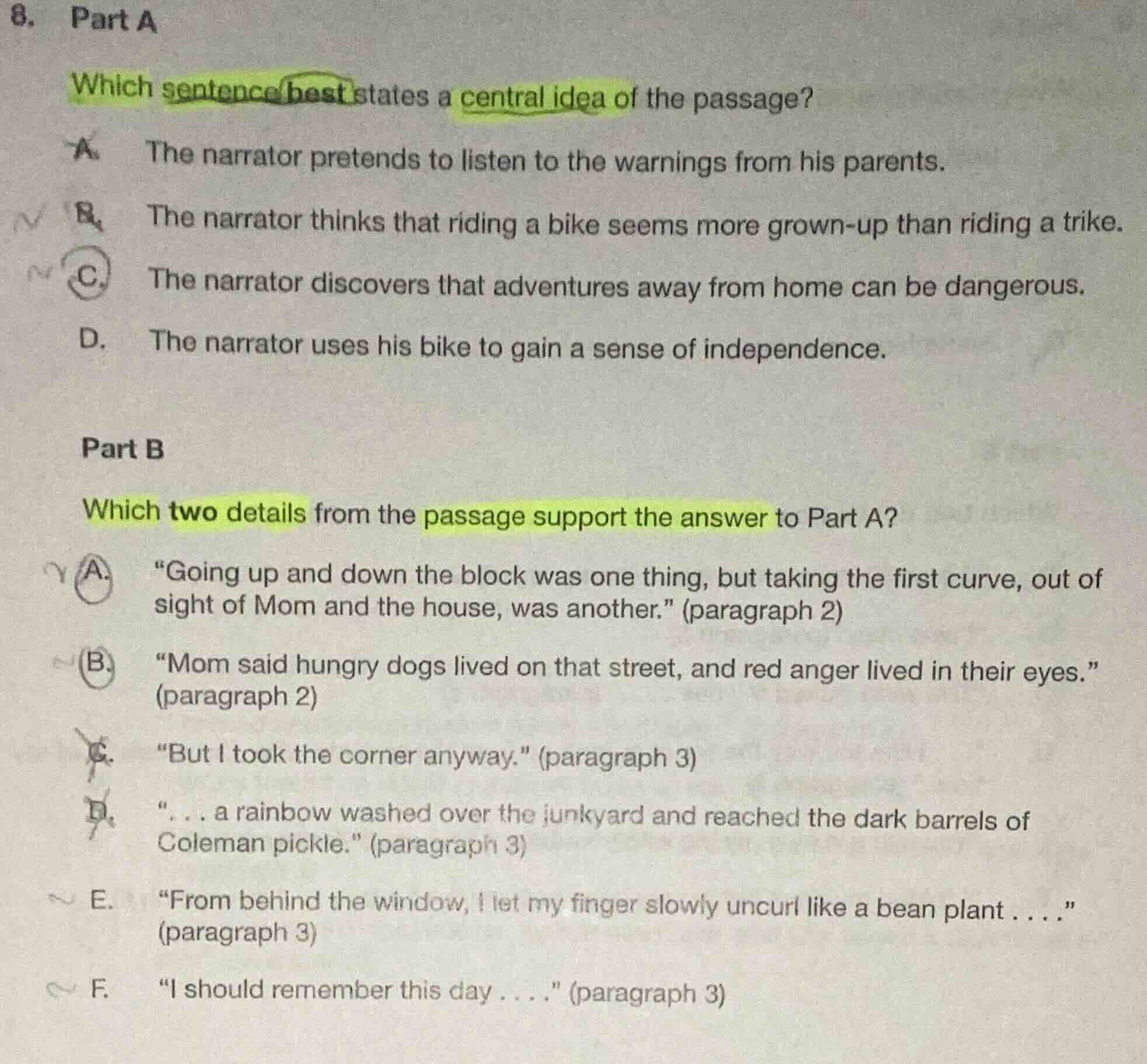
- part a
which sentence best states a central idea of the passage?
a the narrator pretends to listen to the warnings from his parents.
b the narrator thinks that riding a bike seems more grown - up than riding a trike.
c the narrator discovers that adventures away from home can be dangerous.
d. the narrator uses his bike to gain a sense of independence.
part b
which two details from the passage support the answer to part a?
a. \going up and down the block was one thing, but taking the first curve, out of sight of mom and the house, was another.\ (paragraph 2)
b. \mom said hungry dogs lived on that street, and red anger lived in their eyes.\ (paragraph 2)
c. \but i took the corner anyway.\ (paragraph 3)
d. \... a rainbow washed over the junkyard and reached the dark barrels of coleman pickle.\ (paragraph 3)
e. \from behind the window, i let my finger slowly uncurl like a bean plant....\ (paragraph 3)
f. \i should remember this day....\ (paragraph 3)
Part A
To determine the central idea, we analyze each option:
- Option A: Pretending to listen to parents' warnings is a minor detail, not the central idea.
- Option B: The comparison between bike and trike is not the main focus.
- Option C: While adventures have risks, the passage's main idea is about independence via the bike, not just danger.
- Option D: The narrator uses the bike to explore and gain independence (e.g., going out of sight of home, taking risks), which aligns with the passage's core.
We need details that support the central idea of gaining independence through the bike:
- Option A: Going out of sight of Mom and the house shows moving towards independence.
- Option B: Mom's warning about dogs is a danger, not about independence.
- Option C: Taking the corner despite risks shows asserting independence.
- Option D: Rainbow description is imagery, not supportive.
- Option E: Finger movement is a minor detail.
- Option F: Remembering the day is a reflection, not direct support.
So, A and C support the idea of independence (taking the bike out of sight, taking the corner anyway).

Snap & solve any problem in the app
Get step-by-step solutions on Sovi AI
Photo-based solutions with guided steps
Explore more problems and detailed explanations
D. The narrator uses his bike to gain a sense of independence.