QUESTION IMAGE
Question
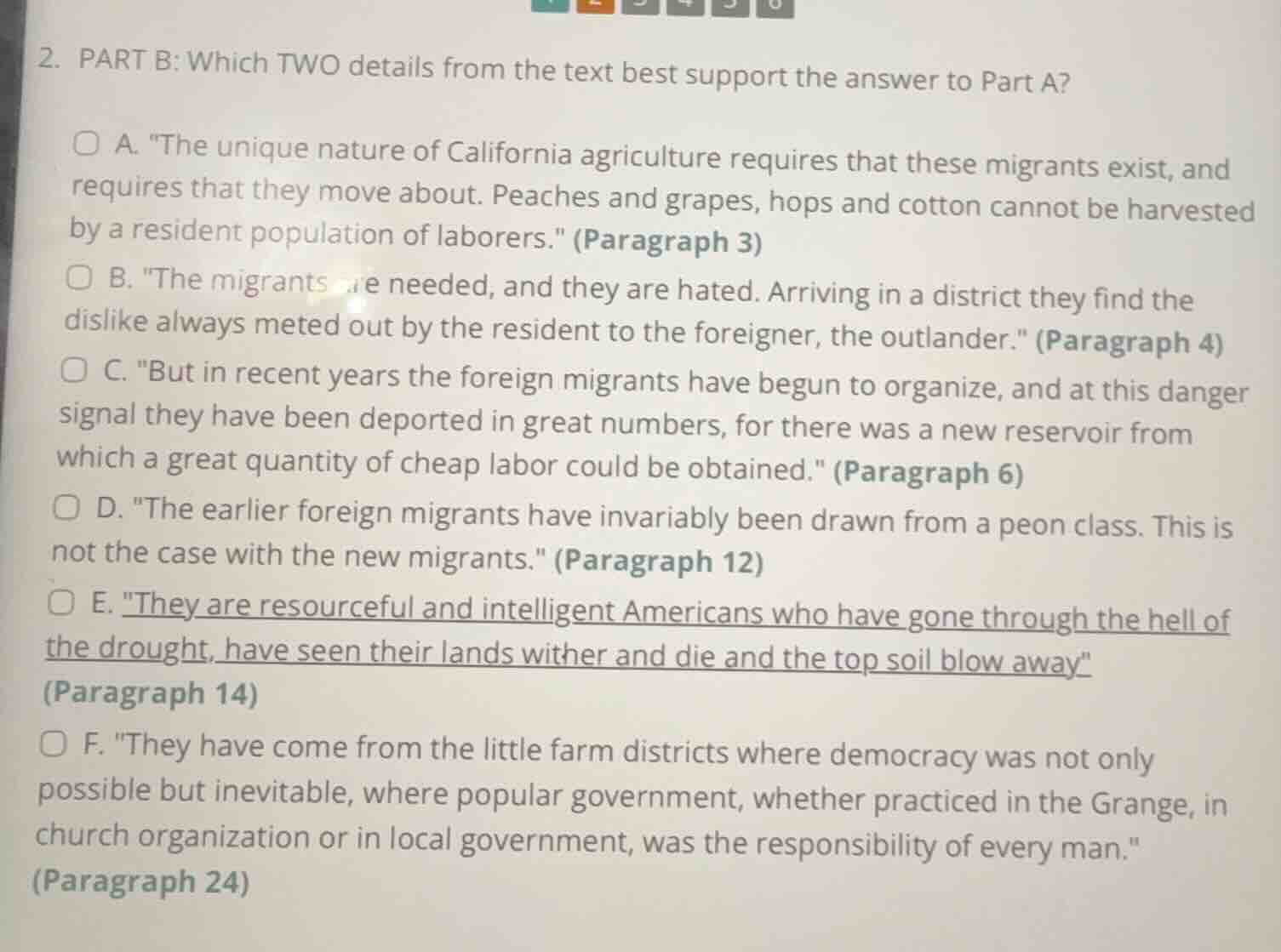
- part b: which two details from the text best support the answer to part a?
a. \the unique nature of california agriculture requires that these migrants exist, and requires that they move about. peaches and grapes, hops and cotton cannot be harvested by a resident population of laborers.\ (paragraph 3)
b. \the migrants are needed, and they are hated. arriving in a district they find the dislike always meted out by the resident to the foreigner, the outlander.\ (paragraph 4)
c. \but in recent years the foreign migrants have begun to organize, and at this danger signal they have been deported in great numbers, for there was a new reservoir from which a great quantity of cheap labor could be obtained.\ (paragraph 6)
d. \the earlier foreign migrants have invariably been drawn from a peon class. this is not the case with the new migrants.\ (paragraph 12)
e. \they are resourceful and intelligent americans who have gone through the hell of the drought, have seen their lands wither and die and the top soil blow away\ (paragraph 14)
f. \they have come from the little farm districts where democracy was not only possible but inevitable, where popular government, whether practiced in the grange, in church organization or in local government, was the responsibility of every man.\ (paragraph 24)
To solve this, we need to assume the answer to Part A (likely about the nature of migrants in California agriculture or their characteristics) and find two details that support it. Let's analyze each option:
- Option A: Explains the unique agricultural needs of California that require migrant labor (migrants must exist and move for harvesting specific crops). This supports a claim about the necessity of migrants.
- Option B: Talks about migrants being needed but hated, focusing on the resident's attitude, not directly supporting a claim about their role/background.
- Option C: Discusses deportation of foreign migrants and a new labor reservoir, about foreign migrants' deportation, not directly supporting a claim about the new (likely domestic) migrants.
- Option D: Compares earlier foreign migrants (from peon class) to new migrants, but doesn't support a claim about their role or why they migrate.
- Option E: Describes the new migrants as resourceful, intelligent Americans who suffered drought, explaining their background (why they migrate: drought destroyed their lands), supporting a claim about their origin/motivation.
- Option F: Talks about their democratic background from farm districts, supporting a claim about their social/political background.
Assuming Part A's answer is about the necessity of migrants (for agriculture) and their background (American, affected by drought), the two best supporting details are A (necessity due to agriculture) and E (background of new migrants as Americans affected by drought). Or if Part A is about the new migrants' characteristics, E and F could be, but A is about the need for migrants. Since Part B asks to support Part A, and if Part A is about why migrants are needed (agricultural necessity) and who they are (American drought victims), A and E work.
To determine the two details supporting Part A (assumed to relate to California migrant labor’s necessity and the new migrants’ background), we analyze:
- Option A: Explains California agriculture’s unique need for mobile migrant labor (specific crops can’t be harvested by resident workers), supporting a claim about migrants’ necessity.
- Option E: Describes new migrants as resourceful, intelligent Americans displaced by drought (explaining their origin/motivation), supporting a claim about their background.
Other options focus on unrelated themes (e.g., hatred of migrants, foreign migrant deportation, class comparisons, or democratic background) and do not directly support the core “need for migrants + their identity” framework.

Snap & solve any problem in the app
Get step-by-step solutions on Sovi AI
Photo-based solutions with guided steps
Explore more problems and detailed explanations
A. "The unique nature of California agriculture requires that these migrants exist, and requires that they move about. Peaches and grapes, hops and cotton cannot be harvested by a resident population of laborers." (Paragraph 3)
E. "They are resourceful and intelligent Americans who have gone through the hell of the drought, have seen their lands wither and die and the top soil blow away" (Paragraph 14)