QUESTION IMAGE
Question
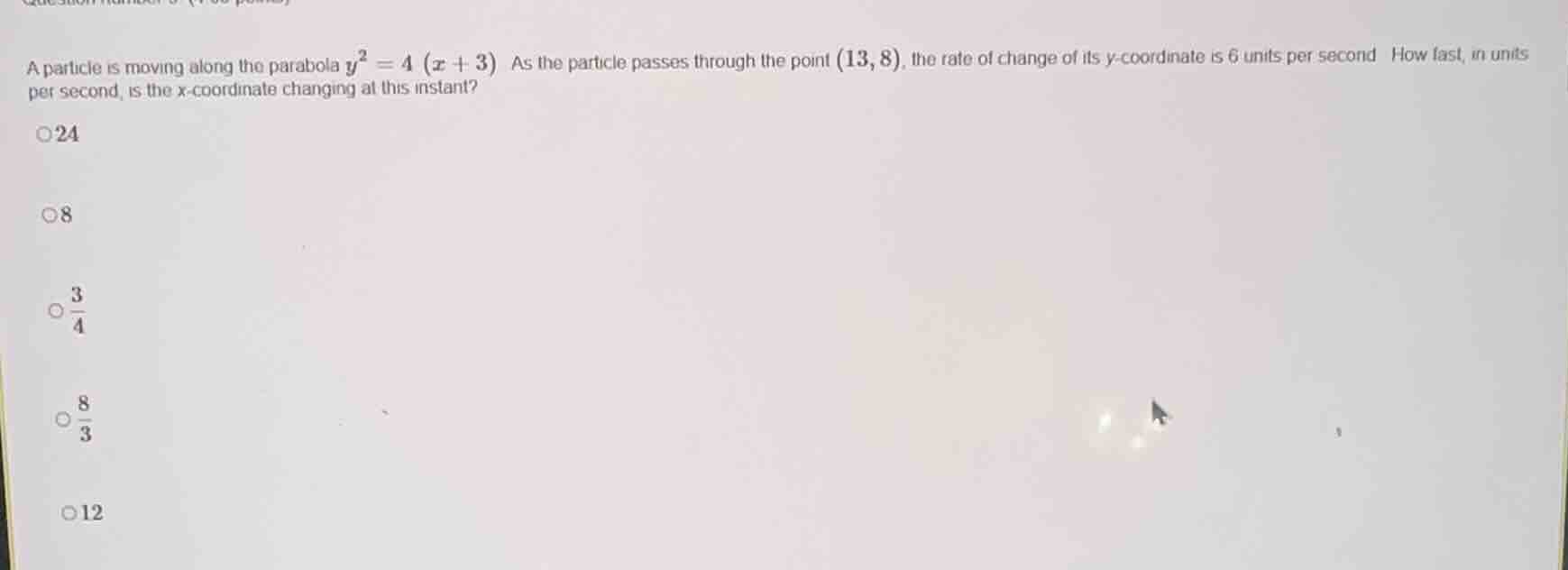
a particle is moving along the parabola $y^2 = 4(x + 3)$. as the particle passes through the point $(13, 8)$, the rate of change of its $y$-coordinate is 6 units per second. how fast, in units per second, is the $x$-coordinate changing at this instant?\
\bigcirc 24\
\bigcirc 8\
\bigcirc \dfrac{3}{4}\
\bigcirc \dfrac{8}{3}\
\bigcirc 12
Step1: Differentiate the equation implicitly
We have the equation \( y^{2} = 4(x + 3) \). Differentiate both sides with respect to time \( t \). Using the chain rule, the derivative of \( y^{2} \) with respect to \( t \) is \( 2y\frac{dy}{dt} \), and the derivative of \( 4(x + 3) \) with respect to \( t \) is \( 4\frac{dx}{dt} \). So we get:
\[ 2y\frac{dy}{dt}=4\frac{dx}{dt} \]
Step2: Solve for \(\frac{dx}{dt}\)
We can simplify the equation from Step 1 to solve for \(\frac{dx}{dt}\). Divide both sides by 2:
\[ y\frac{dy}{dt}=2\frac{dx}{dt} \]
Then, solve for \(\frac{dx}{dt}\):
\[ \frac{dx}{dt}=\frac{y}{2}\cdot\frac{dy}{dt} \]
Step3: Substitute the given values
We know that the particle is at the point \((13, 8)\), so \( y = 8 \), and \(\frac{dy}{dt}=6\) units per second. Substitute these values into the formula for \(\frac{dx}{dt}\):
\[ \frac{dx}{dt}=\frac{8}{2}\cdot6 \]
\[ \frac{dx}{dt}=4\cdot6 \]
\[ \frac{dx}{dt}=24 \]

Snap & solve any problem in the app
Get step-by-step solutions on Sovi AI
Photo-based solutions with guided steps
Explore more problems and detailed explanations
24