QUESTION IMAGE
Question
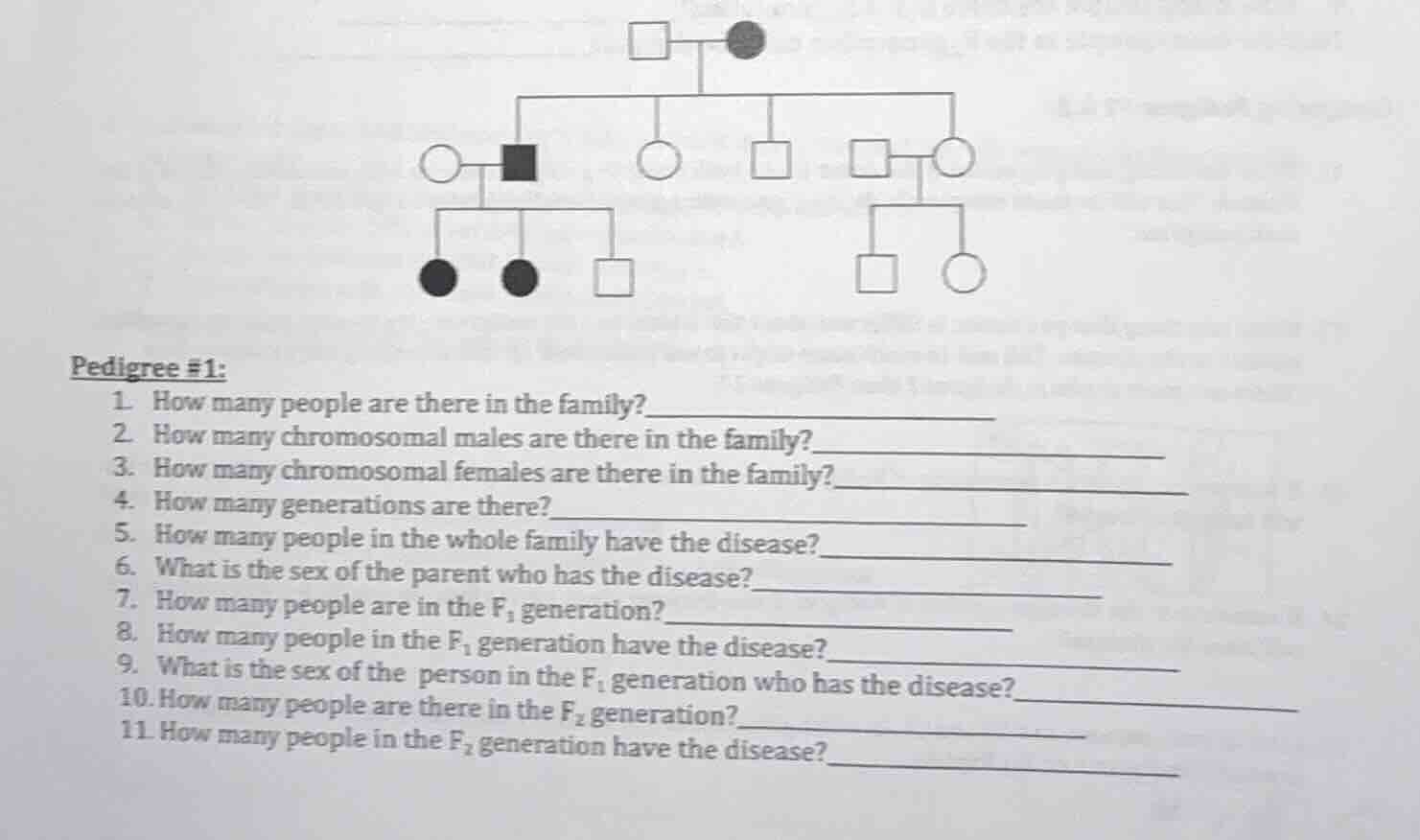
pedigree #1:
- how many people are there in the family?
- how many chromosomal males are there in the family?
- how many chromosomal females are there in the family?
- how many generations are there?
- how many people in the whole family have the disease?
- what is the sex of the parent who has the disease?
- how many people are in the f₁ generation?
- how many people in the f₁ generation have the disease?
- what is the sex of the person in the f₁ generation who has the disease?
- how many people are there in the f₂ generation?
- how many people in the f₂ generation have the disease?
1. How many people are there in the family?
Step1: Count each individual in the pedigree.
- Top generation (P generation): 2 people (1 square, 1 circle with disease).
- F₁ generation: 4 people (1 square with disease, 2 circles, 1 square) + 2 people (1 square, 1 circle) = 6? Wait, no, let's re - count. Wait, the top generation (parents) has 2. Then their children (F₁): let's see the first branch: 1 square (affected), 2 circles, 1 square? Wait, no, the first pair (top) has children: the first row below top: 1 square (affected), 2 circles, 1 square? Wait, no, looking at the pedigree:
Top (P): 2 (square, circle with disease)
F₁: Let's count the children of P: 1 square (affected), 2 circles, 1 square? Wait, no, the first row below P: the first family (square with disease and circle) has children, but the F₁ is the children of P. Wait, the P has 4 children? Wait, the pedigree:
- P generation: 2 (square, circle - filled)
- F₁ generation: 4 (from P: square - filled, circle, square, square) + 2 (the other couple? No, wait, the other couple is in F₁? Wait, no, the first couple (P) has children: the first row below P: 1 square - filled, 2 circles, 1 square? Wait, no, the diagram:
Top: square (white) and circle (filled) → 2.
Then their children (F₁): 1 square (filled), 2 circles (white), 1 square (white), and then another couple (square and circle, white) → but that couple is also F₁? Wait, no, the total people:
Let's list all:
- P: white square
- P: filled circle
- F₁: filled square
- F₁: white circle
- F₁: white square
- F₁: white square
- F₁: white circle (the other couple's female)
- F₁: white square (the other couple's male)
Then the children of filled square and white circle (F₂):
- filled circle
- filled circle
- white square
Children of white square and white circle (F₂):
- white square
- white circle
Wait, that's 13? Wait, no, let's count again carefully:
- P generation: 2 (1,2)
- F₁ generation: 4 (3 - 6: 3 - filled square, 4 - white circle, 5 - white square, 6 - white square) + 2 (7 - white circle, 8 - white square) → total F₁: 6
- F₂ generation: 3 (9 - filled circle, 10 - filled circle, 11 - white square) + 2 (12 - white square, 13 - white circle) → total F₂: 5
Total: 2+6 + 5=13? Wait, no, maybe I made a mistake. Let's count each node:
- Top left: white square (P)
- Top right: filled circle (P)
- Middle left: filled square (F₁)
- Middle: white circle (F₁)
- Middle right: white square (F₁)
- Far right (F₁): white square (F₁)
- Below 6: white circle (F₁, the other couple's female)
- Below 5: white square (F₁, the other couple's male)
- Below 3 and 4: filled circle (F₂)
- Below 3 and 4: filled circle (F₂)
- Below 3 and 4: white square (F₂)
- Below 7 and 8: white square (F₂)
- Below 7 and 8: white circle (F₂)
Wait, that's 13. But maybe my initial count was wrong. Wait, the correct way:
Count all the symbols:
- White square: 1 (P) + 3 (F₁) + 2 (F₂) + 1 (F₂) → 1+3 + 3=7? No, let's count each symbol:
Filled circle: 1 (P) + 2 (F₂) = 3
Filled square: 1 (F₁)
White square: 1 (P) + 3 (F₁) + 2 (F₂) = 6
White circle: 3 (F₁) + 2 (F₂) = 5
Total: 3 (filled circle) + 1 (filled square) + 6 (white square) + 5 (white circle)=15? No, I'm confused. Wait, let's use a better approach:
Each symbol is a person:
- Top white square
- Top filled circle
- F₁ filled square
- F₁ white circle
- F₁ white square
- F₁ white square
- F₁ white circle (the other F₁ female)
- F₁ white square (the other F₁ male)
- F₂ filled circle (child of 3 and 4)
- F₂ filled circle (child of 3 and 4)
- F₂ white square (child of 3 and 4)
- F₂ white square (ch…
Step1: Identify chromosomal males (squares).
White squares: 1 (P) + 3 (F₁: 5,6,8) + 2 (F₂: 11,12) = 1 + 3+2 = 6
Filled square: 1 (F₁: 3)
Total squares (males): 6 + 1=7
Step2: Count.
So chromosomal males: 7 (1 P, 4 F₁, 2 F₂)
Step1: Total people - chromosomal males.
Total people:13, chromosomal males:7, so 13 - 7 = 6
Or count circles:
Filled circles:1 (P) + 2 (F₂:9,10) = 3
White circles:3 (F₁:4,7) + 1 (F₂:13) = 4? Wait, no, 4 (F₁:4,7, and two in F₁? Wait, F₁ circles: 4 (4,7, and two others? No, earlier count:
Filled circles: P (2), F₂ (9,10) → 1 + 2 = 3
White circles: F₁ (4,7) + F₂ (13) + F₁ (another? Wait, F₁ has 4 (3 - 6: 4 is white circle, 7 is white circle, and two others? No, F₁: 3 - filled square, 4 - white circle, 5 - white square, 6 - white square, 7 - white circle, 8 - white square. So white circles in F₁: 4,7 → 2. F₂ white circles:13 → 1. Filled circles:2 (P) + 2 (F₂) → 3. Wait, 3 + (2 + 1)=6. Yes, 3 filled (females) + 3 white (females)=6.

Snap & solve any problem in the app
Get step-by-step solutions on Sovi AI
Photo-based solutions with guided steps
Explore more problems and detailed explanations
13