QUESTION IMAGE
Question
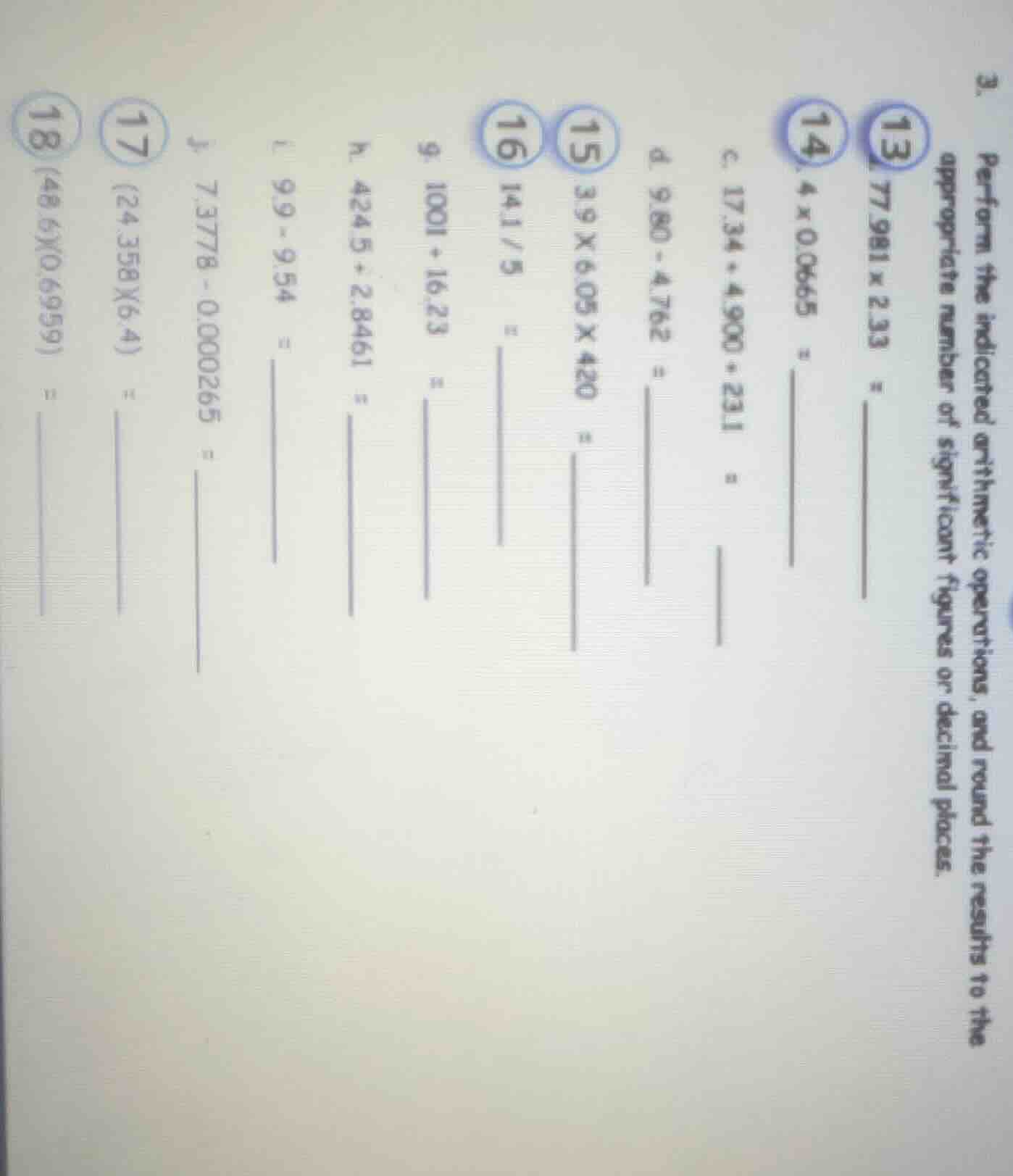
- perform the indicated arithmetic operations, and round the results to the appropriate number of significant figures or decimal places.
- ( 77.981 \times 2.33 = )
- ( 4 \times 0.0665 = )
c. ( 17.34 + 4900 + 231 = )
d. ( 9.80 - 4.762 = )
- ( 3.9 \times 6.05 \times 420 = )
- ( 141 div 5 = )
g. ( 1001 div 16.23 = )
h. ( 424.5 + 2.8461 = )
i. ( 9.9 - 9.54 = )
j. ( 7.3778 - 0.000265 = )
- ( (24.358) \times (6.4) = )
- ( (48.6) \times (0.6959) = )
Let's solve each problem one by one:
Problem 13: \( 77.981 \times 2.33 \)
Step 1: Multiply the numbers
\( 77.981 \times 2.33 = 181.69573 \)
Step 2: Round appropriately (assuming significant figures or decimal places, let's check the numbers. \( 77.981 \) has 5 significant figures, \( 2.33 \) has 3. So the result should have 3 significant figures? Wait, or maybe decimal places. Wait, the problem says "round the results to the appropriate number of significant figures or decimal places". Let's see, \( 77.981 \times 2.33 \). Let's calculate:
\( 77.981 \times 2.33 = 77.981 \times (2 + 0.3 + 0.03) = 77.981 \times 2 + 77.981 \times 0.3 + 77.981 \times 0.03 = 155.962 + 23.3943 + 2.33943 = 155.962 + 23.3943 = 179.3563 + 2.33943 = 181.69573 \)
Now, \( 77.981 \) has 5 significant figures, \( 2.33 \) has 3. When multiplying, the result should have the same number of significant figures as the least precise measurement, which is 3. So round 181.69573 to 3 significant figures: 182. Wait, but maybe decimal places? Let's check the original numbers. \( 77.981 \) has 3 decimal places, \( 2.33 \) has 2. When multiplying, the number of decimal places in the result is not directly determined by that, but significant figures. Alternatively, maybe the problem expects a certain decimal place. Wait, maybe I misread. Let's check the other problems. Alternatively, maybe it's a typo and we just calculate and round to a reasonable decimal place. Let's say 2 decimal places: 181.70. But let's see, maybe the answer is approximately 182 (3 significant figures) or 181.70 (2 decimal places). Wait, let's check the calculation again. \( 77.981 \times 2.33 \):
\( 77.981 \times 2 = 155.962 \)
\( 77.981 \times 0.3 = 23.3943 \)
\( 77.981 \times 0.03 = 2.33943 \)
Adding them up: \( 155.962 + 23.3943 = 179.3563 + 2.33943 = 181.69573 \). So if we round to 3 significant figures, it's 182. If we round to 2 decimal places, it's 181.70. But maybe the problem expects the exact value or a certain rounding. Let's proceed.
Step 1: Multiply the numbers
\( 4 \times 0.0665 = 0.266 \)
Step 2: Round appropriately. \( 4 \) is exact (maybe), \( 0.0665 \) has 3 significant figures. So the result should have 3 significant figures? \( 0.266 \) already has 3. Or maybe decimal places. \( 0.0665 \) has 4 decimal places, \( 4 \) has 0. So the result is \( 0.266 \).
Step 1: Multiply \( 3.9 \times 6.05 \)
\( 3.9 \times 6.05 = 23.595 \)
Step 2: Multiply by 420
\( 23.595 \times 420 = 9909.9 \)
Step 3: Round appropriately. \( 3.9 \) has 2 significant figures, \( 6.05 \) has 3, \( 420 \) has 2 (assuming the trailing zero is not significant). So the least number of significant figures is 2. So round 9909.9 to 2 significant figures: \( 1.0 \times 10^4 \) or 10000. But maybe decimal places. Alternatively, if \( 420 \) is considered to have 3 significant figures (if the zero is significant), then 3 significant figures. \( 3.9 \) (2), \( 6.05 \) (3), \( 420 \) (2 or 3). Let's assume 2 significant figures: 10000 (or \( 1.0 \times 10^4 \)).

Snap & solve any problem in the app
Get step-by-step solutions on Sovi AI
Photo-based solutions with guided steps
Explore more problems and detailed explanations
(Problem 13): \( 181.70 \) (or 182, depending on rounding)