QUESTION IMAGE
Question
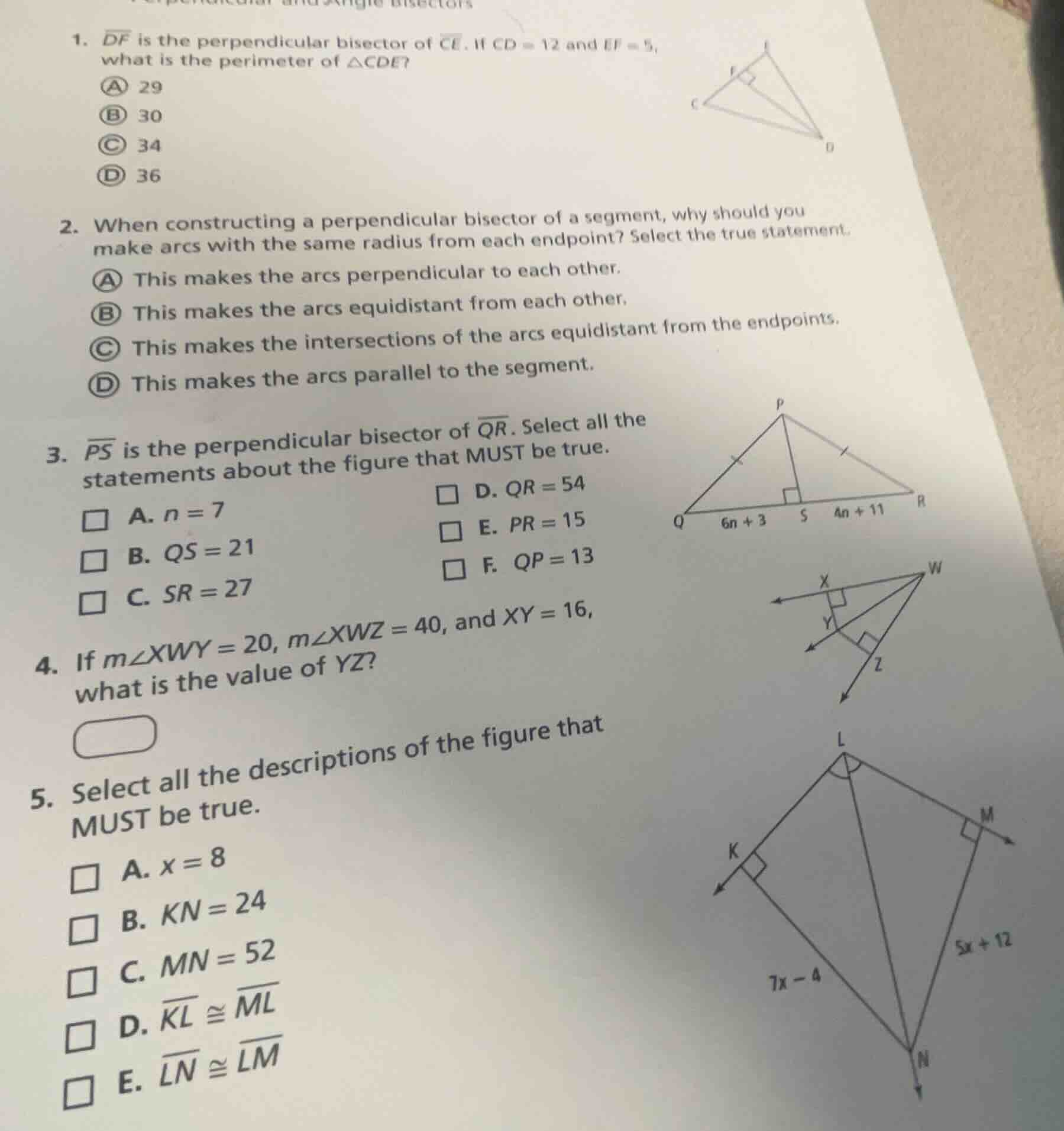
- $overline{df}$ is the perpendicular bisector of $overline{ce}$. if $cd = 12$ and $ef = 5$, what is the perimeter of $\triangle cde$?
a 29
b 30
c 34
d 36
- when constructing a perpendicular bisector of a segment, why should you make arcs with the same radius from each endpoint? select the true statement.
a this makes the arcs perpendicular to each other.
b this makes the arcs equidistant from each other.
c this makes the intersections of the arcs equidistant from the endpoints.
d this makes the arcs parallel to the segment.
- $overline{ps}$ is the perpendicular bisector of $overline{qr}$. select all the statements about the figure that must be true.
$square$ a. $n = 7$
$square$ b. $qs = 21$
$square$ c. $sr = 27$
$square$ d. $qr = 54$
$square$ e. $pr = 15$
$square$ f. $qp = 13$
- if $mangle xwy = 20$, $mangle xwz = 40$, and $xy = 16$, what is the value of $yz$?
- select all the descriptions of the figure that must be true.
$square$ a. $x = 8$
$square$ b. $kn = 24$
$square$ c. $mn = 52$
$square$ d. $overline{kl} cong overline{ml}$
$square$ e. $overline{ln} cong overline{lm}$
Step1: Use perpendicular bisector property
Since $\overline{DF}$ is the perpendicular bisector of $\overline{CE}$, $CD = DE = 12$ and $CF = EF = 5$, so $CE = CF + EF = 5 + 5 = 10$.
Step2: Calculate perimeter of $\triangle CDE$
Perimeter = $CD + DE + CE = 12 + 12 + 10$
A perpendicular bisector requires points equidistant from the segment's endpoints. Using the same radius from each endpoint ensures the arc intersections are equidistant from both endpoints, which is the core requirement for constructing the bisector.
Step1: Set segments equal (bisector property)
$\overline{PS}$ bisects $\overline{QR}$, so $QS = SR$: $6n + 3 = 4n + 11$
Step2: Solve for $n$
$6n - 4n = 11 - 3$ → $2n = 8$ → $n = 4$
Step3: Calculate segment lengths
$QS = 6(4)+3=27$, $SR=27$, $QR=27+27=54$; $QP=PR$ but no length given to confirm E/F.
Step1: Identify angle bisector
$m\angle XWZ = 40$, $m\angle XWY = 20$, so $\overline{WY}$ bisects $\angle XWZ$.
Step2: Use angle bisector property
Points on an angle bisector are equidistant from the angle's sides, so $YZ = XY = 16$.

Snap & solve any problem in the app
Get step-by-step solutions on Sovi AI
Photo-based solutions with guided steps
Explore more problems and detailed explanations
C. 34
---