QUESTION IMAGE
Question
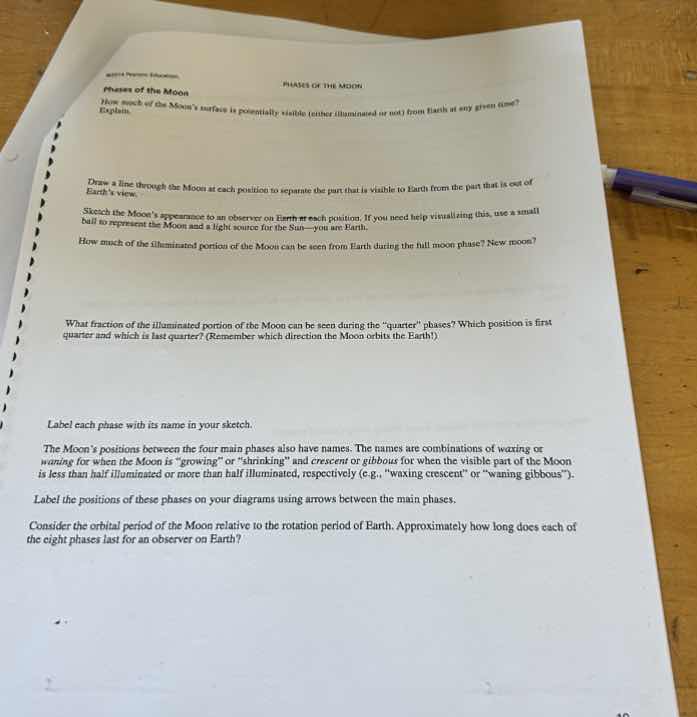
phases of the moonphases of the moonhow much of the moons surface is potentially visible (either illuminated or not) from earth at any given time?explain.draw a line through the moon at each position to separate the part that is visible to earth from the part that is out of earths view.sketch the moons appearance to an observer on earth at each position. if you need help visualizing this, use a small ball to represent the moon and a light source for the sun-you are earth.how much of the illuminated portion of the moon can be seen from earth during the full moon phase? new moon?what fraction of the illuminated portion of the moon can be seen during the \quarter\ phases? which position is first quarter and which is last quarter? (remember which direction the moon orbits the earth!)label each phase with its name in your sketch.the moons positions between the four main phases also have names. the names are combinations of waxing or waning for when the moon is \growing\ or \shrinking\ and crescent or gibbous for when the visible part of the moon is less than half illuminated or more than half illuminated, respectively (e.g., \waxing crescent\ or \waning gibbous\).label the positions of these phases on your diagrams using arrows between the main phases.consider the orbital period of the moon relative to the rotation period of earth. approximately how long does each of the eight phases last for an observer on earth?
- For the first question: The Moon is tidally locked to Earth, so the same face always faces us.
- For full/new moon visibility: Full moon has the entire illuminated face facing Earth; new moon has the illuminated face turned away.
- For quarter phases: Quarter phases show half the illuminated portion, with first quarter being when the Moon is waxing (growing) as it orbits eastward.
- For phase naming: Waxing means the visible portion is growing, waning means shrinking; crescent is <50% visible, gibbous is >50% visible.
- For phase duration: The lunar cycle is ~29.5 days, split evenly across 8 phases.

Snap & solve any problem in the app
Get step-by-step solutions on Sovi AI
Photo-based solutions with guided steps
Explore more problems and detailed explanations
- Approximately 50% of the Moon's surface is potentially visible from Earth at any given time (due to tidal locking, the same hemisphere always faces us, with small libration effects adding a tiny extra portion, but the core visible portion is half).
- During full moon: 100% of the illuminated portion of the Moon can be seen from Earth. During new moon: 0% of the illuminated portion can be seen from Earth.
- During "quarter" phases, $\frac{1}{2}$ (50%) of the illuminated portion of the Moon can be seen. The first quarter is the phase where the Moon is waxing (growing in visibility) as it orbits Earth eastward; the last (third) quarter is the waning phase, occurring after full moon.
- (Sketch instructions: Draw a circle for the Sun off to one side, Earth at the center, and 8 Moon positions around Earth. For each:
- New moon: Between Earth and Sun, dark side facing Earth
- Waxing crescent: Small illuminated sliver on the right (east) side
- First quarter: Right half illuminated
- Waxing gibbous: More than half, right side illuminated
- Full moon: Entire face illuminated, opposite the Sun
- Waning gibbous: More than half, left (west) side illuminated
- Last (third) quarter: Left half illuminated
- Waning crescent: Small illuminated sliver on the left side
Label each position with the corresponding phase name, and draw arrows between main phases pointing to the intermediate phases.)
- Each of the eight phases lasts approximately $\frac{29.5}{8} \approx 3.7$ days (the full lunar synodic cycle is ~29.5 days, divided evenly among the 8 distinct phases).