QUESTION IMAGE
Question
phylum ciliophora
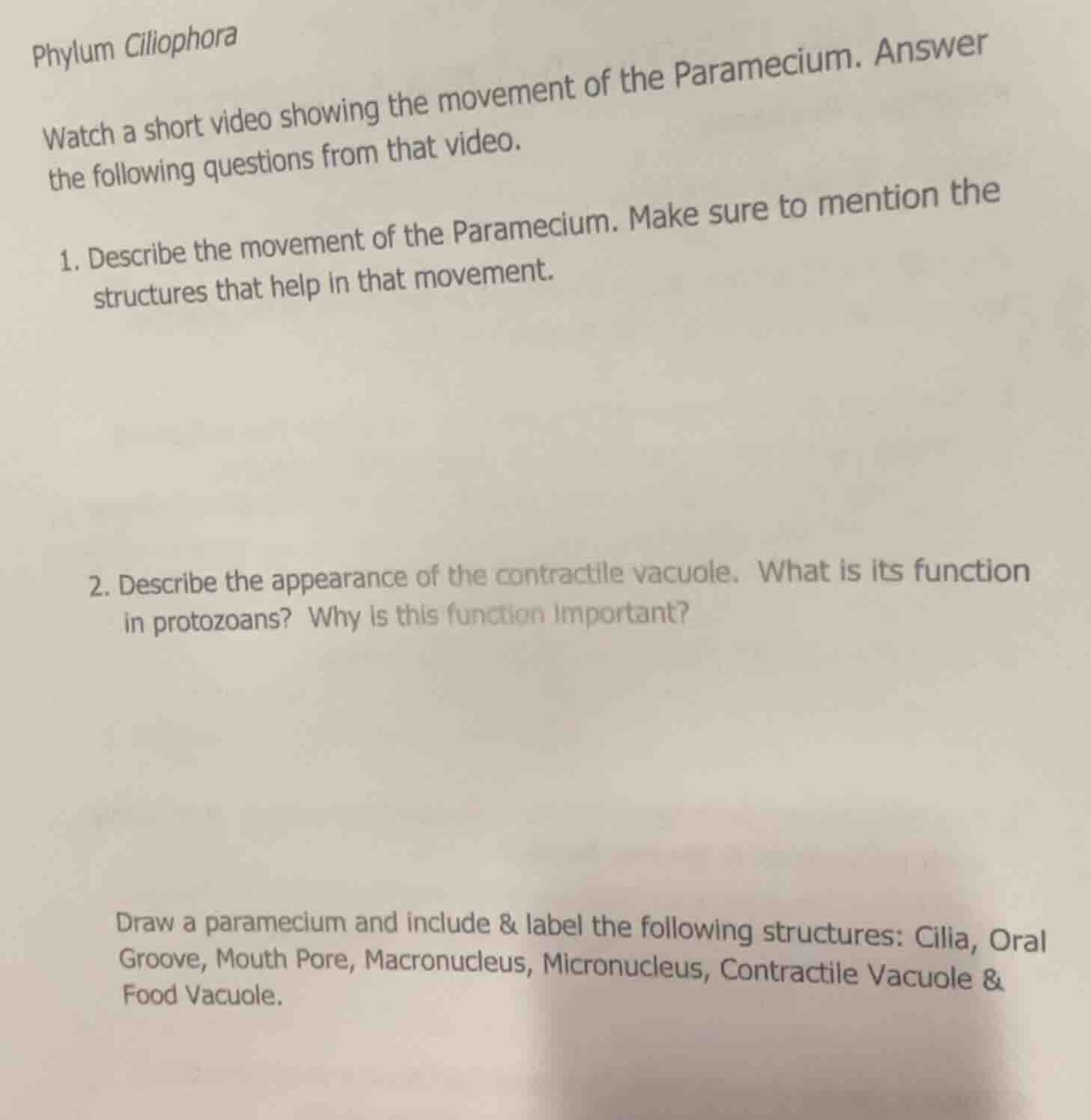
watch a short video showing the movement of the paramecium. answer the following questions from that video.
- describe the movement of the paramecium. make sure to mention the structures that help in that movement.
- describe the appearance of the contractile vacuole. what is its function in protozoans? why is this function important?
draw a paramecium and include & label the following structures: cilia, oral groove, mouth pore, macronucleus, micronucleus, contractile vacuole & food vacuole.
Brief Explanations
- For Paramecium movement: It uses hair-like cilia covering its cell surface; the cilia beat in coordinated, wave-like motions to propel the organism forward, and can reverse beat direction to change course or avoid obstacles.
- For the contractile vacuole: It appears as a clear, spherical, membrane-bound structure that fills and empties repeatedly. Its function is osmoregulation: it expels excess water that enters the cell via osmosis. This is critical because protozoans like Paramecium live in freshwater (hypotonic) environments; without this structure, water would build up inside the cell, causing it to burst.
- For the labeled diagram: The Paramecium is an elongated, slipper-shaped cell. Labeled structures are:
- Cilia: Tiny hair-like projections covering the outer surface
- Oral Groove: A curved, funnel-like indentation on the side of the cell
- Mouth Pore: The narrow opening at the end of the oral groove
- Macronucleus: A large, oval-shaped nucleus near the center
- Micronucleus: A small, round nucleus adjacent to the macronucleus
- Contractile Vacuole: A clear spherical structure near the cell's end, with associated collecting canals
- Food Vacuole: Small, spherical structures within the cytoplasm that digest food

Snap & solve any problem in the app
Get step-by-step solutions on Sovi AI
Photo-based solutions with guided steps
Explore more problems and detailed explanations
- Paramecium moves via coordinated wave-like beats of tiny, hair-like cilia covering its entire cell surface. The cilia propel it forward in a spiral path; reversing cilia beat direction lets it backtrack or turn to avoid barriers.
- The contractile vacuole is a clear, spherical, membrane-bound structure that cycles between filling with fluid and shrinking to expel it. Its function is osmoregulation: it removes excess water that enters the cell from its hypotonic freshwater environment. This is essential because without it, constant water influx would cause the Paramecium's cell to swell and rupture, killing the organism.
- (Descriptive diagram breakdown, as a text-based representation):
          [Cilia (covering outer surface)]
┌───────────────────────────────────────────────────┐
│  Oral Groove ────────────▶ [Mouth Pore]           │
│                                                   │
│    [Macronucleus (large oval)]                    │
│    [Micronucleus (small round, next to macro)]    │
│                                                   │
│    [Food Vacuoles (small spheres in cytoplasm)]   │
│                                                   │
│                [Contractile Vacuole]              │
└───────────────────────────────────────────────────┘
(Note: A hand-drawn diagram would be an elongated slipper shape with all the listed structures labeled at their respective positions.)