QUESTION IMAGE
Question
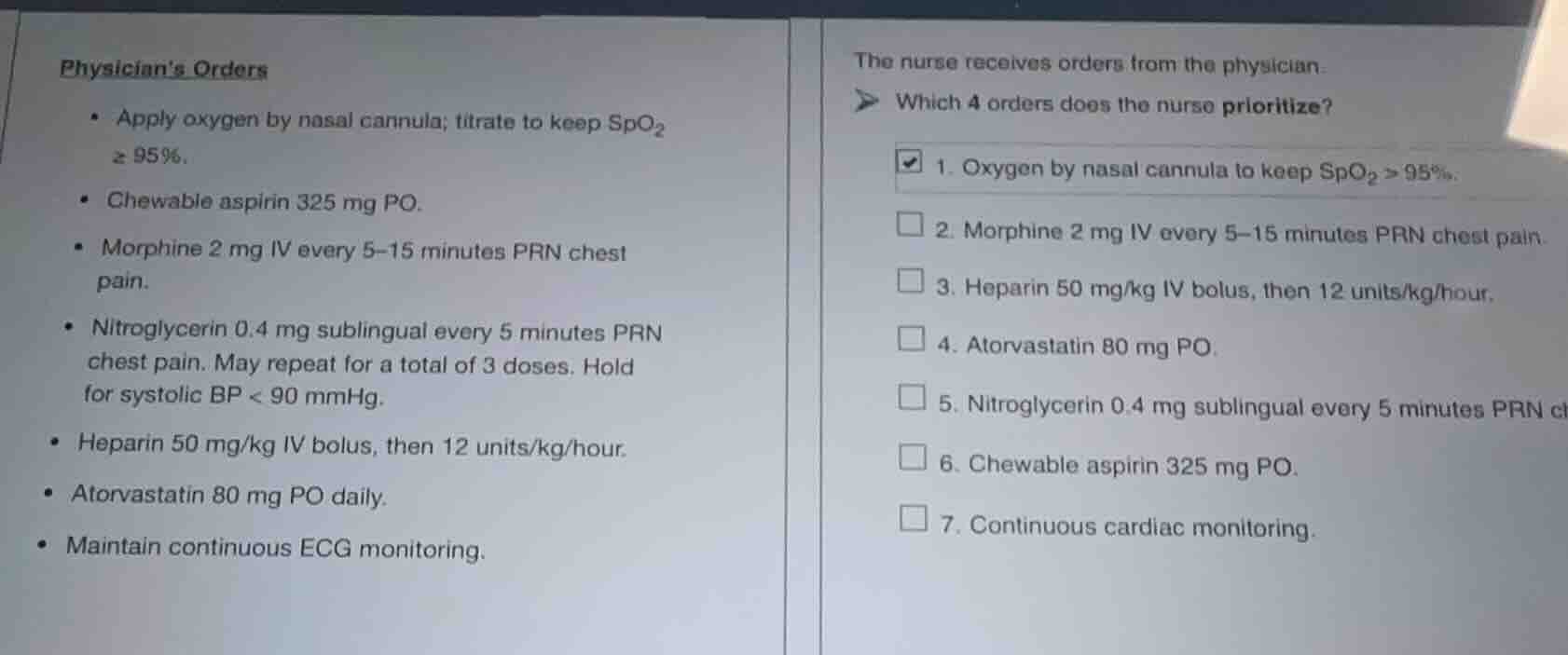
physician’s orders
- apply oxygen by nasal cannula; titrate to keep spo₂ ≥ 95%.
- chewable aspirin 325 mg po.
- morphine 2 mg iv every 5–15 minutes prn chest pain.
- nitroglycerin 0.4 mg sublingual every 5 minutes prn chest pain. may repeat for a total of 3 doses. hold for systolic bp < 90 mmhg.
- heparin 50 mg/kg iv bolus, then 12 units/kg/hour.
- atorvastatin 80 mg po daily.
- maintain continuous ecg monitoring.
the nurse receives orders from the physician.
which 4 orders does the nurse prioritize?
☑ 1. oxygen by nasal cannula to keep spo₂ > 95%.
□ 2. morphine 2 mg iv every 5–15 minutes prn chest pain.
□ 3. heparin 50 mg/kg iv bolus, then 12 units/kg/hour.
□ 4. atorvastatin 80 mg po.
□ 5. nitroglycerin 0.4 mg sublingual every 5 minutes prn ch
□ 6. chewable aspirin 325 mg po.
□ 7. continuous cardiac monitoring.
To determine the top 4 prioritized orders for a patient (likely with acute coronary syndrome), we prioritize interventions addressing immediate life - threatening issues and core acute coronary syndrome management:
- Oxygen (1): Maintaining adequate oxygenation ($\text{SpO}_2\geq95\%$) is vital for tissue perfusion, especially in cardiac events.
- Aspirin (6): Chewable aspirin (325 mg PO) is given immediately to inhibit platelet aggregation, a key step in preventing further thrombus formation in acute coronary syndrome.
- Nitroglycerin (5): Sublingual nitroglycerin (0.4 mg every 5 minutes PRN chest pain, up to 3 doses) relieves chest pain by vasodilation, improving coronary blood flow and reducing preload/afterload.
- Heparin (3): Heparin (50 mg/kg IV bolus then 12 units/kg/hour) is an anticoagulant, crucial for preventing thrombus expansion in acute coronary syndrome.
Morphine (2) is for pain but is secondary to oxygen, aspirin, nitroglycerin, and heparin. Atorvastatin (4) is a statin for long - term lipid management, not immediate. Continuous cardiac monitoring (7) is important but the first four address more immediate physiological needs.

Snap & solve any problem in the app
Get step-by-step solutions on Sovi AI
Photo-based solutions with guided steps
Explore more problems and detailed explanations
- Oxygen by nasal cannula to keep $\text{SpO}_2 > 95\%$.
- Chewable aspirin 325 mg PO.
- Nitroglycerin 0.4 mg sublingual every 5 minutes PRN chest pain.
- Heparin 50 mg/kg IV bolus, then 12 units/kg/hour.