QUESTION IMAGE
Question
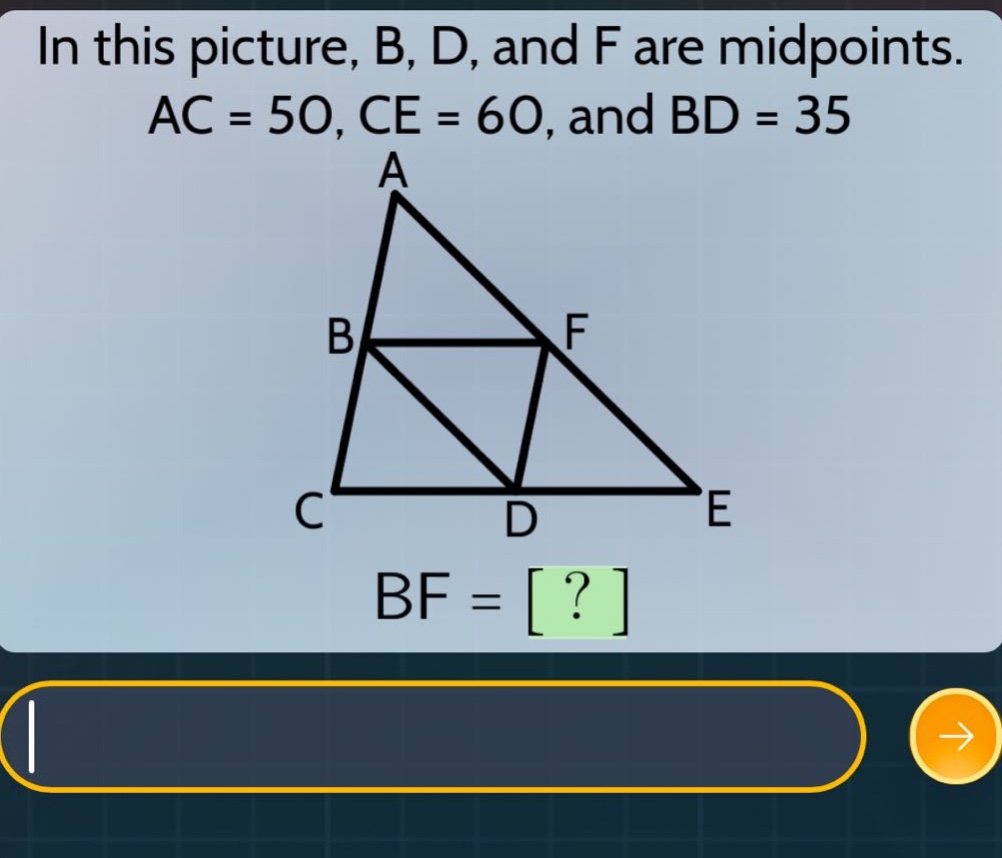
in this picture, b, d, and f are midpoints. ac = 50, ce = 60, and bd = 35
bf = ?
Step1: Identify Midsegment Theorem
Since B, D, F are midpoints, we use the midsegment theorem (or midline theorem) in triangles. The midsegment of a triangle is parallel to the third side and half its length. Also, in a quadrilateral formed by midpoints, opposite sides are equal (midline properties).
Step2: Analyze BD and CE, BF and AC
First, check BD: B is midpoint of AC, D is midpoint of CE? Wait, no. Wait, B is midpoint of AC (since AC=50, so AB=BC=25). D is midpoint of CE (CE=60, so CD=DE=30). Now, BD: let's see, BD connects midpoint of AC to midpoint of CE? Wait, maybe BF is parallel to CE? No, wait, BF: B is midpoint of AC, F is midpoint of AE? Wait, the figure: triangle ACE, with B midpoint of AC, D midpoint of CE, F midpoint of AE. Then BD is midsegment of triangle ACE? Wait, no, BD: B to D, where D is midpoint of CE, B is midpoint of AC. Wait, actually, in triangle ACE, the midsegment connecting midpoints of AC and CE would be parallel to AE? No, midsegment connects midpoints of two sides, parallel to the third. Wait, maybe BF is parallel to CE? Wait, no, let's re-examine.
Wait, the problem: B, D, F are midpoints. So B is midpoint of AC, D is midpoint of CE, F is midpoint of AE. Then, BD: connects midpoint of AC to midpoint of CE. Then BF: connects midpoint of AC to midpoint of AE. Wait, but also, in the quadrilateral BFDC? No, maybe BF is equal to CD? Wait, no. Wait, CE is 60, D is midpoint, so CD=30. But BD is 35. Wait, maybe BF is equal to CD? No, wait, AC is 50, B is midpoint, so AB=BC=25. Wait, maybe BF is equal to CD? No, wait, let's think again.
Wait, the midsegment theorem: in triangle ACE, the midsegment from B (midpoint of AC) to F (midpoint of AE) would be parallel to CE and half its length? Wait, no, midsegment connects midpoints of two sides, so midpoint of AC (B) and midpoint of AE (F) would have midsegment BF parallel to CE and BF = ½ CE? Wait, CE is 60, so ½ CE is 30? But BD is 35. Wait, maybe I got the sides wrong.
Wait, another approach: BD is a midsegment? Wait, B is midpoint of AC, D is midpoint of CE. Then BD is parallel to AE and BD = ½ AE? Wait, no, midsegment connects midpoints of two sides, so if B is midpoint of AC and D is midpoint of CE, then BD is not a midsegment of triangle ACE. Wait, maybe the figure is triangle ACE, with B midpoint of AC, F midpoint of AE, D midpoint of CE. Then BF is midsegment of triangle ACE, so BF = ½ CE? Wait, CE is 60, so BF = 30? But BD is 35. Wait, no, maybe I mixed up.
Wait, the problem says AC=50, CE=60, BD=35. We need to find BF. Let's think about the midline in the quadrilateral. Since B, D, F are midpoints, BFDC is a parallelogram? Wait, B is midpoint of AC, F is midpoint of AE, D is midpoint of CE. Then BF is parallel to CE (midsegment of triangle ACE: B and F are midpoints of AC and AE, so BF || CE and BF = ½ CE). Wait, CE is 60, so ½ CE is 30. But wait, BD: B is midpoint of AC, D is midpoint of CE, so BD is parallel to AE and BD = ½ AE. But we don't know AE. Wait, maybe another way: in the figure, BF is equal to CD? Wait, CD is ½ CE = 30. Wait, but let's check the midsegment theorem again.
Wait, the midsegment theorem states that the segment connecting the midpoints of two sides of a triangle is parallel to the third side and half as long. So in triangle ACE, if B is the midpoint of AC and F is the midpoint of AE, then BF is the midsegment, so BF || CE and BF = ½ CE. CE is 60, so BF = ½ * 60 = 30. Wait, but why is BD given? Maybe to distract, or maybe I made a mistake. Wait, let's confirm: AC=50, so AB=BC=25. CE=60, so CD=DE=30. If B, D, F are midp…

Snap & solve any problem in the app
Get step-by-step solutions on Sovi AI
Photo-based solutions with guided steps
Explore more problems and detailed explanations
30