QUESTION IMAGE
Question
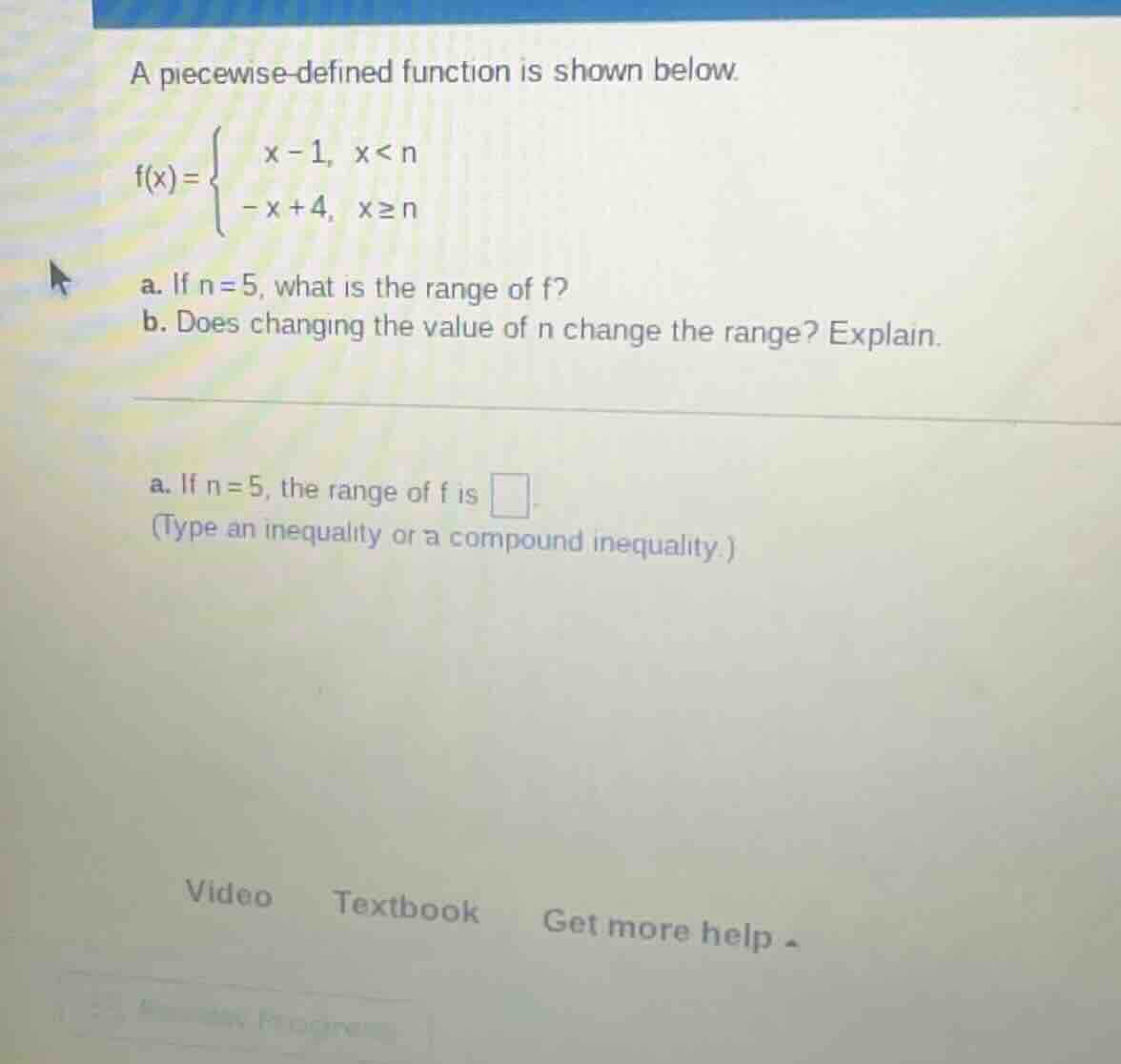
a piecewise - defined function is shown below.
$f(x)=\begin{cases}x - 1, & xlt n\\-x + 4, & xgeq nend{cases}$
a. if $n = 5$, what is the range of $f$?
b. does changing the value of $n$ change the range? explain.
a. if $n = 5$, the range of $f$ is $square$.
(type an inequality or a compound inequality.)
Step1: Analyze first piece (x<5)
For $f(x)=x-1$ where $x<5$, as $x$ approaches $5$ from the left, $f(x)$ approaches $5-1=4$. As $x$ decreases to $-\infty$, $f(x)$ also goes to $-\infty$. So the output here is $f(x) < 4$.
Step2: Analyze second piece (x≥5)
For $f(x)=-x+4$ where $x\geq5$, when $x=5$, $f(5)=-5+4=-1$. As $x$ increases to $+\infty$, $f(x)$ goes to $-\infty$. So the output here is $f(x) \leq -1$.
Step3: Combine the ranges
The combined range of the two pieces is all values less than 4, since the second piece's range ($f(x)\leq-1$) is a subset of $f(x)<4$.
Step4: Answer part b logic
When $n$ changes, the point where the pieces switch changes, but both pieces are linear: $x-1$ increases to $n-1$ as $x$ approaches $n$, and $-x+4$ decreases from $-n+4$ as $x$ increases past $n$. The maximum value of the entire function is always the smaller of the two one-sided limits at $x=n$? No—actually, for any $n$, $x-1$ can take all values less than $n-1$, and $-x+4$ can take all values less than or equal to $-n+4$. The overall upper bound of the range is the maximum of $n-1$ and $-n+4$. The maximum of $n-1$ and $-n+4$ occurs when $n-1=-n+4$, so $2n=5$, $n=2.5$. At $n=2.5$, the maximum value is $1.5$. For any $n$, the upper limit of the range is $\max(n-1, -n+4)$, and the lower limit is $-\infty$. So changing $n$ changes the upper bound of the range, thus changing the range.

Snap & solve any problem in the app
Get step-by-step solutions on Sovi AI
Photo-based solutions with guided steps
Explore more problems and detailed explanations
a. $f(x) < 4$
b. Yes, changing $n$ changes the range. The upper bound of the function's output depends on $n$: the maximum value of the function is $\max(n-1, -n+4)$, which shifts as $n$ changes, so the set of all possible output values (the range) changes.