QUESTION IMAGE
Question
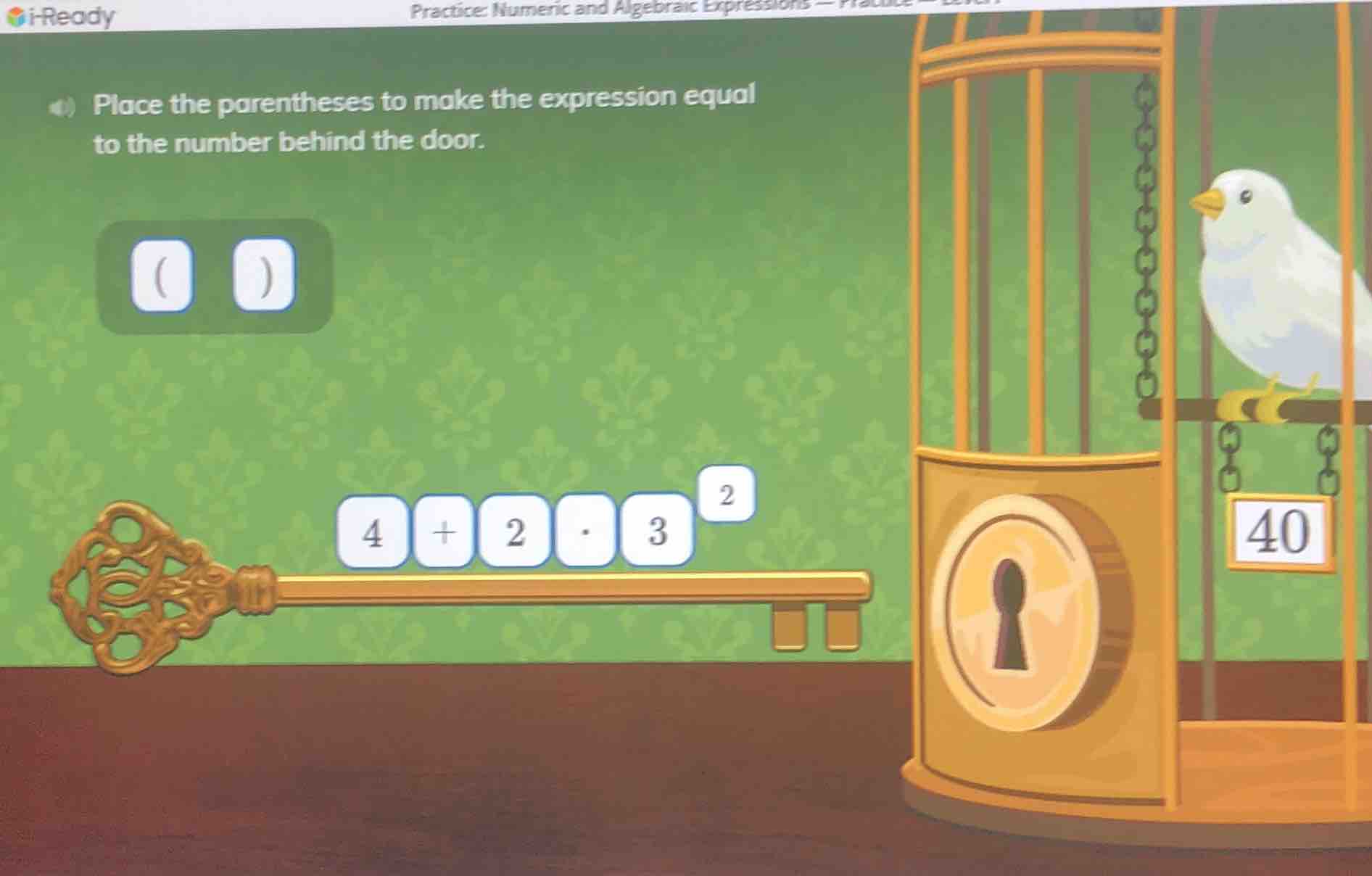
place the parentheses to make the expression equal to the number behind the door. 4 + 2 · 3² (the number behind the door is 40)
Step1: Analizar la expresión original
La expresión es \(4 + 2 \cdot 3^2\). Sin paréntesis, se calcula primero la potencia: \(3^2 = 9\), luego la multiplicación: \(2 \cdot 9 = 18\), y finalmente la suma: \(4 + 18 = 22\), que no es 40. Necesitamos cambiar el orden de operaciones con paréntesis.
Step2: Probar agrupar \(4 + 2\)
Si hacemos \((4 + 2) \cdot 3^2\), primero resolvemos el paréntesis: \(4 + 2 = 6\), luego la potencia: \(3^2 = 9\), y finalmente la multiplicación: \(6 \cdot 9 = 54\), que no es 40.
Step3: Probar agrupar \(2 \cdot 3\)
No, no. Probemos agrupar \(4 + 2 \cdot 3\)? No, mejor probar agrupar de otra manera. Espera, quizás \( (4 + 2) \cdot 3^2 \) no, o \( 4 + (2 \cdot 3)^2 \). Calculamos \( (2 \cdot 3)^2 = 6^2 = 36 \), luego \(4 + 36 = 40\). Sí, eso funciona.

Snap & solve any problem in the app
Get step-by-step solutions on Sovi AI
Photo-based solutions with guided steps
Explore more problems and detailed explanations
\(4 + (2 \cdot 3)^2\)