QUESTION IMAGE
Question
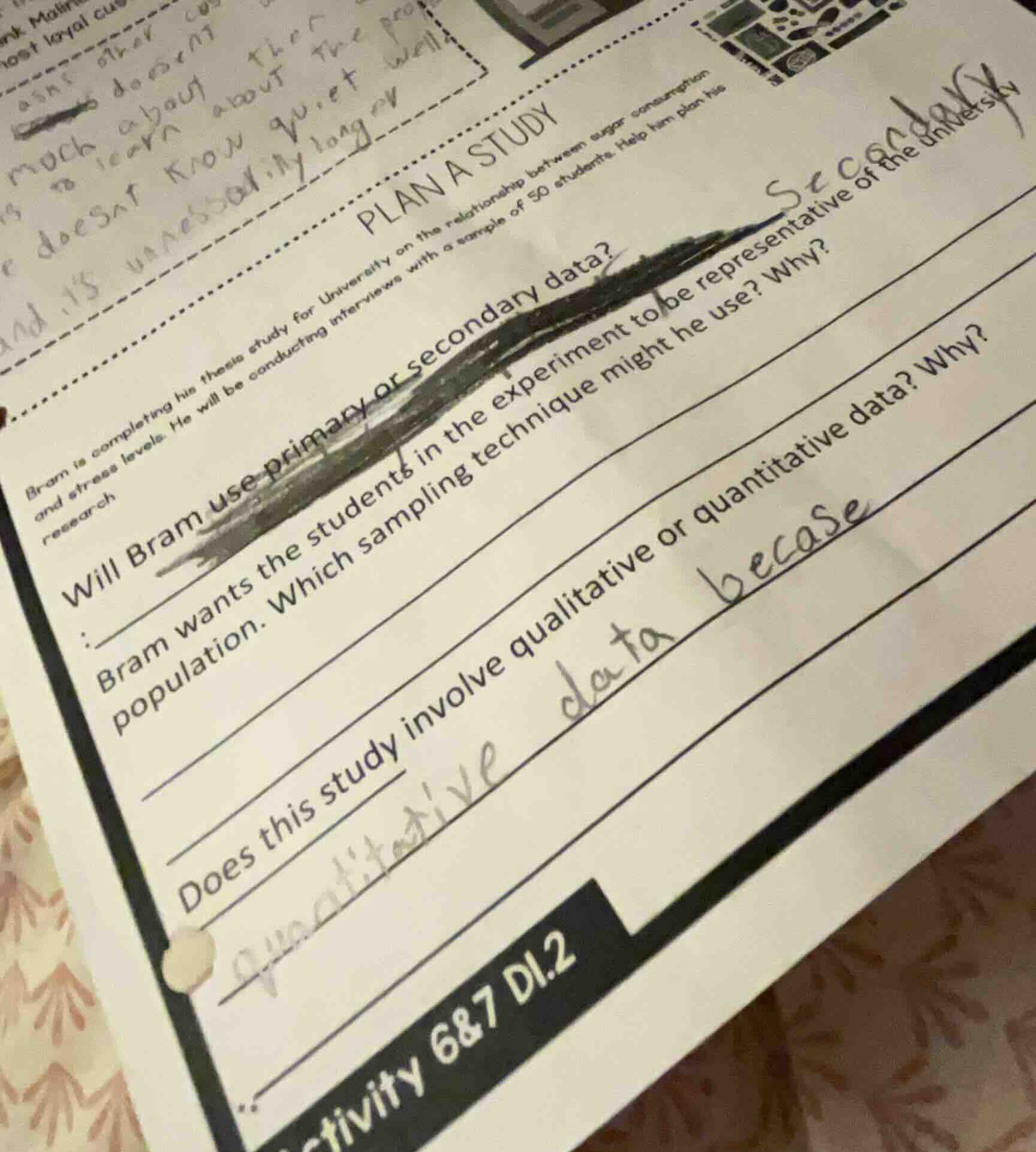
plan a study bram is completing his thesis study for university on the relationship between sugar consumption and stress levels. he will be conducting interviews with a sample of 50 students. help him plan his research will bram use primary or secondary data? : bram wants the students in the experiment to be representative of the population. which sampling technique might he use? why? does this study involve qualitative or quantitative data? why?
1. Will Bram use primary or secondary data?
Bram is conducting interviews (collecting new data) for his thesis on student sugar consumption and stress. Primary data is original data collected by the researcher, while secondary is pre - existing. Since he’s doing interviews, he’ll use primary data.
For a university - wide study with 50 students, simple random sampling (e.g., randomly selecting 50 students from all university students) is feasible. It gives each student an equal chance, ensuring representativeness as every student has the same probability of being chosen, reducing bias. Stratified sampling (dividing by year/degree, then sampling) could also work to ensure diversity, but simple random is straightforward for a general student population.
If stress levels are measured numerically (e.g., on a scale 1 - 10) and sugar consumption is measured in grams/portions, it’s quantitative (numerical data for analysis). If stress is explored through open - ended interview responses (non - numerical, descriptive), it could have qualitative, but since it’s about a relationship (likely measured with numbers), it’s quantitative. The study’s focus on “relationship between” suggests measuring variables numerically.

Snap & solve any problem in the app
Get step-by-step solutions on Sovi AI
Photo-based solutions with guided steps
Explore more problems and detailed explanations
Primary data. Because he is conducting interviews (collecting original data) for his research.