QUESTION IMAGE
Question
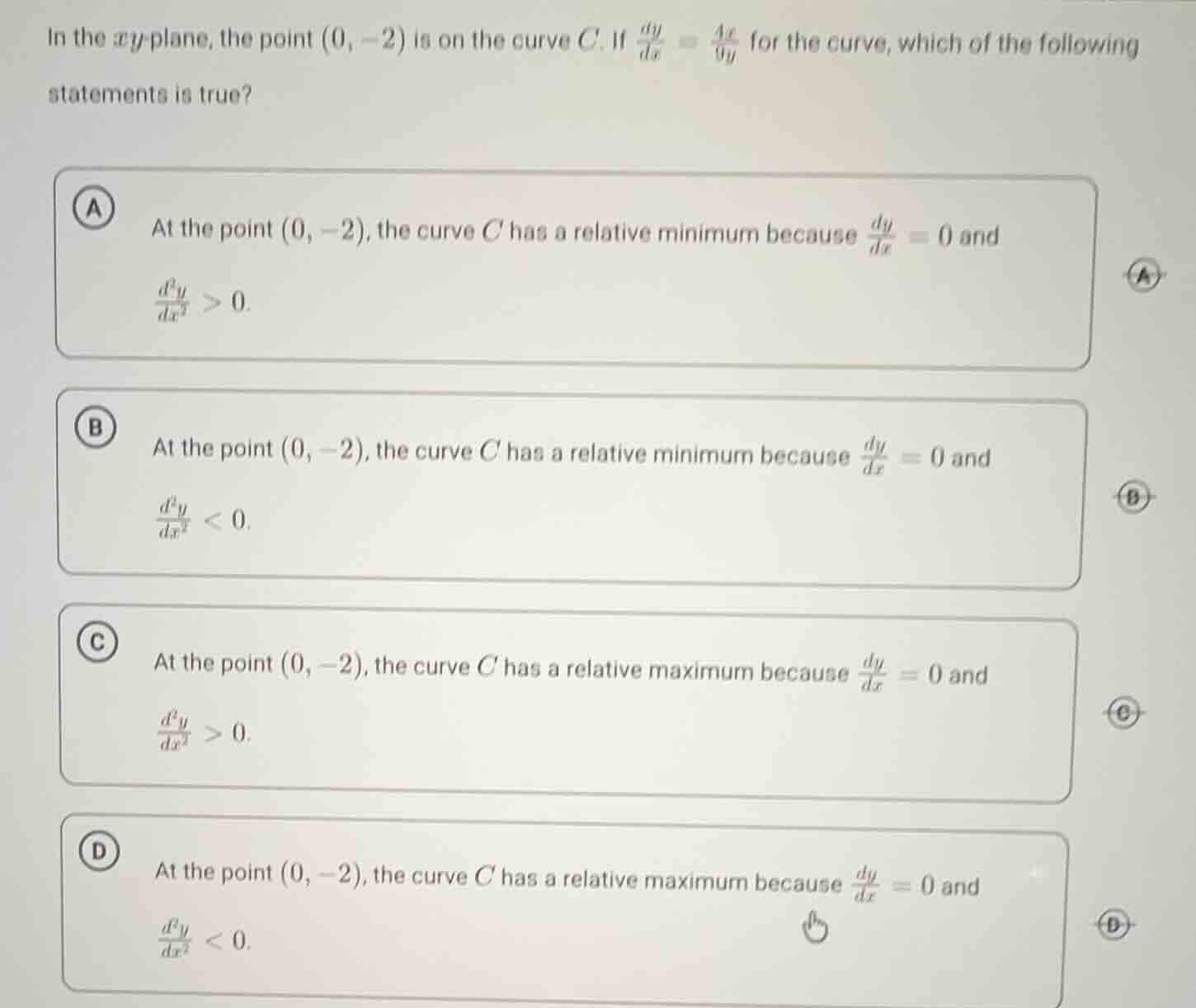
in the $xy$-plane, the point $(0, -2)$ is on the curve $c$. if $\frac{dy}{dx} = \frac{4x}{9y}$ for the curve, which of the following statements is true?
a at the point $(0, -2)$, the curve $c$ has a relative minimum because $\frac{dy}{dx} = 0$ and $\frac{d^2y}{dx^2} > 0$.
b at the point $(0, -2)$, the curve $c$ has a relative minimum because $\frac{dy}{dx} = 0$ and $\frac{d^2y}{dx^2} < 0$.
c at the point $(0, -2)$, the curve $c$ has a relative maximum because $\frac{dy}{dx} = 0$ and $\frac{d^2y}{dx^2} > 0$.
d at the point $(0, -2)$, the curve $c$ has a relative maximum because $\frac{dy}{dx} = 0$ and $\frac{d^2y}{dx^2} < 0$.
Step1: Find \(\frac{dy}{dx}\) at \((0, -2)\)
Substitute \(x = 0\) and \(y=-2\) into \(\frac{dy}{dx}=\frac{4x}{9y}\).
\(\frac{dy}{dx}=\frac{4\times0}{9\times(-2)} = 0\). So the first - derivative is zero at \((0, - 2)\), which means the point \((0, - 2)\) is a critical point.
Step2: Find the second - derivative \(\frac{d^{2}y}{dx^{2}}\) using implicit differentiation
We have \(\frac{dy}{dx}=\frac{4x}{9y}\). Use the quotient rule \((\frac{u}{v})^\prime=\frac{u^\prime v - uv^\prime}{v^{2}}\), where \(u = 4x\) and \(v=9y\).
First, find \(u^\prime=\frac{d}{dx}(4x)=4\) and \(v^\prime=\frac{d}{dx}(9y)=9\frac{dy}{dx}\).
So \(\frac{d^{2}y}{dx^{2}}=\frac{4\times9y-4x\times9\frac{dy}{dx}}{(9y)^{2}}=\frac{4y - 4x\frac{dy}{dx}}{9y^{2}}\).
Step3: Substitute \(x = 0\), \(y=-2\) and \(\frac{dy}{dx}=0\) into the second - derivative formula
Substitute these values into \(\frac{d^{2}y}{dx^{2}}=\frac{4y - 4x\frac{dy}{dx}}{9y^{2}}\).
We get \(\frac{d^{2}y}{dx^{2}}=\frac{4\times(-2)-4\times0\times0}{9\times(-2)^{2}}=\frac{-8}{9\times4}=\frac{-8}{36}=-\frac{2}{9}<0\).
Step4: Use the second - derivative test
The second - derivative test states that if \(\frac{dy}{dx}=0\) at a critical point \((a,b)\):
- If \(\frac{d^{2}y}{dx^{2}}(a,b)>0\), the function has a relative minimum at \((a,b)\).
- If \(\frac{d^{2}y}{dx^{2}}(a,b)<0\), the function has a relative maximum at \((a,b)\).
Since \(\frac{dy}{dx}=0\) and \(\frac{d^{2}y}{dx^{2}}<0\) at the point \((0, - 2)\), the curve \(C\) has a relative maximum at the point \((0, - 2)\).

Snap & solve any problem in the app
Get step-by-step solutions on Sovi AI
Photo-based solutions with guided steps
Explore more problems and detailed explanations
D. At the point \((0, -2)\), the curve \(C\) has a relative maximum because \(\frac{dy}{dx} = 0\) and \(\frac{d^{2}y}{dx^{2}}<0\).