QUESTION IMAGE
Question
plant cell organelle structures quiz
identify the organelles by number
1 6 11
2 7 12
3 8 13
4 9 14
5 10
word bank
mitochondrion chloroplast vacuole
nucleolus rough er golgi body
cytoplasm cell membrane nucleus
smooth er nuclear membrane ribosome
cell wall lysosome
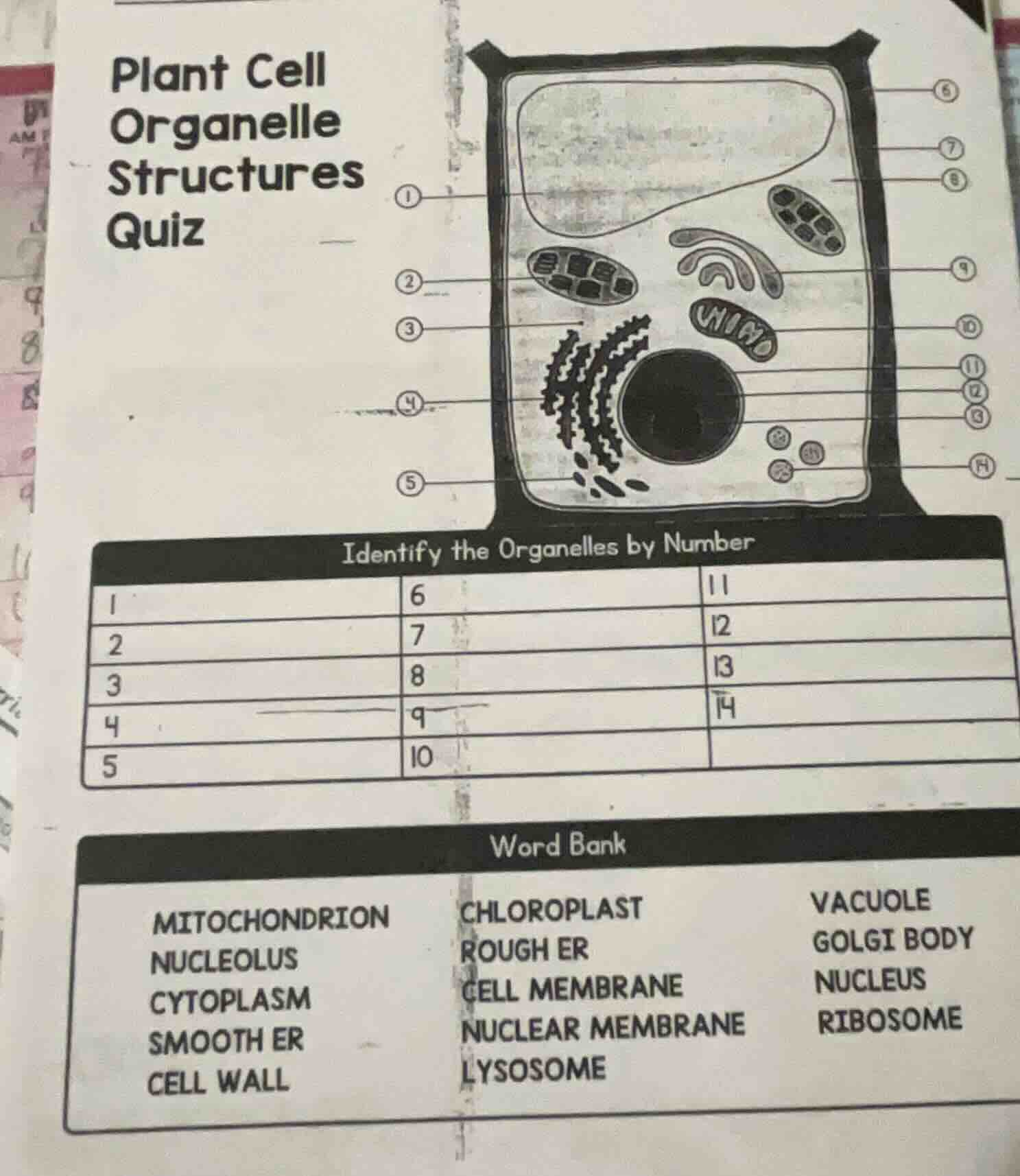
To solve this plant cell organelle identification, we analyze each numbered structure based on plant cell anatomy:
1 (Structure ①)
- Observation: Large, fluid - filled sac.
- Match: VACUOLE (stores water, nutrients, etc. in plant cells).
2 (Structure ②)
- Observation: Oval - shaped with chlorophyll - like appearance (for photosynthesis).
- Match: CHLOROPLAST (site of photosynthesis in plant cells).
3 (Structure ③)
- Observation: Small, dot - like structures (protein synthesis sites).
- Match: RIBOSOME (synthesizes proteins).
4 (Structure ④)
- Observation: Network with ribosomes attached (involved in protein synthesis and transport).
- Match: ROUGH ER (rough endoplasmic reticulum, has ribosomes, processes proteins).
5 (Structure ⑤)
- Observation: Network without ribosomes (involved in lipid synthesis, detoxification).
- Match: SMOOTH ER (smooth endoplasmic reticulum, no ribosomes).
6 (Structure ⑥)
- Observation: Rigid, outer layer (provides structure and support).
- Match: CELL WALL (unique to plant cells, gives rigidity).
7 (Structure ⑦)
- Observation: Thin, flexible layer inside cell wall (controls substance movement).
- Match: CELL MEMBRANE (regulates entry/exit of materials).
8 (Structure ⑧)
- Observation: Jelly - like substance filling the cell (holds organelles).
- Match: CYTOPLASM (the fluid matrix of the cell).
9 (Structure ⑨)
- Observation: Stacked, pancake - like structure (modifies, sorts, packages molecules).
- Match: GOLGI BODY (Golgi apparatus, processes cellular products).
10 (Structure ⑩)
- Observation: Bean - shaped, with inner folds (site of cellular respiration).
- Match: MITOCHONDRION (produces ATP, energy for the cell).
11 (Structure ⑪)
- Observation: Double - layered membrane around nucleus (separates nucleus from cytoplasm).
- Match: NUCLEAR MEMBRANE (encloses the nucleus).
12 (Structure ⑫)
- Observation: Large, circular structure (contains genetic material).
- Match: NUCLEUS (control center of the cell, has DNA).
13 (Structure ⑬)
- Observation: Small, dense structure inside nucleus (produces ribosomes).
- Match: NUCLEOLUS (found within the nucleus, makes ribosomal subunits).
14 (Structure ⑭)
- Observation: Small, vesicle - like (involved in digestion, rare in plant cells but in the word bank).
- Match: LYSOSOME (contains digestive enzymes, though less common in plants, present in the word bank).
Final Answers (Filled Table - Example for Clarity)
| Number | Organelle |
|---|---|
| 2 | CHLOROPLAST |
| 3 | RIBOSOME |
| 4 | ROUGH ER |
| 5 | SMOOTH ER |
| 6 | CELL WALL |
| 7 | CELL MEMBRANE |
| 8 | CYTOPLASM |
| 9 | GOLGI BODY |
| 10 | MITOCHONDRION |
| 11 | NUCLEAR MEMBRANE |
| 12 | NUCLEUS |
| 13 | NUCLEOLUS |
| 14 | LYSOSOME |
(Note: For the original table in the problem, fill each number’s row with the corresponding organelle from the word bank using the above matches.)

Snap & solve any problem in the app
Get step-by-step solutions on Sovi AI
Photo-based solutions with guided steps
Explore more problems and detailed explanations
To solve this plant cell organelle identification, we analyze each numbered structure based on plant cell anatomy:
1 (Structure ①)
- Observation: Large, fluid - filled sac.
- Match: VACUOLE (stores water, nutrients, etc. in plant cells).
2 (Structure ②)
- Observation: Oval - shaped with chlorophyll - like appearance (for photosynthesis).
- Match: CHLOROPLAST (site of photosynthesis in plant cells).
3 (Structure ③)
- Observation: Small, dot - like structures (protein synthesis sites).
- Match: RIBOSOME (synthesizes proteins).
4 (Structure ④)
- Observation: Network with ribosomes attached (involved in protein synthesis and transport).
- Match: ROUGH ER (rough endoplasmic reticulum, has ribosomes, processes proteins).
5 (Structure ⑤)
- Observation: Network without ribosomes (involved in lipid synthesis, detoxification).
- Match: SMOOTH ER (smooth endoplasmic reticulum, no ribosomes).
6 (Structure ⑥)
- Observation: Rigid, outer layer (provides structure and support).
- Match: CELL WALL (unique to plant cells, gives rigidity).
7 (Structure ⑦)
- Observation: Thin, flexible layer inside cell wall (controls substance movement).
- Match: CELL MEMBRANE (regulates entry/exit of materials).
8 (Structure ⑧)
- Observation: Jelly - like substance filling the cell (holds organelles).
- Match: CYTOPLASM (the fluid matrix of the cell).
9 (Structure ⑨)
- Observation: Stacked, pancake - like structure (modifies, sorts, packages molecules).
- Match: GOLGI BODY (Golgi apparatus, processes cellular products).
10 (Structure ⑩)
- Observation: Bean - shaped, with inner folds (site of cellular respiration).
- Match: MITOCHONDRION (produces ATP, energy for the cell).
11 (Structure ⑪)
- Observation: Double - layered membrane around nucleus (separates nucleus from cytoplasm).
- Match: NUCLEAR MEMBRANE (encloses the nucleus).
12 (Structure ⑫)
- Observation: Large, circular structure (contains genetic material).
- Match: NUCLEUS (control center of the cell, has DNA).
13 (Structure ⑬)
- Observation: Small, dense structure inside nucleus (produces ribosomes).
- Match: NUCLEOLUS (found within the nucleus, makes ribosomal subunits).
14 (Structure ⑭)
- Observation: Small, vesicle - like (involved in digestion, rare in plant cells but in the word bank).
- Match: LYSOSOME (contains digestive enzymes, though less common in plants, present in the word bank).
Final Answers (Filled Table - Example for Clarity)
| Number | Organelle |
|---|---|
| 2 | CHLOROPLAST |
| 3 | RIBOSOME |
| 4 | ROUGH ER |
| 5 | SMOOTH ER |
| 6 | CELL WALL |
| 7 | CELL MEMBRANE |
| 8 | CYTOPLASM |
| 9 | GOLGI BODY |
| 10 | MITOCHONDRION |
| 11 | NUCLEAR MEMBRANE |
| 12 | NUCLEUS |
| 13 | NUCLEOLUS |
| 14 | LYSOSOME |
(Note: For the original table in the problem, fill each number’s row with the corresponding organelle from the word bank using the above matches.)