QUESTION IMAGE
Question
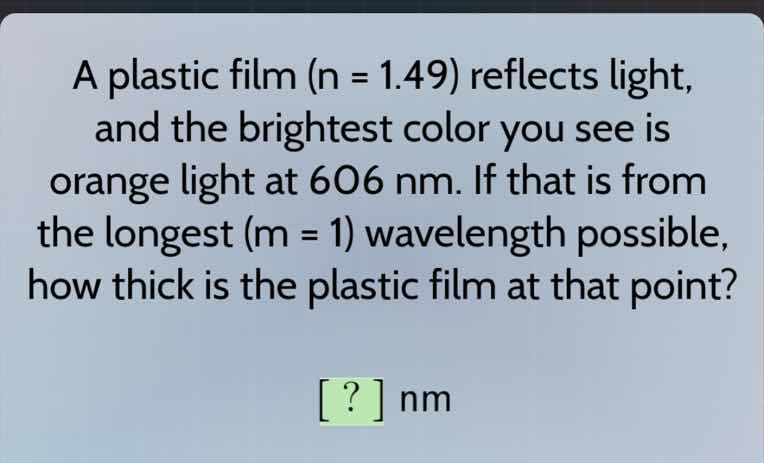
a plastic film (n = 1.49) reflects light, and the brightest color you see is orange light at 606 nm. if that is from the longest (m = 1) wavelength possible, how thick is the plastic film at that point?? nm
Step1: Recall the formula for thin - film interference (constructive interference for reflection)
For a thin film, when light reflects from the top and bottom surfaces, the condition for constructive interference (bright fringes) in the case of a film with \(n>1\) (plastic film, \(n = 1.49\)) and considering the phase changes: when light reflects from a medium with higher refractive index, a phase change of \(\lambda/2\) occurs. For a plastic film in air (\(n_{air}=1\)), the reflection from the top surface (air - plastic, \(n\) increases) has a phase change of \(\lambda/2\), and the reflection from the bottom surface (plastic - air, \(n\) decreases) has no phase change. So the path difference for constructive interference is \(2nt=(m +\frac{1}{2})\lambda\) when \(m = 0,1,2,\cdots\). But in this problem, we are told that it is the longest wavelength possible for \(m = 1\). Wait, actually, let's re - examine the condition. Wait, maybe I made a mistake. Let's think again.
Wait, the formula for constructive interference in thin - film reflection: when the film is between two media with lower refractive index (air on both sides? No, the film is a plastic film, so air on top and maybe air on the bottom? Wait, the problem is about reflection. So the light is incident from air (\(n = 1\)) onto the plastic film (\(n=1.49\)) and then reflects. The reflection from the first surface (air - plastic) has a phase shift of \(\lambda/2\) (because \(n_{plastic}>n_{air}\)), and the reflection from the second surface (plastic - air) has no phase shift (because \(n_{air} The phase shift from the first reflection is \(\lambda/2\), and the phase shift from the path difference is \(\frac{2nt}{\lambda}\times2\pi\). The total phase difference for constructive interference is \(\frac{2nt}{\lambda}\times2\pi+\pi = 2\pi m\) (where \(m = 1,2,3,\cdots\)) (because the first reflection has a \(\pi\) phase shift (\(\lambda/2\) path equivalent) and the path difference gives a phase shift of \(\frac{2nt}{\lambda}\times2\pi\)). Dividing both sides by \(2\pi\), we get \(\frac{2nt}{\lambda}+\frac{1}{2}=m\). So \(2nt=(m - \frac{1}{2})\lambda\). But the problem says "the longest wavelength possible" for \(m = 1\). Wait, the wavelength \(\lambda\) in the formula is the wavelength in vacuum. Let's solve for \(t\): \(t=\frac{(m-\frac{1}{2})\lambda}{2n}\). We are given \(m = 1\), \(\lambda=606\) nm, \(n = 1.49\). Substitute \(m = 1\), \(\lambda = 606\) nm, and \(n=1.49\) into the formula \(t=\frac{(m-\frac{1}{2})\lambda}{2n}\) First, calculate \(m-\frac{1}{2}\) when \(m = 1\): \(1-\frac{1}{2}=\frac{1}{2}\) Then, \(2n = 2\times1.49 = 2.98\) Now, \(t=\frac{\frac{1}{2}\times606}{2.98}\) Calculate the numerator: \(\frac{1}{2}\times606 = 303\) Then, \(t=\frac{303}{2.98}\approx101.68\) nm? Wait, that can't be right. Wait, maybe I mixed up the formula. Wait, another approach: maybe the formula is \(2nt=m\lambda\) for constructive interference. Wait, let's think about the phase changes again. If the film is in air, and we have reflection from the top (phase change \(\lambda/2\)) and reflection from the botto…Step2: Substitute the values into the formula

Snap & solve any problem in the app
Get step-by-step solutions on Sovi AI
Photo-based solutions with guided steps
Explore more problems and detailed explanations
\(\approx305\) (The more precise calculation: \(\frac{1.5\times606}{2.98}=\frac{909}{2.98}\approx305.03\) nm)