QUESTION IMAGE
Question
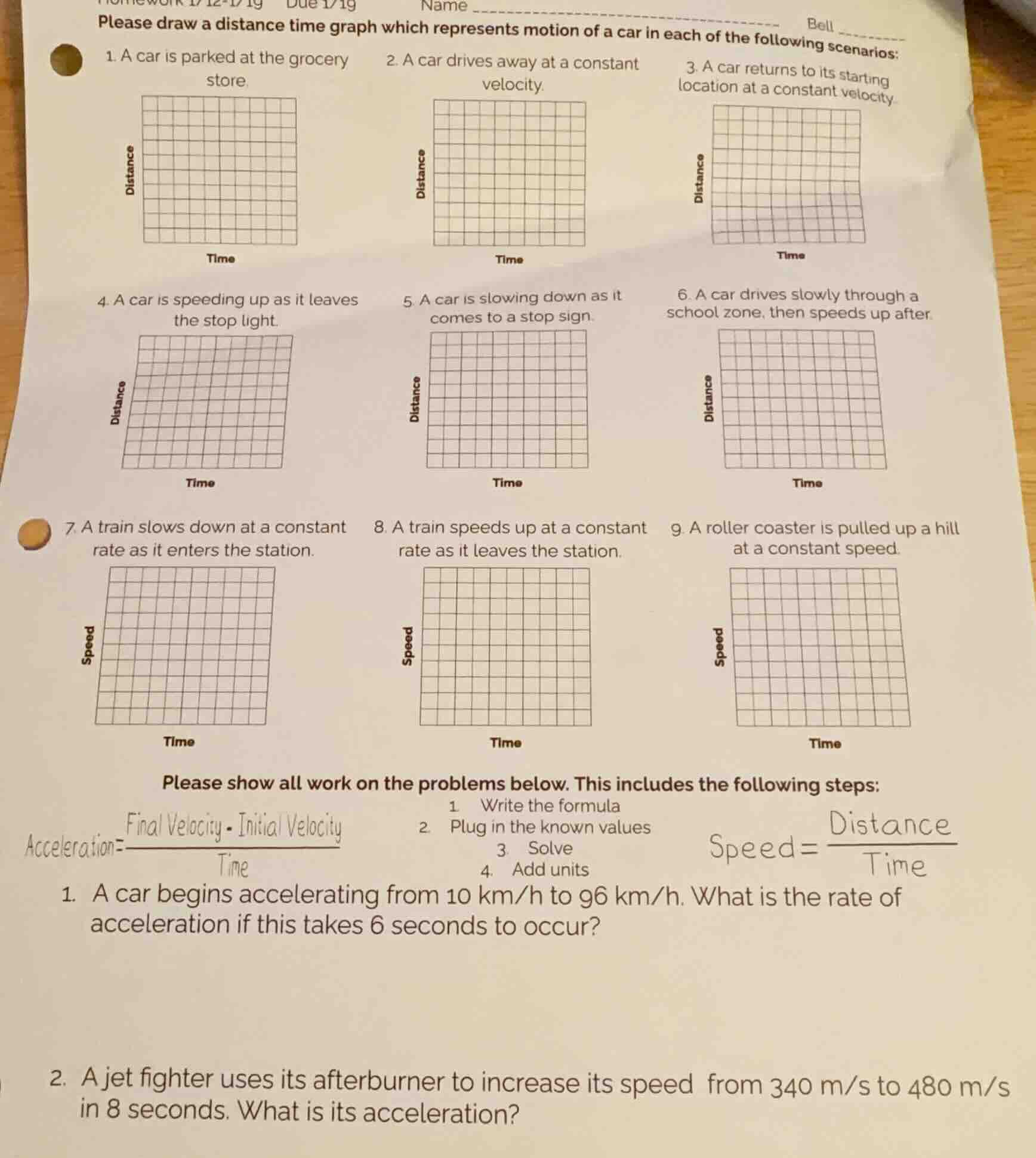
please draw a distance time graph which represents motion of a car in each of the following scenarios:
- a car is parked at the grocery store.
- a car drives away at a constant velocity.
- a car returns to its starting location at a constant velocity.
- a car is speeding up as it leaves the stop light.
- a car is slowing down as it comes to a stop sign.
- a car drives slowly through a school zone, then speeds up after.
- a train slows down at a constant rate as it enters the station.
- a train speeds up at a constant rate as it leaves the station.
- a roller coaster is pulled up a hill at a constant speed.
please show all work on the problems below. this includes the following steps:
- write the formula
- plug in the known values
- solve
- add units
acceleration = (final velocity - initial velocity) / time
speed = distance / time
- a car begins accelerating from 10 km/h to 96 km/h. what is the rate of acceleration if this takes 6 seconds to occur?
- a jet fighter uses its afterburner to increase its speed from 340 m/s to 480 m/s in 8 seconds. what is its acceleration?
Problem 1: Car Acceleration Calculation
Step1: Recall the acceleration formula
The formula for acceleration is \( a = \frac{v_f - v_i}{t} \), where \( v_f \) is the final velocity, \( v_i \) is the initial velocity, and \( t \) is the time.
Step2: Convert velocities to m/s (since time is in seconds)
- Initial velocity \( v_i = 10 \, \text{km/h} \). To convert to m/s: \( 10 \times \frac{1000}{3600} \approx 2.78 \, \text{m/s} \)
- Final velocity \( v_f = 96 \, \text{km/h} \). To convert to m/s: \( 96 \times \frac{1000}{3600} \approx 26.67 \, \text{m/s} \)
Step3: Plug values into the formula
\( a = \frac{26.67 - 2.78}{6} \)
Step4: Calculate the numerator
\( 26.67 - 2.78 = 23.89 \)
Step5: Divide by time
\( a = \frac{23.89}{6} \approx 3.98 \, \text{m/s}^2 \) (or we can also work in km/h per second and then convert, but m/s² is standard for acceleration)
Alternatively, if we keep units as km/h and seconds, we can convert the time to hours: \( t = 6 \, \text{seconds} = \frac{6}{3600} \, \text{hours} = \frac{1}{600} \, \text{hours} \)
Then \( a = \frac{96 - 10}{\frac{1}{600}} = 86 \times 600 = 51600 \, \text{km/h}^2 \), but converting to m/s² is more standard. Let's redo with m/s:
\( v_i = 10 \, \text{km/h} = \frac{10 \times 1000}{3600} = \frac{25}{9} \approx 2.7778 \, \text{m/s} \)
\( v_f = 96 \, \text{km/h} = \frac{96 \times 1000}{3600} = \frac{80}{3} \approx 26.6667 \, \text{m/s} \)
\( t = 6 \, \text{s} \)
\( a = \frac{\frac{80}{3} - \frac{25}{9}}{6} = \frac{\frac{240 - 25}{9}}{6} = \frac{\frac{215}{9}}{6} = \frac{215}{54} \approx 3.98 \, \text{m/s}^2 \) (or approximately \( 4.0 \, \text{m/s}^2 \))
Step1: Use the acceleration formula
\( a = \frac{v_f - v_i}{t} \), where \( v_f = 480 \, \text{m/s} \), \( v_i = 340 \, \text{m/s} \), \( t = 8 \, \text{s} \)
Step2: Plug in the values
\( a = \frac{480 - 340}{8} \)
Step3: Calculate the numerator
\( 480 - 340 = 140 \)
Step4: Divide by time
\( a = \frac{140}{8} = 17.5 \, \text{m/s}^2 \)

Snap & solve any problem in the app
Get step-by-step solutions on Sovi AI
Photo-based solutions with guided steps
Explore more problems and detailed explanations
The acceleration of the car is approximately \( \boldsymbol{3.98 \, \text{m/s}^2} \) (or \( 4.0 \, \text{m/s}^2 \) for simplicity)