QUESTION IMAGE
Question
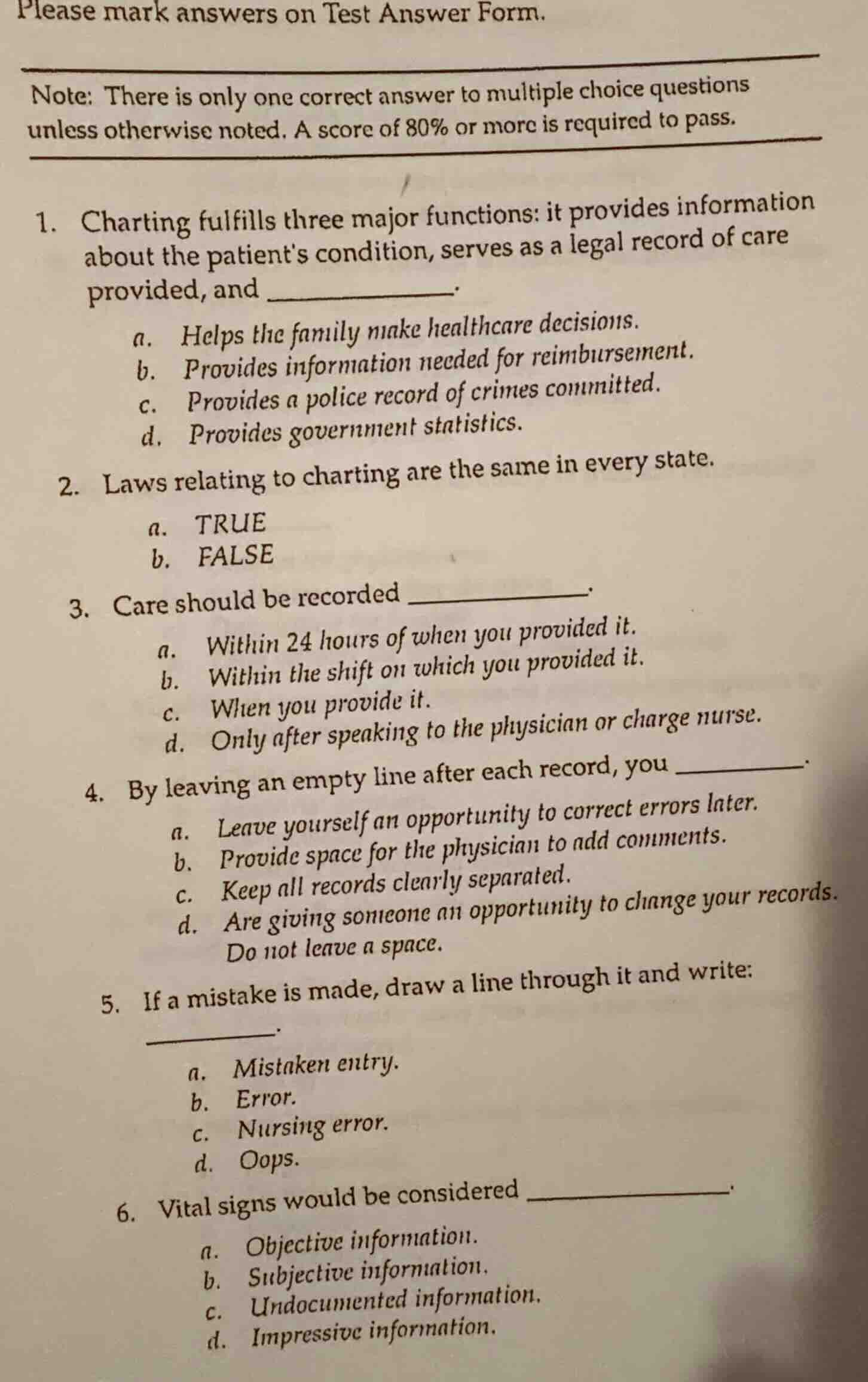
please mark answers on test answer form.
note: there is only one correct answer to multiple choice questions unless otherwise noted. a score of 80% or more is required to pass.
- charting fulfills three major functions: it provides information about the patients condition, serves as a legal record of care provided, and ________.
a. helps the family make healthcare decisions.
b. provides information needed for reimbursement.
c. provides a police record of crimes committed.
d. provides government statistics.
- laws relating to charting are the same in every state.
a. true
b. false
- care should be recorded ________.
a. within 24 hours of when you provided it.
b. within the shift on which you provided it.
c. when you provide it.
d. only after speaking to the physician or charge nurse.
- by leaving an empty line after each record, you ________.
a. leave yourself an opportunity to correct errors later.
b. provide space for the physician to add comments.
c. keep all records clearly separated.
d. are giving someone an opportunity to change your records.
do not leave a space.
- if a mistake is made, draw a line through it and write: ________.
a. mistaken entry.
b. error.
c. nursing error.
d. oops.
- vital signs would be considered ________.
a. objective information.
b. subjective information.
c. undocumented information.
d. impressive information.
Question 1
Charting in healthcare: one of its functions is for reimbursement (insurance, etc.). Option a: family decisions not main charting function. Option c: police record irrelevant. Option d: government stats not main. So b is correct.
Laws vary by state (e.g., regulations on medical records, charting). So "same in every state" is false.
Care should be recorded when provided (timely, accurate). Option a: 24h is too late. Option b: shift - not as timely as when provided. Option d: no need to wait for physician/nurse. So c is correct.

Snap & solve any problem in the app
Get step-by-step solutions on Sovi AI
Photo-based solutions with guided steps
Explore more problems and detailed explanations
b. Provides information needed for reimbursement.