QUESTION IMAGE
Question
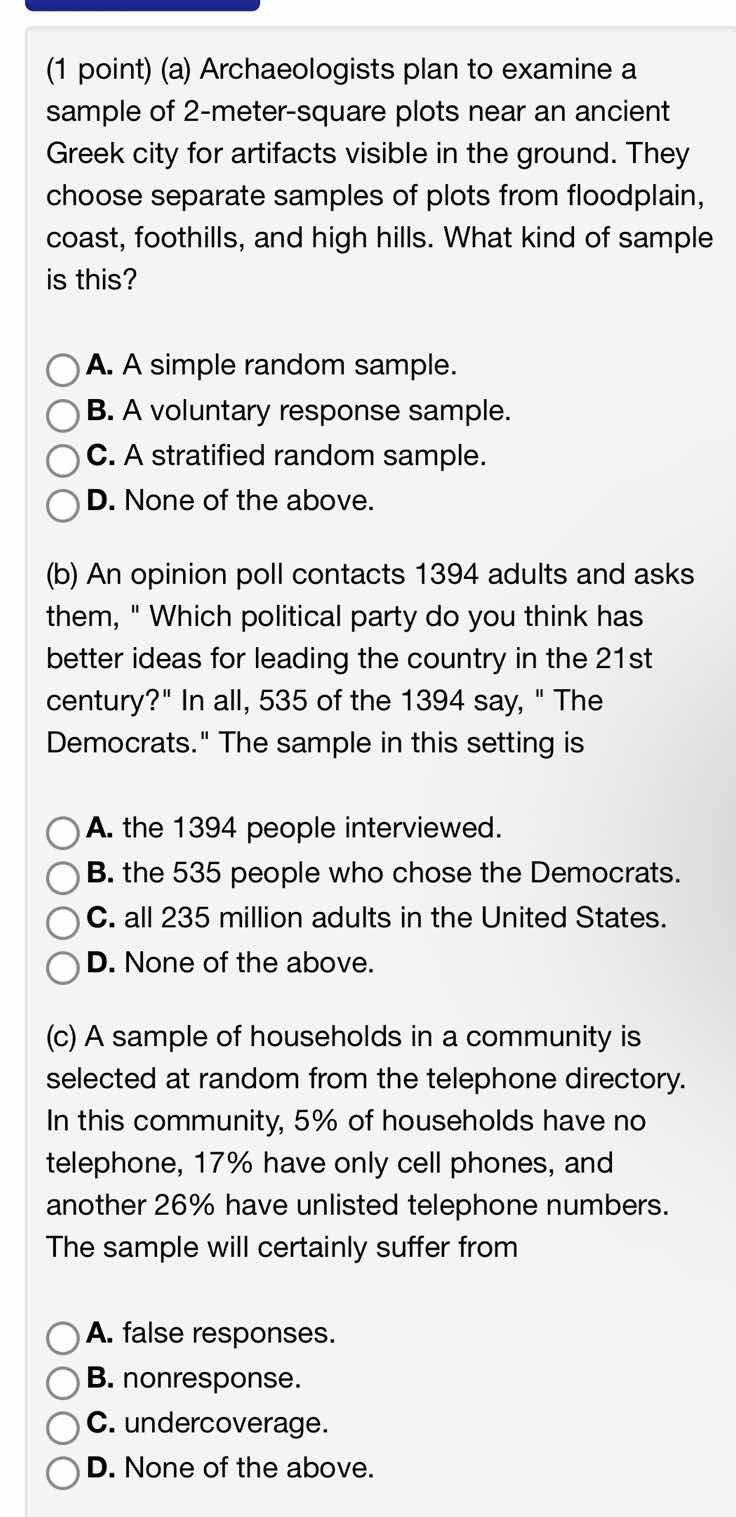
(1 point) (a) archaeologists plan to examine a sample of 2-meter-square plots near an ancient greek city for artifacts visible in the ground. they choose separate samples of plots from floodplain, coast, foothills, and high hills. what kind of sample is this? a. a simple random sample. b. a voluntary response sample. c. a stratified random sample. d. none of the above. (b) an opinion poll contacts 1394 adults and asks them, \ which political party do you think has better ideas for leading the country in the 21st century?\ in all, 535 of the 1394 say, \ the democrats.\ the sample in this setting is a. the 1394 people interviewed. b. the 535 people who chose the democrats. c. all 235 million adults in the united states. d. none of the above. (c) a sample of households in a community is selected at random from the telephone directory. in this community, 5% of households have no telephone, 17% have only cell phones, and another 26% have unlisted telephone numbers. the sample will certainly suffer from a. false responses. b. nonresponse. c. undercoverage. d. none of the above.
Part (a)
To determine the sample type, we analyze each option:
- Option A: A simple random sample involves randomly selecting individuals from the entire population without stratification. Here, the population is divided into groups (floodplain, coast, foothills, high hills), so it's not simple random.
- Option B: A voluntary response sample is when people self - select to participate, which is not the case here as archaeologists are choosing samples from specific groups.
- Option C: A stratified random sample is when the population is divided into strata (in this case, different land - type groups: floodplain, coast, foothills, high hills) and samples are taken from each stratum. This matches the archaeologists' sampling method.
- Option D: Since option C is correct, this is incorrect.
- Option A: In a survey, the sample is the group of individuals who are actually surveyed. Here, 1394 adults are contacted and surveyed, so they are the sample.
- Option B: The 535 people who chose the Democrats are a subset of the sample (the respondents with a particular answer), not the entire sample.
- Option C: All 235 million adults in the US are the population, not the sample.
- Option D: Since option A is correct, this is incorrect.
- Option A: False responses are when respondents give incorrect answers, which is not related to the sampling method here (selecting from the telephone directory).
- Option B: Non - response is when selected individuals do not respond, but here the problem is about not being able to select certain households (those without telephones, with only cell phones, or unlisted) in the first place.
- Option C: Undercoverage occurs when some members of the population are not included in the sampling frame (the telephone directory in this case). Households without telephones, with only cell phones, or with unlisted numbers are not in the telephone directory, so they are not covered in the sample.
- Option D: Since option C is correct, this is incorrect.

Snap & solve any problem in the app
Get step-by-step solutions on Sovi AI
Photo-based solutions with guided steps
Explore more problems and detailed explanations
C. A stratified random sample.