QUESTION IMAGE
Question
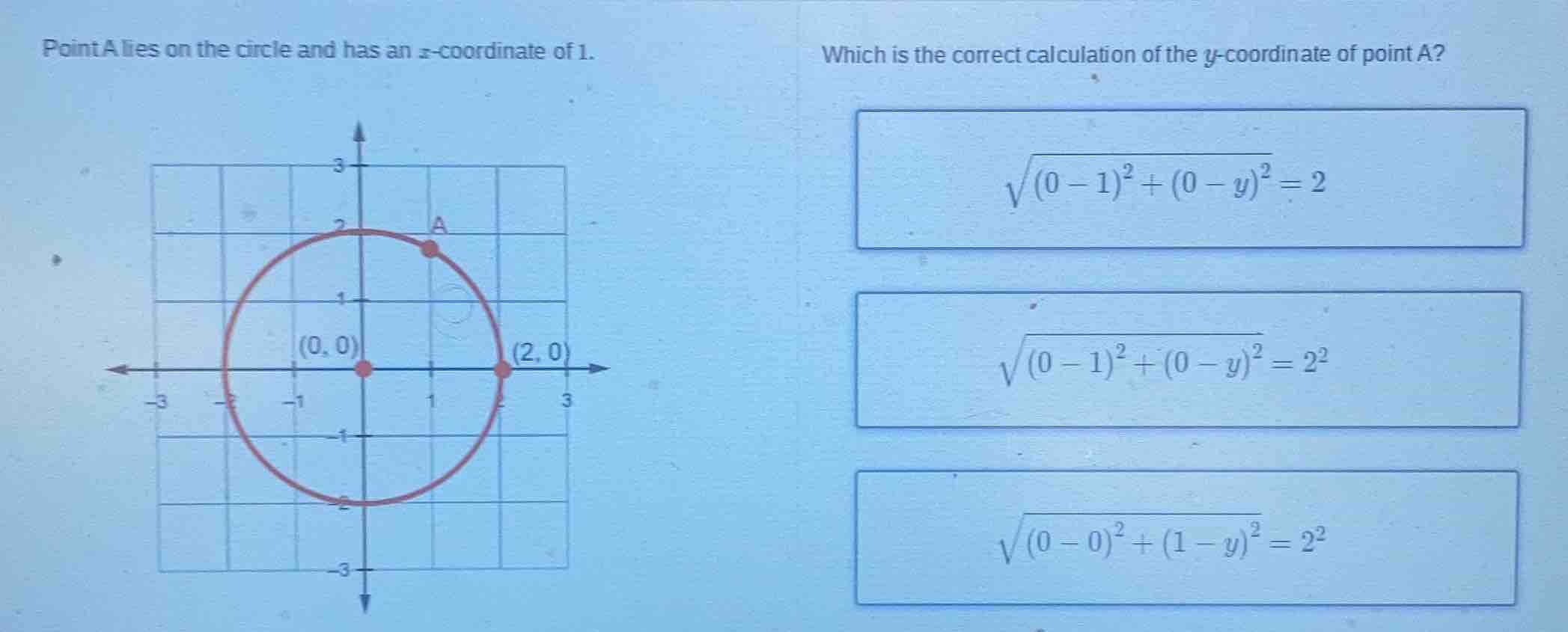
point a lies on the circle and has an x - coordinate of 1. which is the correct calculation of the y - coordinate of point a? \\(\sqrt{(0 - 1)^2+(0 - y)^2}=2\\) \\(\sqrt{(0 - 1)^2+(0 - y)^2}=2^2\\) \\(\sqrt{(0 - 0)^2+(1 - y)^2}=2^2\\)
Step1: Identify the circle's center and radius
The circle is centered at \((0,0)\) (from the graph) and passes through \((2,0)\), so the radius \(r = 2\). The distance formula between two points \((x_1,y_1)\) and \((x_2,y_2)\) is \(d=\sqrt{(x_2 - x_1)^2+(y_2 - y_1)^2}\). For point \(A(1,y)\) on the circle, the distance from the center \((0,0)\) to \(A\) should equal the radius.
Step2: Apply the distance formula
Using the distance formula with \((x_1,y_1)=(0,0)\) and \((x_2,y_2)=(1,y)\), we get \(\sqrt{(0 - 1)^2+(0 - y)^2}\). This distance must equal the radius, which is \(2\). But wait, the distance formula squared is also used in the circle equation \((x - h)^2+(y - k)^2=r^2\) (where \((h,k)\) is the center). So the distance from \((0,0)\) to \((1,y)\) is \(\sqrt{(0 - 1)^2+(0 - y)^2}\), and since the radius is \(2\), squaring both sides (from the circle equation \(x^2 + y^2=r^2\)) gives \((0 - 1)^2+(0 - y)^2 = 2^2\), which is equivalent to \(\sqrt{(0 - 1)^2+(0 - y)^2}=2\) (taking square roots, but actually the correct equation from the circle formula is \((x - 0)^2+(y - 0)^2 = 2^2\), so for \(x = 1\), \(1^2+y^2 = 4\), and solving for \(y\) would involve \(\sqrt{(0 - 1)^2+(0 - y)^2}=2\) (since the left side is the distance, equal to radius \(2\)). Wait, no—wait, the second option has \(2^2\) on the right. Wait, let's re - examine. The circle equation is \((x - h)^2+(y - k)^2=r^2\). Here, \(h = 0\), \(k = 0\), \(r = 2\), so \((x)^2+(y)^2=4\). For point \(A(1,y)\), substituting \(x = 1\) gives \(1 + y^2=4\), which can be written as \((0 - 1)^2+(0 - y)^2=2^2\). If we take the square root of both sides, \(\sqrt{(0 - 1)^2+(0 - y)^2}=\sqrt{2^2}=2\). Wait, but the options: the first option is \(\sqrt{(0 - 1)^2+(0 - y)^2}=2\), the second is \(\sqrt{(0 - 1)^2+(0 - y)^2}=2^2\), the third is \(\sqrt{(0 - 0)^2+(1 - y)^2}=2^2\).
Wait, the distance from \((0,0)\) to \((1,y)\) is \(\sqrt{(1 - 0)^2+(y - 0)^2}=\sqrt{(0 - 1)^2+(0 - y)^2}\), and this distance is the radius, which is \(2\). But in the circle equation, \((x - 0)^2+(y - 0)^2=r^2\), so \((1)^2+(y)^2 = 2^2\), which is \((0 - 1)^2+(0 - y)^2=2^2\). If we take the square root of both sides, \(\sqrt{(0 - 1)^2+(0 - y)^2}=\sqrt{2^2}=2\). But the second option has \(\sqrt{(0 - 1)^2+(0 - y)^2}=2^2\), which is wrong. Wait, no—maybe I made a mistake. Wait, the first option: \(\sqrt{(0 - 1)^2+(0 - y)^2}=2\). Let's calculate the left - hand side: \(\sqrt{(- 1)^2+(-y)^2}=\sqrt{1 + y^2}\). Setting this equal to \(2\) gives \(1 + y^2=4\), so \(y^2 = 3\), \(y=\pm\sqrt{3}\). The second option: \(\sqrt{(0 - 1)^2+(0 - y)^2}=2^2 = 4\). Then squaring both sides, \(1 + y^2=16\), which is not correct. The third option: \(\sqrt{(0 - 0)^2+(1 - y)^2}=2^2\), which is \(\sqrt{0+(1 - y)^2}=4\), so \((1 - y)^2 = 16\), which is also incorrect. Wait, so the first option is \(\sqrt{(0 - 1)^2+(0 - y)^2}=2\), which is correct because the distance from \((0,0)\) to \((1,y)\) is the radius \(2\). But wait, the problem's options: maybe I misread. Wait, the first option is \(\sqrt{(0 - 1)^2+(0 - y)^2}=2\), the second is \(\sqrt{(0 - 1)^2+(0 - y)^2}=2^2\), the third is \(\sqrt{(0 - 0)^2+(1 - y)^2}=2^2\). So the correct one is the second option? Wait, no—wait, the circle equation is \((x)^2+(y)^2=r^2\), so \(x = 1\), \(y = y\), \(r = 2\), so \(1 + y^2=4\), which is \((0 - 1)^2+(0 - y)^2=2^2\). If we take the square root of both sides, \(\sqrt{(0 - 1)^2+(0 - y)^2}=\sqrt{2^2}=2\). But the second option has \(2^2\) on the right. Wait, maybe the question is about the equation to solve for \(y\). Let's think again. The distance…

Snap & solve any problem in the app
Get step-by-step solutions on Sovi AI
Photo-based solutions with guided steps
Explore more problems and detailed explanations
The correct calculation is \(\boldsymbol{\sqrt{(0 - 1)^2+(0 - y)^2}=2}\) (the first option among the given options, assuming the first option is \(\sqrt{(0 - 1)^2+(0 - y)^2}=2\), the second is \(\sqrt{(0 - 1)^2+(0 - y)^2}=2^2\), and the third is \(\sqrt{(0 - 0)^2+(1 - y)^2}=2^2\)).