QUESTION IMAGE
Question
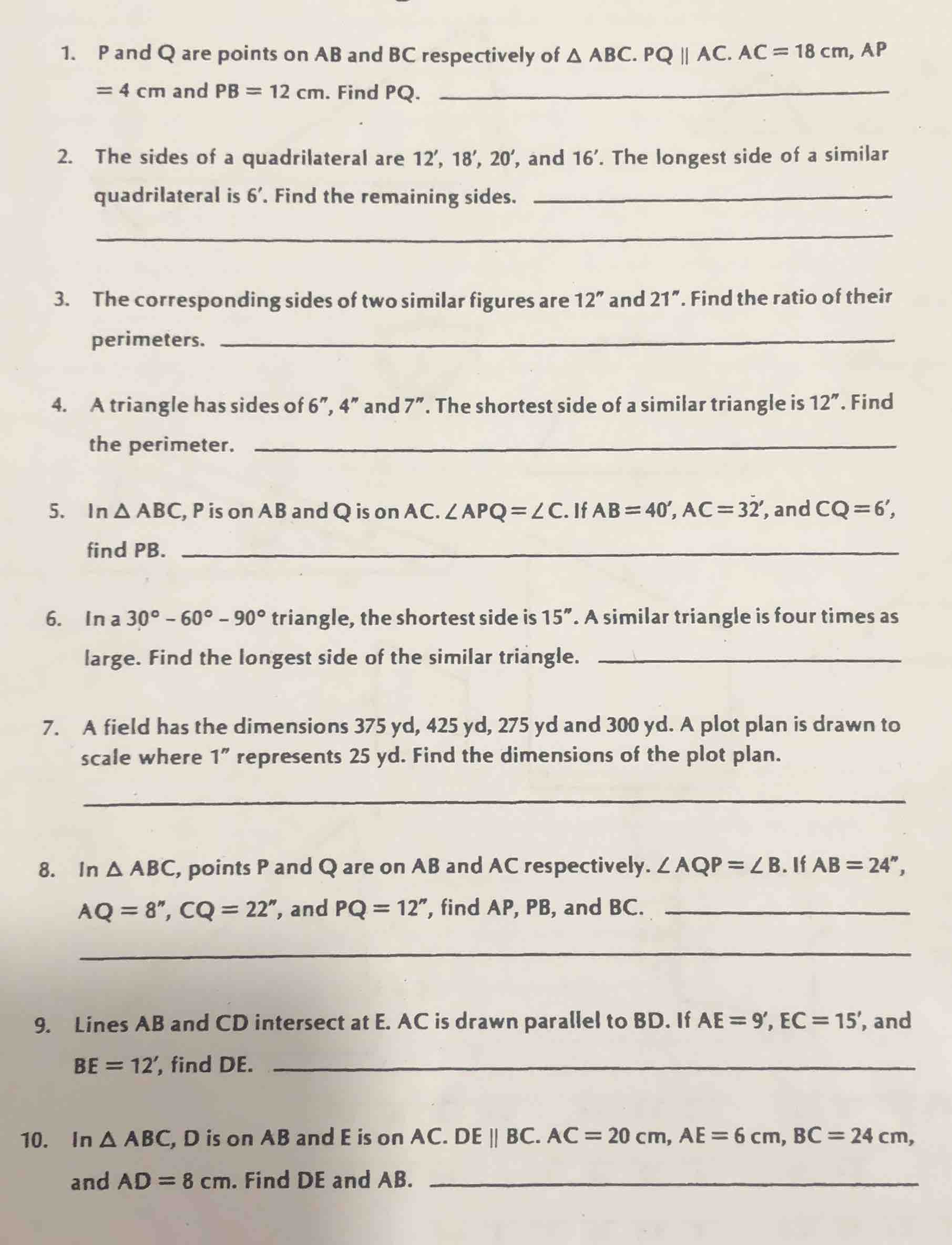
- p and q are points on ab and bc respectively of δ abc. pq || ac. ac = 18 cm, ap = 4 cm and pb = 12 cm. find pq.
- the sides of a quadrilateral are 12, 18, 20, and 16. the longest side of a similar quadrilateral is 6. find the remaining sides.
- the corresponding sides of two similar figures are 12\ and 21\. find the ratio of their perimeters.
- a triangle has sides of 6\, 4\ and 7\. the shortest side of a similar triangle is 12\. find the perimeter.
- in δ abc, p is on ab and q is on ac. ∠apq = ∠c. if ab = 40, ac = 32, and cq = 6, find pb.
- in a 30° - 60° - 90° triangle, the shortest side is 15\. a similar triangle is four times as large. find the longest side of the similar triangle.
- a field has the dimensions 375 yd, 425 yd, 275 yd and 300 yd. a plot plan is drawn to scale where 1\ represents 25 yd. find the dimensions of the plot plan.
- in δ abc, points p and q are on ab and ac respectively. ∠ aqp = ∠ b. if ab = 24\, aq = 8\, cq = 22\, and pq = 12\, find ap, pb, and bc.
- lines ab and cd intersect at e. ac is drawn parallel to bd. if ae = 9, ec = 15, and be = 12, find de.
- in δ abc, d is on ab and e is on ac. de || bc. ac = 20 cm, ae = 6 cm, bc = 24 cm, and ad = 8 cm. find de and ab.
Problem 1
Step1: Identify similar triangles
Since \( PQ \parallel AC \), by the Basic Proportionality Theorem (Thales' theorem), \( \triangle BPQ \sim \triangle BAC \). So the ratio of corresponding sides is equal.
First, find \( AB = AP + PB = 4 + 12 = 16 \) cm.
Step2: Set up the proportion
The ratio of \( PB \) to \( AB \) is equal to the ratio of \( PQ \) to \( AC \). So \( \frac{PB}{AB}=\frac{PQ}{AC} \).
Substitute the values: \( \frac{12}{16}=\frac{PQ}{18} \).
Step3: Solve for \( PQ \)
Cross - multiply: \( 16\times PQ = 12\times18 \).
\( 16PQ = 216 \).
\( PQ=\frac{216}{16}=\frac{27}{2} = 13.5 \) cm.
Step1: Find the scale factor
The sides of the first quadrilateral are \( 12',18',20',16' \). The longest side is \( 20' \). The longest side of the similar quadrilateral is \( 6' \). The scale factor \( k=\frac{6}{20}=\frac{3}{10} \).
Step2: Find the remaining sides
For the side of length \( 12' \): New length \( = 12\times\frac{3}{10}=3.6' \).
For the side of length \( 18' \): New length \( = 18\times\frac{3}{10}=5.4' \).
For the side of length \( 16' \): New length \( = 16\times\frac{3}{10}=4.8' \).
Step1: Recall the property of similar figures
For similar figures, the ratio of their perimeters is equal to the ratio of their corresponding sides.
Step2: Find the ratio of corresponding sides
The corresponding sides are \( 12'' \) and \( 21'' \). The ratio of the sides is \( \frac{12}{21}=\frac{4}{7} \).
Since the ratio of perimeters is equal to the ratio of corresponding sides, the ratio of their perimeters is \( \frac{4}{7} \).

Snap & solve any problem in the app
Get step-by-step solutions on Sovi AI
Photo-based solutions with guided steps
Explore more problems and detailed explanations
\( 13.5 \) cm