QUESTION IMAGE
Question
- - / 6 points
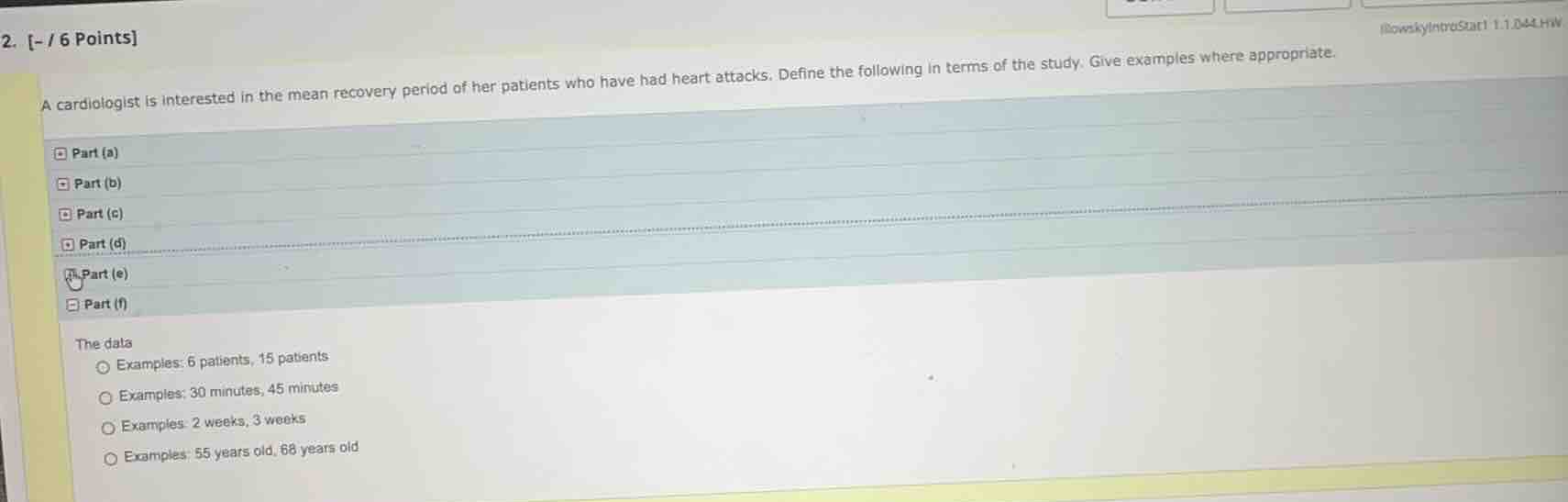
a cardiologist is interested in the mean recovery period of her patients who have had heart attacks. define the following in terms of the study. give examples where appropriate.
part (a)
part (b)
part (c)
part (d)
part (e)
part (f)
the data
examples: 6 patients, 15 patients
examples: 30 minutes, 45 minutes
examples: 2 weeks, 3 weeks
examples: 55 years old, 68 years old
To solve this, we analyze the study context: the cardiologist is interested in the mean recovery period of heart attack patients. Recovery period here is measured in time (like weeks). Let's evaluate each option:
- "Examples: 6 patients, 15 patients" → This is about the number of patients (sample size), not recovery period data. Eliminate.
- "Examples: 30 minutes, 45 minutes" → Recovery from a heart attack is unlikely to be measured in minutes (too short for typical heart attack recovery). Eliminate.
- "Examples: 2 weeks, 3 weeks" → Recovery period for heart attack patients is plausibly measured in weeks. This fits the study's focus on recovery period.
- "Examples: 55 years old, 68 years old" → This is patient age, not recovery period. Eliminate.
The study focuses on the mean recovery period of heart attack patients. The data for recovery period should represent time (e.g., weeks) for recovery. Among the options, "2 weeks, 3 weeks" are time - based and relevant to recovery period, while other options relate to number of patients, short - duration (unlikely for heart attack recovery), or patient age (not recovery period).

Snap & solve any problem in the app
Get step-by-step solutions on Sovi AI
Photo-based solutions with guided steps
Explore more problems and detailed explanations
Examples: 2 weeks, 3 weeks