QUESTION IMAGE
Question
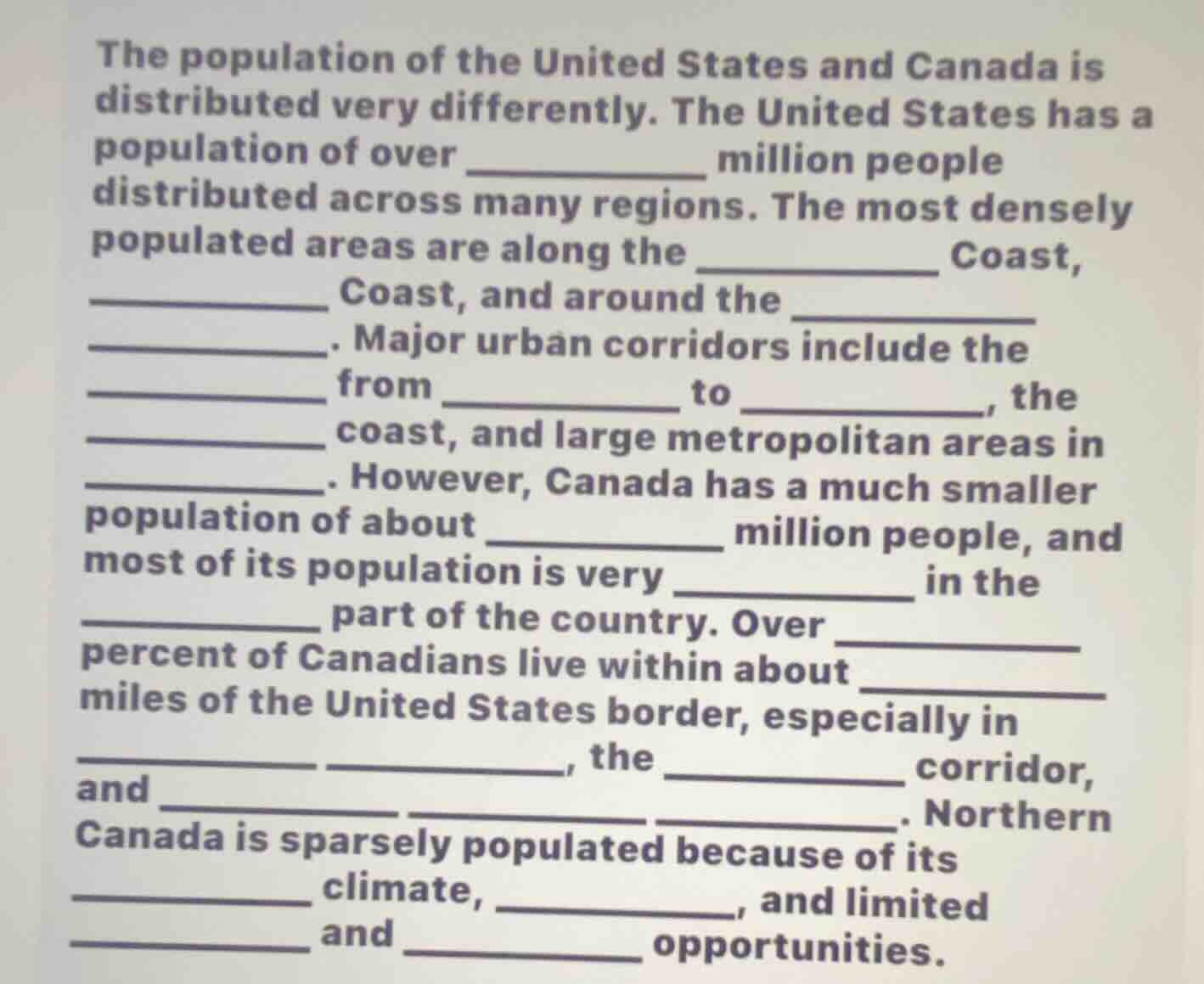
the population of the united states and canada is distributed very differently. the united states has a population of over _______ million people distributed across many regions. the most densely populated areas are along the _____ coast, _____ coast, and around the _____ _____. major urban corridors include the _____ from _____ to _____, the _____ coast, and large metropolitan areas in _____. however, canada has a much smaller population of about _____ million people, and most of its population is very _____ in the _____ part of the country. over _____ percent of canadians live within about _____ miles of the united states border, especially in _____ _____, the _____ corridor, and _____ _____ _____. northern canada is sparsely populated because of its _____ climate, _____, and limited _____ and _______ opportunities.
This fills in the blanks with standard demographic and geographic facts about the US and Canada's population distribution.

Snap & solve any problem in the app
Get step-by-step solutions on Sovi AI
Photo-based solutions with guided steps
Explore more problems and detailed explanations
The population of the United States and Canada is distributed very differently. The United States has a population of over 334 million people distributed across many regions. The most densely populated areas are along the East Coast, West Coast, and around the Great Lakes. Major urban corridors include the Northeast Megalopolis from Boston to Washington, D.C., the Pacific coast, and large metropolitan areas in Texas. However, Canada has a much smaller population of about 39 million people, and most of its population is very concentrated in the southern part of the country. Over 80 percent of Canadians live within about 100 miles of the United States border, especially in Southwestern Ontario, the Quebec City-Windsor corridor, and British Columbia's Lower Mainland. Northern Canada is sparsely populated because of its harsh Arctic/subarctic climate, permafrost, and limited economic and living opportunities.