QUESTION IMAGE
Question
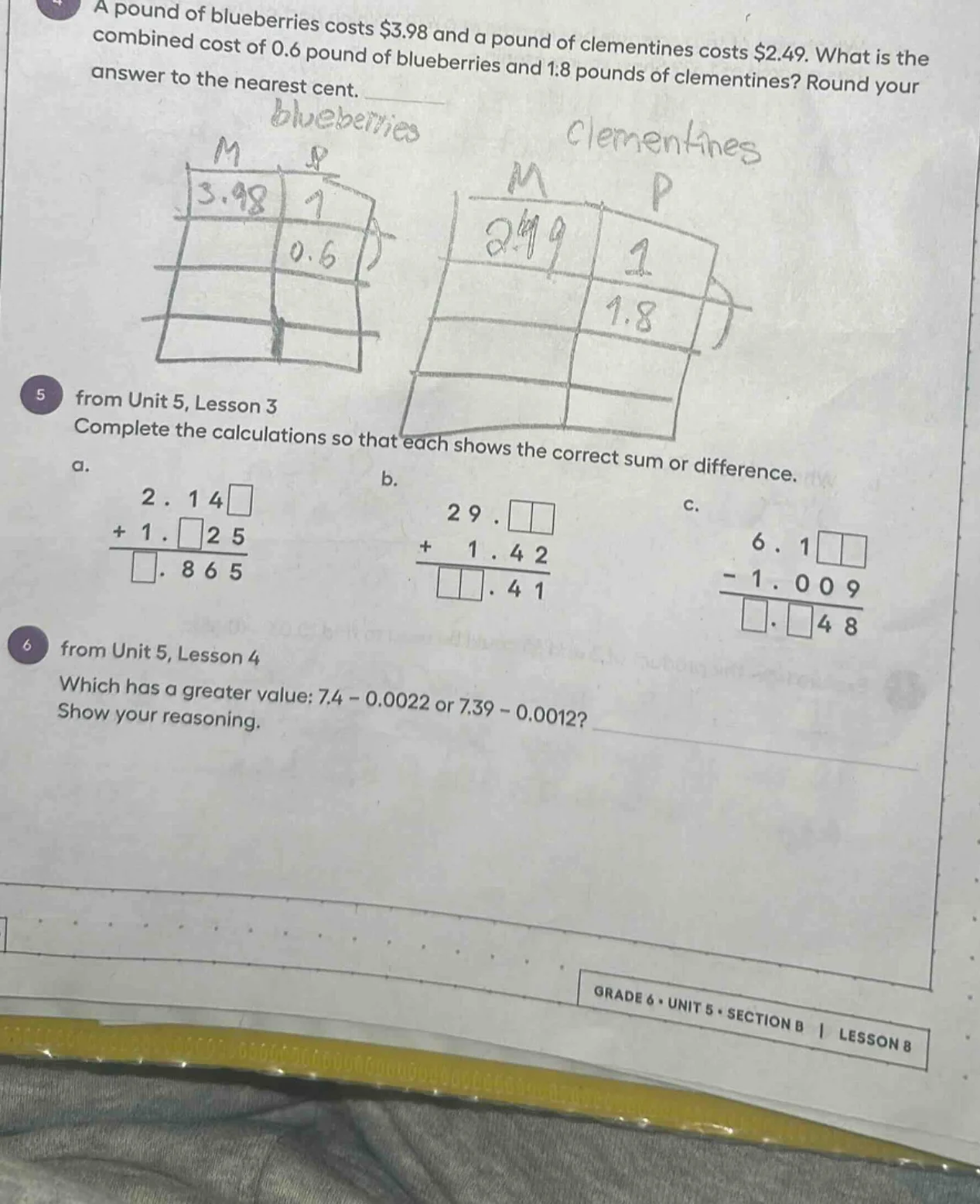
4 a pound of blueberries costs $3.98 and a pound of clementines costs $2.49. what is the combined cost of 0.6 pound of blueberries and 1.8 pounds of clementines? round your answer to the nearest cent.
5 from unit 5, lesson 3
complete the calculations so that each shows the correct sum or difference.
a.
\
b.
\
c.
\
6 from unit 5, lesson 4
which has a greater value: 7.4 - 0.0022 or 7.39 - 0.0012?
show your reasoning.
Problem 4
Step1: Calculate cost of blueberries
Cost of 1 pound blueberries = $3.98, so for 0.6 pound: $3.98 × 0.6 = $2.388
Step2: Calculate cost of clementines
Cost of 1 pound clementines = $2.49, so for 1.8 pounds: $2.49 × 1.8 = $4.482
Step3: Sum the two costs
Total cost = $2.388 + $4.482 = $6.87
Step1: Analyze the thousandths place
The sum's thousandths digit is 5, and the second number has 5 in thousandths place, so the first number's thousandths digit (□) must be 0 (since 0 + 5 = 5).
Step2: Analyze the hundredths place
Sum's hundredths digit is 6. First number has 4, second has 2. 4 + 2 = 6, so that's good.
Step3: Analyze the tenths place
Sum's tenths digit is 8. First number has 1, so the second number's tenths digit (□) must be 7 (1 + 7 = 8).
Step4: Analyze the ones place
First number has 2, second has 1. 2 + 1 = 3, so the sum's ones digit (□) is 3.
So the numbers are:
2.140
+ 1.725
-------
3.865
Step1: Analyze the hundredths place
Sum's hundredths digit is 1, second number has 2. So first number's hundredths digit (□) must be 9 (9 + 2 = 11, carry over 1).
Step2: Analyze the tenths place
Sum's tenths digit is 4, second number has 4, plus carry over 1: 4 + 1 = 5? Wait, no. Wait, sum's tenths digit is 4, second number's tenths is 4, so first number's tenths (□) + 4 + carry over (from hundredths) = 4. Wait, hundredths: 9 + 2 = 11, carry over 1. So tenths: □ + 4 + 1 = 14? Wait, no, sum's tenths is 4, so maybe: first number's tenths (□) + 4 + 1 (carry) = 14? No, that can't be. Wait, maybe I messed up. Wait, sum is □□.41, second number is 1.42, first number is 29.□□. So 29.□□ + 1.42 = □□.41. So 29 + 1 = 30, so the sum's tens and ones are 30? Wait, 29 + 1 = 30, so sum is 30.41? Wait, 30.41 - 1.42 = 28.99? No, 29.□□ + 1.42 = 30.41. So 30.41 - 1.42 = 28.99. Wait, that doesn't make sense. Wait, maybe:
Wait, sum's hundredths: 1, second number's hundredths: 2. So first number's hundredths: 11 - 2 = 9 (since we borrow? No, addition. So 9 + 2 = 11, carry over 1. Then tenths: □ + 4 + 1 = 14? No, sum's tenths is 4, so □ + 4 + 1 = 4? No, that would be negative. Wait, maybe the sum is 30.41? Let's check: 29.99 + 1.42 = 31.41? No. Wait, 29.99 + 1.42 = 31.41. No. Wait, maybe the sum is 30.41: 29.99 + 1.42 = 31.41. No. Wait, maybe I made a mistake. Let's do 30.41 - 1.42 = 28.99. But first number is 29.□□, so that's not possible. Wait, maybe the sum is 30.41, so 29.99 + 1.42 = 31.41. No, this is confusing. Wait, maybe the first number's tenths is 9, hundredths is 9: 29.99 + 1.42 = 31.41. But the sum is □□.41, so 31.41. So:
29.99
+ 1.42
-------
31.41
Yes, that works. So first number's tenths and hundredths are 9 and 9, sum's tens and ones are 31.

Snap & solve any problem in the app
Get step-by-step solutions on Sovi AI
Photo-based solutions with guided steps
Explore more problems and detailed explanations
$6.87