QUESTION IMAGE
Question
pplication
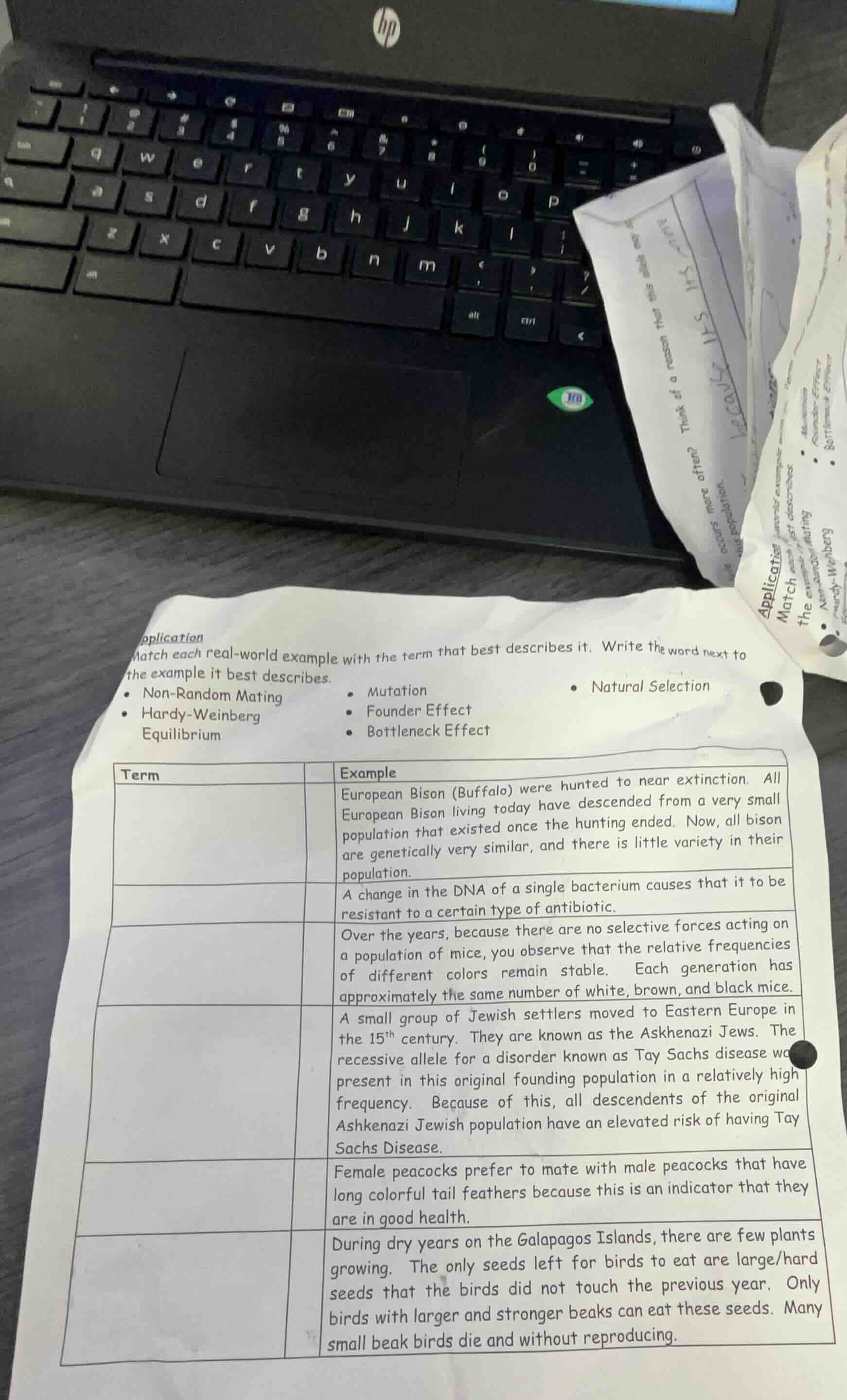
match each real-world example with the term that best describes it. write the word next to
the example it best describes.
- non-random mating
- hardy-weinberg
equilibrium
- mutation
- founder effect
- bottleneck effect
- natural selection
| term | example | ---- | ---- | european bison (buffalo) were hunted to near extinction. all european bison living today have descended from a very small population that existed once the hunting ended. now, all bison are genetically very similar, and there is little variety in their population. | a change in the dna of a single bacterium causes that it to be resistant to a certain type of antibiotic. | over the years, because there are no selective forces acting on a population of mice, you observe that the relative frequencies of different colors remain stable. each generation has approximately the same number of white, brown, and black mice. | a small group of jewish settlers moved to eastern europe in the 15th century. they are known as the askhenazi jews. the recessive allele for a disorder known as tay sachs disease wa present in this original founding population in a relatively high frequency. because of this, all descendents of the original ashkenazi jewish population have an elevated risk of having tay sachs disease. | female peacocks prefer to mate with male peacocks that have long colorful tail feathers because this is an indicator that they are in good health. | during dry years on the galapagos islands, there are few plants growing. the only seeds left for birds to eat are large/hard seeds that the birds did not touch the previous year. only birds with larger and stronger beaks can eat these seeds. many small beak birds die and without reproducing. |
Brief Explanations
- Bottleneck Effect: This occurs when a population is drastically reduced, leaving only a small group to repopulate, leading to reduced genetic diversity. The near-extinction of European bison fits this.
- Mutation: A mutation is a change in an organism's DNA that can lead to new traits, like antibiotic resistance in a bacterium.
- Hardy-Weinberg Equilibrium: This principle describes a population where allele and genotype frequencies remain constant over generations, with no evolutionary forces acting on it, which matches the stable mouse population.
- Founder Effect: This happens when a small subset of a population establishes a new population, leading to higher frequencies of certain traits (like the Tay Sachs allele in Ashkenazi Jews) in descendants.
- Non-Random Mating: This is when individuals choose mates based on specific traits, such as female peacocks selecting males with colorful tails.
- Natural Selection: This is the process where organisms with traits suited to their environment survive and reproduce more successfully, like large-beaked birds surviving dry years in the Galapagos.

Snap & solve any problem in the app
Get step-by-step solutions on Sovi AI
Photo-based solutions with guided steps
Explore more problems and detailed explanations
| Term | Example |
|---|---|
| Mutation | A change in the DNA of a single bacterium causes that it to be resistant to a certain type of antibiotic. |
| Hardy-Weinberg Equilibrium | Over the years, because there are no selective forces acting on a population of mice, you observe that the relative frequencies of different colors remain stable. Each generation has approximately the same number of white, brown, and black mice. |
| Founder Effect | A small group of Jewish settlers moved to Eastern Europe in the 15th century. They are known as the Askhenazi Jews. The recessive allele for a disorder known as Tay Sachs disease was present in this original founding population in a relatively high frequency. Because of this, all descendents of the original Ashkenazi Jewish population have an elevated risk of having Tay Sachs Disease. |
| Non-Random Mating | Female peacocks prefer to mate with male peacocks that have long colorful tail feathers because this is an indicator that they are in good health. |
| Natural Selection | During dry years on the Galapagos Islands, there are few plants growing. The only seeds left for birds to eat are large/hard seeds that the birds did not touch the previous year. Only birds with larger and stronger beaks can eat these seeds. Many small beak birds die and without reproducing. |