QUESTION IMAGE
Question
practice makes perfect
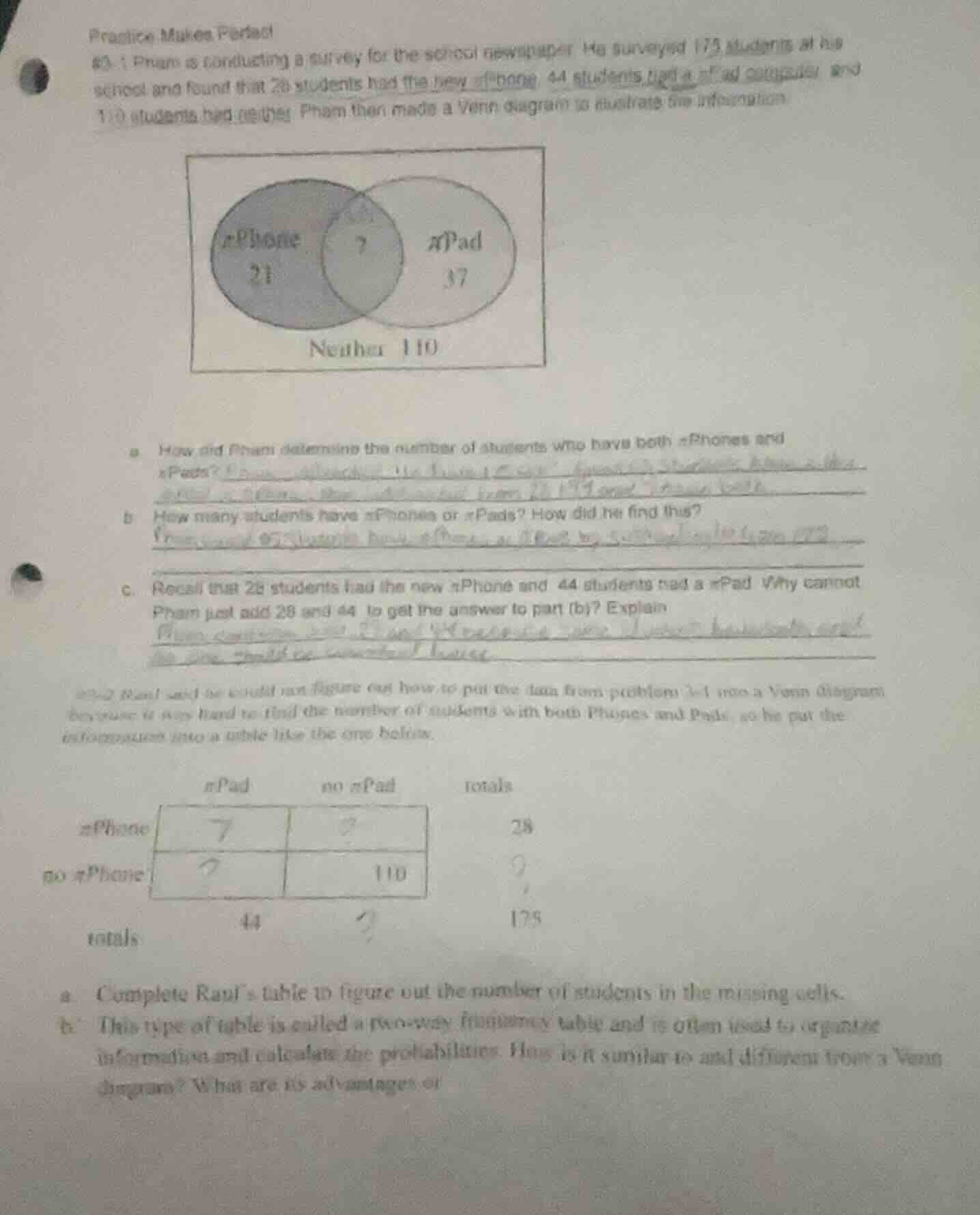
63.1 pham is conducting a survey for the school newspaper. he surveyed 175 students at his school and found that 28 students had the new xphone, 44 students had a xpad computer, and 110 students had neither. pham then made a venn diagram to illustrate the information.
venn diagram image: two overlapping circles labeled xphone (21 in non-overlapping,? in overlapping) and xpad (37 in non-overlapping), neither 110 below
a how did pham determine the number of students who have both xphones and xpads?
b how many students have xphones or xpads? how did he find this?
c recall that 28 students had the new xphone and 44 students had a xpad. why cannot pham just add 28 and 44 to get the answer to part (b)? explain
63.2 raul said he could not figure out how to put the data from problem 3-1 into a venn diagram because it was hard to find the number of students with both phones and pads, so he put the information into a table like the one below.
two - way table: rows xphone, no xphone; columns xpad, no xpad, totals. xphone row: xpad (7), no xpad (?), total 28; no xphone row: xpad (?), no xpad (110), total (?); totals column: xpad (44), no xpad (?), total 175
a complete raul’s table to figure out the number of students in the missing cells.
b this type of table is called a two - way frequency table and is often used to organize information and calculate the probabilities. how is it similar to and different from a venn diagram? what are its advantages or
For Problem 83.1
Step1: Find total with device
Total students: $175$, neither: $110$.
$175 - 110 = 65$
Step2: Calculate overlap (both devices)
Total with iPhone: $28$, total with iPad: $44$. Sum: $28+44=72$. Overlap = $72 - 65 = 7$
Step3: Verify "or" count
iPhone only: $28-7=21$, iPad only: $44-7=37$. Sum: $21+37+7=65$
Step1: Fill iPhone no iPad
Total iPhone: $28$, both: $7$.
$28 - 7 = 21$
Step2: Fill no iPhone with iPad
Total iPad: $44$, both: $7$.
$44 - 7 = 37$
Step3: Fill no iPhone total
Total students: $175$, total iPhone: $28$.
$175 - 28 = 147$
Step4: Fill no iPad total
Total students: $175$, total iPad: $44$.
$175 - 44 = 131$

Snap & solve any problem in the app
Get step-by-step solutions on Sovi AI
Photo-based solutions with guided steps
Explore more problems and detailed explanations
a. Pham first calculated the total number of students with either device ($175-110=65$). Then he found the sum of students with iPhones and iPads ($28+44=72$), and subtracted the total with either device to get the overlap: $72-65=7$.
b. 65 students have iPhones or iPads. This is found by subtracting the number of students with neither device from the total surveyed: $175-110=65$.
c. Adding 28 and 44 counts the students who have both devices twice, so the result would be higher than the actual number of unique students with either device.
---