QUESTION IMAGE
Question
practice set 2
double-check your work.
9
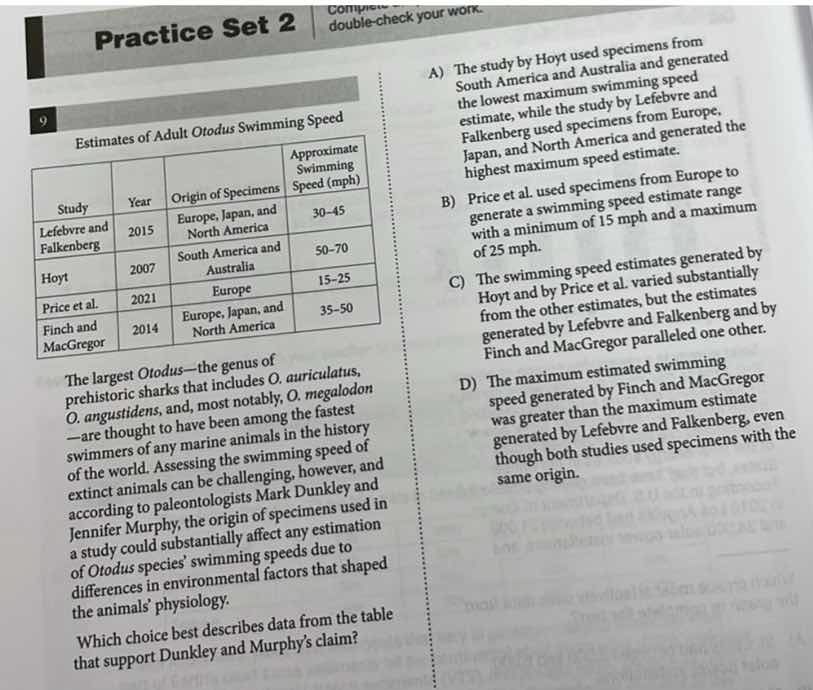
estimates of adult otodus swimming speed
| study | year | origin of specimens | approximate swimming speed (mph) | ---- | ---- | ---- | ---- | lefebvre and falkenberg | 2015 | europe, japan, and north america | 30-45 | hoyt | 2007 | south america and australia | 50-70 | price et al. | 2021 | europe | 15-25 | finch and macgregor | 2014 | europe, japan, and north america | 35-50 | the largest otodus—the genus of prehistoric sharks that includes o. auriculatus, o. angustidens, and, most notably, o. megalodon —are thought to have been among the fastest swimmers of any marine animals in the history of the world. assessing the swimming speed of extinct animals can be challenging, however, and according to paleontologists mark dunkley and jennifer murphy, the origin of specimens used in a study could substantially affect any estimation of otodus species swimming speeds due to differences in environmental factors that shaped the animals physiology. |
which choice best describes data from the table that support dunkley and murphys claim?
a) the study by hoyt used specimens from south america and australia and generated the lowest maximum swimming speed estimate, while the study by lefebvre and falkenberg used specimens from europe, japan, and north america and generated the highest maximum speed estimate.
b) price et al. used specimens from europe to generate a swimming speed estimate range with a minimum of 15 mph and a maximum of 25 mph.
c) the swimming speed estimates generated by hoyt and by price et al. varied substantially from the other estimates, but the estimates generated by lefebvre and falkenberg and by finch and macgregor paralleled one other.
d) the maximum estimated swimming speed generated by finch and macgregor was greater than the maximum estimate generated by lefebvre and falkenberg, even though both studies used specimens with the same origin.
First, analyze Dunkley and Murphy's claim: specimen origin affects swimming speed estimates due to physiological differences from environmental factors. Then cross-reference each option with the table data:
- Option A: Hoyt used South America/Australia specimens for 50-70 mph, while Lefebvre/Falkenberg used Europe/Japan/North America for 30-45 mph. This contradicts the claim in A (it says Hoyt had the lowest estimate, which is wrong).
- Option B: Price et al.'s range is 15-25 mph, not 15-25 mph with a 25 mph max as stated (the max is 25, but the claim about origin is not addressed here, and the range detail is misaligned to support the core claim).
- Option C: Hoyt (South America/Australia: 50-70) and Price et al. (Europe:15-25) have very different estimates, while Lefebvre/Falkenberg (Europe/Japan/North America:30-45) and Finch and MacGregor (Europe/Japan/North America:35-50) have similar, overlapping ranges. This directly supports the claim that origin affects estimates: same-origin studies have matching results, different-origin studies do not.
- Option D: Finch and MacGregor's max is 50 mph, Lefebvre/Falkenberg's max is 45 mph, but the claim about "same origin" is incorrect—Lefebvre/Falkenberg and Finch/MacGregor share origin, but the statement frames this as a contradiction, which does not support the core claim about origin affecting estimates.

Snap & solve any problem in the app
Get step-by-step solutions on Sovi AI
Photo-based solutions with guided steps
Explore more problems and detailed explanations
C) The swimming speed estimates generated by Hoyt and by Price et al. varied substantially from the other estimates, but the estimates generated by Lefebvre and Falkenberg and by Finch and MacGregor paralleled one other.