QUESTION IMAGE
Question
7 practice 7 (from unit 4, lesson 3)
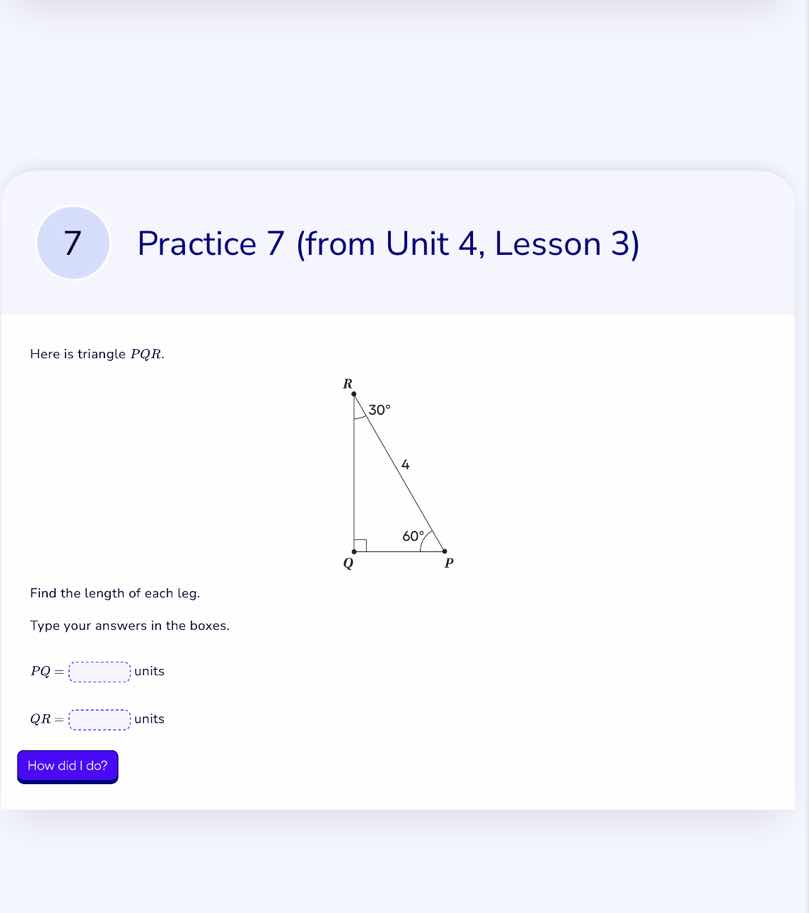
here is triangle pqr.
find the length of each leg.
type your answers in the boxes.
pq = \boxed{} units
qr = \boxed{} units
how did i do?
Step1: Identify the triangle type
Triangle \( PQR \) is a right - triangle with \( \angle Q = 90^{\circ} \), \( \angle P=60^{\circ} \), \( \angle R = 30^{\circ} \) and hypotenuse \( PR = 4 \) units. In a 30 - 60 - 90 triangle, the sides are in the ratio \( 1:\sqrt{3}:2 \), where the side opposite \( 30^{\circ} \) is the shortest side (let's call it \( x \)), the side opposite \( 60^{\circ} \) is \( x\sqrt{3} \), and the hypotenuse is \( 2x \).
Step2: Find the length of \( PQ \)
The side \( PQ \) is opposite the \( 30^{\circ} \) angle (\( \angle R \)). Let the length of \( PQ=x \). Since the hypotenuse \( PR = 4 \) and in a 30 - 60 - 90 triangle, hypotenuse \( = 2x \). So, \( 2x=4 \), then \( x = \frac{4}{2}=2 \). Wait, no. Wait, \( \angle R = 30^{\circ} \), so the side opposite \( \angle R \) is \( PQ \), and the side opposite \( \angle P = 60^{\circ} \) is \( QR \). Wait, let's correct: In right - triangle \( PQR \), right - angled at \( Q \), \( \angle R = 30^{\circ} \), \( \angle P=60^{\circ} \), hypotenuse \( PR = 4 \).
The side opposite \( 30^{\circ} \) (which is \( \angle R \)) is \( PQ \). In a 30 - 60 - 90 triangle, the length of the side opposite \( 30^{\circ} \) is half of the hypotenuse. So, \( PQ=\frac{1}{2}\times PR \). Since \( PR = 4 \), then \( PQ=\frac{1}{2}\times4 = 2 \) units.
Step3: Find the length of \( QR \)
The side \( QR \) is opposite the \( 60^{\circ} \) angle (\( \angle P \)). In a 30 - 60 - 90 triangle, the length of the side opposite \( 60^{\circ} \) is \( \sqrt{3} \) times the length of the side opposite \( 30^{\circ} \). We know that the side opposite \( 30^{\circ} \) ( \( PQ \)) is 2 units. So, \( QR = PQ\times\sqrt{3}=2\times\sqrt{3}=2\sqrt{3} \)? Wait, no. Wait, another way: Using trigonometric ratios.
We can use cosine and sine. For \( PQ \): \( \cos(60^{\circ})=\frac{PQ}{PR} \). Since \( \cos(60^{\circ})=\frac{1}{2} \) and \( PR = 4 \), then \( \frac{1}{2}=\frac{PQ}{4} \), so \( PQ = 4\times\frac{1}{2}=2 \) units.
For \( QR \): \( \sin(60^{\circ})=\frac{QR}{PR} \). Since \( \sin(60^{\circ})=\frac{\sqrt{3}}{2} \) and \( PR = 4 \), then \( QR = 4\times\frac{\sqrt{3}}{2}=2\sqrt{3} \)? Wait, no, wait. Wait, \( \angle P = 60^{\circ} \), so \( \cos(\angle P)=\frac{PQ}{PR} \), \( \sin(\angle P)=\frac{QR}{PR} \). Wait, no: In right - triangle \( PQR \), \( \angle Q = 90^{\circ} \), so:
\( \cos(\angle P)=\frac{PQ}{PR} \), \( \sin(\angle P)=\frac{QR}{PR} \)
\( \cos(60^{\circ})=\frac{PQ}{4} \), \( \cos(60^{\circ}) = 0.5 \), so \( PQ=4\times0.5 = 2 \)
\( \sin(60^{\circ})=\frac{QR}{4} \), \( \sin(60^{\circ})=\frac{\sqrt{3}}{2} \), so \( QR = 4\times\frac{\sqrt{3}}{2}=2\sqrt{3}\approx3.464 \)? Wait, no, wait, maybe I mixed up the angles. Wait, \( \angle R = 30^{\circ} \), so \( \sin(\angle R)=\frac{PQ}{PR} \), \( \cos(\angle R)=\frac{QR}{PR} \)
\( \sin(30^{\circ})=\frac{PQ}{4} \), \( \sin(30^{\circ})=\frac{1}{2} \), so \( PQ = 4\times\frac{1}{2}=2 \)
\( \cos(30^{\circ})=\frac{QR}{4} \), \( \cos(30^{\circ})=\frac{\sqrt{3}}{2} \), so \( QR = 4\times\frac{\sqrt{3}}{2}=2\sqrt{3}\approx3.464 \)? Wait, but let's check again.
Wait, the triangle is right - angled at \( Q \), so:
- \( PQ \) is adjacent to \( \angle P \) and opposite to \( \angle R \)
- \( QR \) is adjacent to \( \angle R \) and opposite to \( \angle P \)
- \( PR \) is the hypotenuse.
Since \( \angle R = 30^{\circ} \), the side opposite \( \angle R \) is \( PQ \). In a 30 - 60 - 90 triangle, the side opposite 30° is half the hypotenuse. So \( PQ=\frac{1}{2}\times PR=\frac{1}{2}\times4 = 2 \) units.
The side opposite \( \angle P = 60…

Snap & solve any problem in the app
Get step-by-step solutions on Sovi AI
Photo-based solutions with guided steps
Explore more problems and detailed explanations
\( PQ=\boldsymbol{2} \) units, \( QR=\boldsymbol{2\sqrt{3}} \) (or approximately \( 3.46 \)) units. Wait, but the problem says "type your answers in the boxes". Maybe we can write \( PQ = 2 \) and \( QR = 2\sqrt{3}\approx3.46 \), but let's see, in exact form, \( PQ = 2 \), \( QR = 2\sqrt{3} \).