QUESTION IMAGE
Question
practices and principles
english
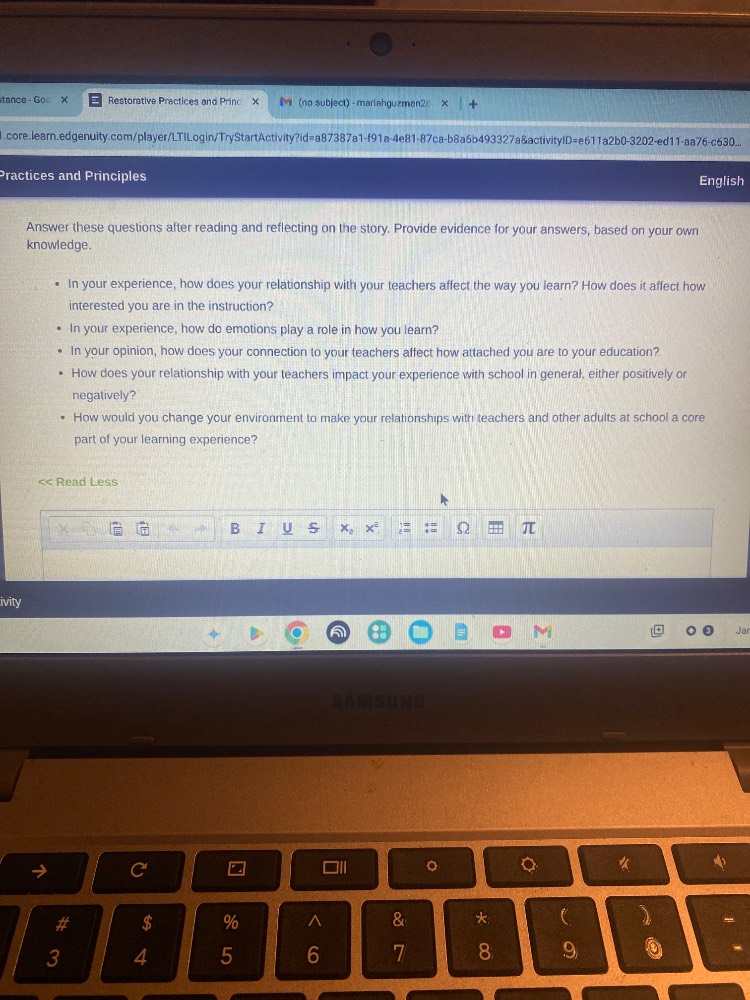
answer these questions after reading and reflecting on the story. provide evidence for your answers, based on your own knowledge.
- in your experience, how does your relationship with your teachers affect the way you learn? how does it affect how interested you are in the instruction?
- in your experience, how do emotions play a role in how you learn?
- in your opinion, how does your connection to your teachers affect how attached you are to your education?
- how does your relationship with your teachers impact your experience with school in general, either positively or negatively?
- how would you change your environment to make your relationships with teachers and other adults at school a core part of your learning experience?
<<read less
ivity
Response
These questions are related to the relationship between students and teachers, and the impact on learning. Let's take the first question as an example to answer:
Brief Explanations
- For the first question "In your experience, how does your relationship with your teachers affect the way you learn? How does it affect how interested you are in the instruction?":
- A positive relationship with teachers can enhance learning. For example, if a student has a good rapport with a teacher, they are more likely to feel comfortable asking questions. This leads to a better understanding of the subject matter. In terms of interest in instruction, a teacher - student relationship based on respect and mutual understanding can make the student look forward to the teacher's classes. The teacher may be more attuned to the student's learning style and can tailor the instruction, which in turn increases the student's interest. For instance, a teacher who knows a student is interested in practical applications can use real - world examples in the lessons, making the instruction more engaging for that student.
- For the second question "In your experience, how do emotions play a role in how you learn?":
- Positive emotions like enthusiasm and curiosity can be very beneficial. When a student is enthusiastic about a topic, they are more likely to be focused and retain information better. For example, if a student is excited about a science experiment, they will pay close attention to the steps and the results, and this excitement can also motivate them to explore related concepts outside of class. On the other hand, negative emotions such as anxiety or frustration can hinder learning. If a student is anxious about a difficult math concept, they may have trouble concentrating and understanding the material. For example, a student who is afraid of making mistakes in front of the class may be too nervous to participate in problem - solving activities, which can slow down their learning process.
- For the third question "In your opinion, how does your connection to your teachers affect how attached you are to your education?":
- A strong connection to teachers can increase a student's attachment to education. Teachers can serve as role models and sources of inspiration. If a student respects and admires a teacher, they may associate positive feelings with the educational process. For example, a teacher who is passionate about literature can inspire a student to develop a love for reading and writing, which in turn makes the student more attached to their overall education as they see the value in learning.
- For the fourth question "How does your relationship with your teachers impact your experience with school in general, either positively or negatively?":
- A positive relationship with teachers can make the overall school experience more enjoyable. The student will look forward to going to school, participating in classes, and engaging in school - related activities. For example, a student who has good relationships with multiple teachers may be more involved in extracurricular activities related to those teachers' subjects. Conversely, a negative relationship, such as a conflict with a teacher, can make the student dread going to school. They may start to dislike the school environment as a whole because of the negative interactions with that teacher.
- For the fifth question "How would you change your environment to make your relationships with teachers and other adults at school a core part of your learning experience?":
- One way could be to increase opportunities for one - on - one interactions. Schools could schedule regular office hours for teachers where students can meet with them to discuss not only academ…

Snap & solve any problem in the app
Get step-by-step solutions on Sovi AI
Photo-based solutions with guided steps
Explore more problems and detailed explanations
s:
- For the first question: A positive relationship with teachers promotes learning by encouraging question - asking and better understanding. It increases interest in instruction as teachers can tailor lessons to students' styles, e.g., using real - world examples for interested students.
- For the second question: Positive emotions like enthusiasm boost focus and retention (e.g., excitement about a science experiment). Negative emotions like anxiety hinder concentration and understanding (e.g., math - related anxiety affecting participation).
- For the third question: A strong connection to teachers increases attachment to education as teachers can inspire and be role models, e.g., a literature - passionate teacher inspiring a love for reading.
- For the fourth question: Positive relationships make school enjoyable (e.g., increased participation in activities), while negative ones can make school unappealing (e.g., dreading school due to teacher conflict).
- For the fifth question: Increase one - on - one interactions (e.g., teacher office hours), create mentorship programs, and organize teacher - student feedback sessions.