QUESTION IMAGE
Question
pre - war world war ii
social studies
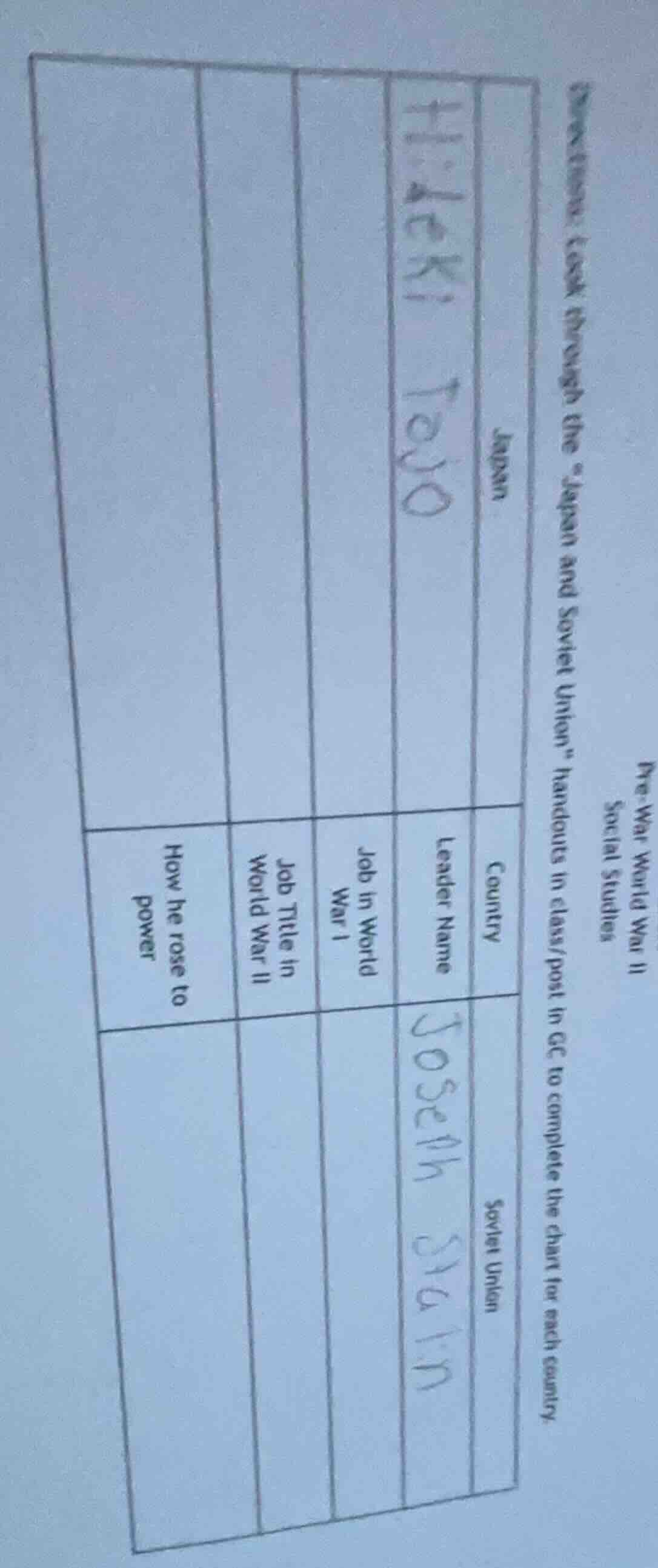
in - class: look through the “japan and soviet union” handouts in class/post in gc to complete the chart for each country.
| japan | soviet union | |
|---|---|---|
| leader name | hideki tojo | joseph stalin |
| job in world war i | ||
| job title in world war ii | ||
| how he rose to power |
Response
To complete the chart for Japan (Hideki Tojo) and the Soviet Union (Joseph Stalin) in the context of pre - World War II and World War II, we analyze each row:
For Hideki Tojo (Japan)
- Job in World War I: During World War I, Japan was an ally of the Entente Powers. Hideki Tojo served in the Japanese military. He was a young officer, and his role was mainly related to military service, gaining experience in the army.
- Job Title in World War II: He was the Prime Minister of Japan and also held the position of Minister of War. As Prime Minister, he was the head of the Japanese government, and as Minister of War, he had significant control over the Japanese military, playing a crucial role in Japan's war efforts.
- How he rose to power: Tojo rose to power through the Japanese military hierarchy. His hard - line militarist views and his success in the military (including his service in various military campaigns and his rise through the ranks) made him popular among the militarist faction in Japan. The political situation in Japan at that time, with the increasing influence of the military in politics, also facilitated his rise. He was appointed to key positions, and eventually, he became Prime Minister, consolidating his power with the support of the military and the ultranationalist groups.
For Joseph Stalin (Soviet Union)
- Job in World War I: During World War I, the Russian Empire was involved. Stalin was involved in revolutionary activities against the Tsarist regime. He was a Bolshevik, and his role was in organizing and participating in revolutionary actions, as well as working within the Bolshevik Party to undermine the Tsarist war effort and promote the cause of socialism.
- Job Title in World War II: He was the General Secretary of the Communist Party of the Soviet Union and the Premier of the Soviet Union. As the leader of the Communist Party, he had ultimate control over the Soviet political system, and as Premier, he was the head of the Soviet government. He was responsible for leading the Soviet Union's war effort against Nazi Germany.
- How he rose to power: Stalin rose to power through the internal power struggles within the Bolshevik Party after the Russian Revolution. After Lenin's death, he outmaneuvered his rivals (such as Trotsky) through a combination of political alliances, propaganda, and his control over the party apparatus. He gradually consolidated his power, eliminating opposition within the party and establishing a totalitarian regime, with himself as the supreme leader of the Soviet Union.
Filled - in Chart
| Country | Leader Name | Job in World War I | Job Title in World War II | How he rose to power |
|---|---|---|---|---|
| Soviet Union | Joseph Stalin | Involved in revolutionary activities against Tsarist regime (Bolshevik) | General Secretary of Communist Party and Premier of Soviet Union | Rose through Bolshevik Party power struggles, outmaneuvered rivals, consolidated control over party and state |

Snap & solve any problem in the app
Get step-by-step solutions on Sovi AI
Photo-based solutions with guided steps
Explore more problems and detailed explanations
To complete the chart for Japan (Hideki Tojo) and the Soviet Union (Joseph Stalin) in the context of pre - World War II and World War II, we analyze each row:
For Hideki Tojo (Japan)
- Job in World War I: During World War I, Japan was an ally of the Entente Powers. Hideki Tojo served in the Japanese military. He was a young officer, and his role was mainly related to military service, gaining experience in the army.
- Job Title in World War II: He was the Prime Minister of Japan and also held the position of Minister of War. As Prime Minister, he was the head of the Japanese government, and as Minister of War, he had significant control over the Japanese military, playing a crucial role in Japan's war efforts.
- How he rose to power: Tojo rose to power through the Japanese military hierarchy. His hard - line militarist views and his success in the military (including his service in various military campaigns and his rise through the ranks) made him popular among the militarist faction in Japan. The political situation in Japan at that time, with the increasing influence of the military in politics, also facilitated his rise. He was appointed to key positions, and eventually, he became Prime Minister, consolidating his power with the support of the military and the ultranationalist groups.
For Joseph Stalin (Soviet Union)
- Job in World War I: During World War I, the Russian Empire was involved. Stalin was involved in revolutionary activities against the Tsarist regime. He was a Bolshevik, and his role was in organizing and participating in revolutionary actions, as well as working within the Bolshevik Party to undermine the Tsarist war effort and promote the cause of socialism.
- Job Title in World War II: He was the General Secretary of the Communist Party of the Soviet Union and the Premier of the Soviet Union. As the leader of the Communist Party, he had ultimate control over the Soviet political system, and as Premier, he was the head of the Soviet government. He was responsible for leading the Soviet Union's war effort against Nazi Germany.
- How he rose to power: Stalin rose to power through the internal power struggles within the Bolshevik Party after the Russian Revolution. After Lenin's death, he outmaneuvered his rivals (such as Trotsky) through a combination of political alliances, propaganda, and his control over the party apparatus. He gradually consolidated his power, eliminating opposition within the party and establishing a totalitarian regime, with himself as the supreme leader of the Soviet Union.
Filled - in Chart
| Country | Leader Name | Job in World War I | Job Title in World War II | How he rose to power |
|---|---|---|---|---|
| Soviet Union | Joseph Stalin | Involved in revolutionary activities against Tsarist regime (Bolshevik) | General Secretary of Communist Party and Premier of Soviet Union | Rose through Bolshevik Party power struggles, outmaneuvered rivals, consolidated control over party and state |