QUESTION IMAGE
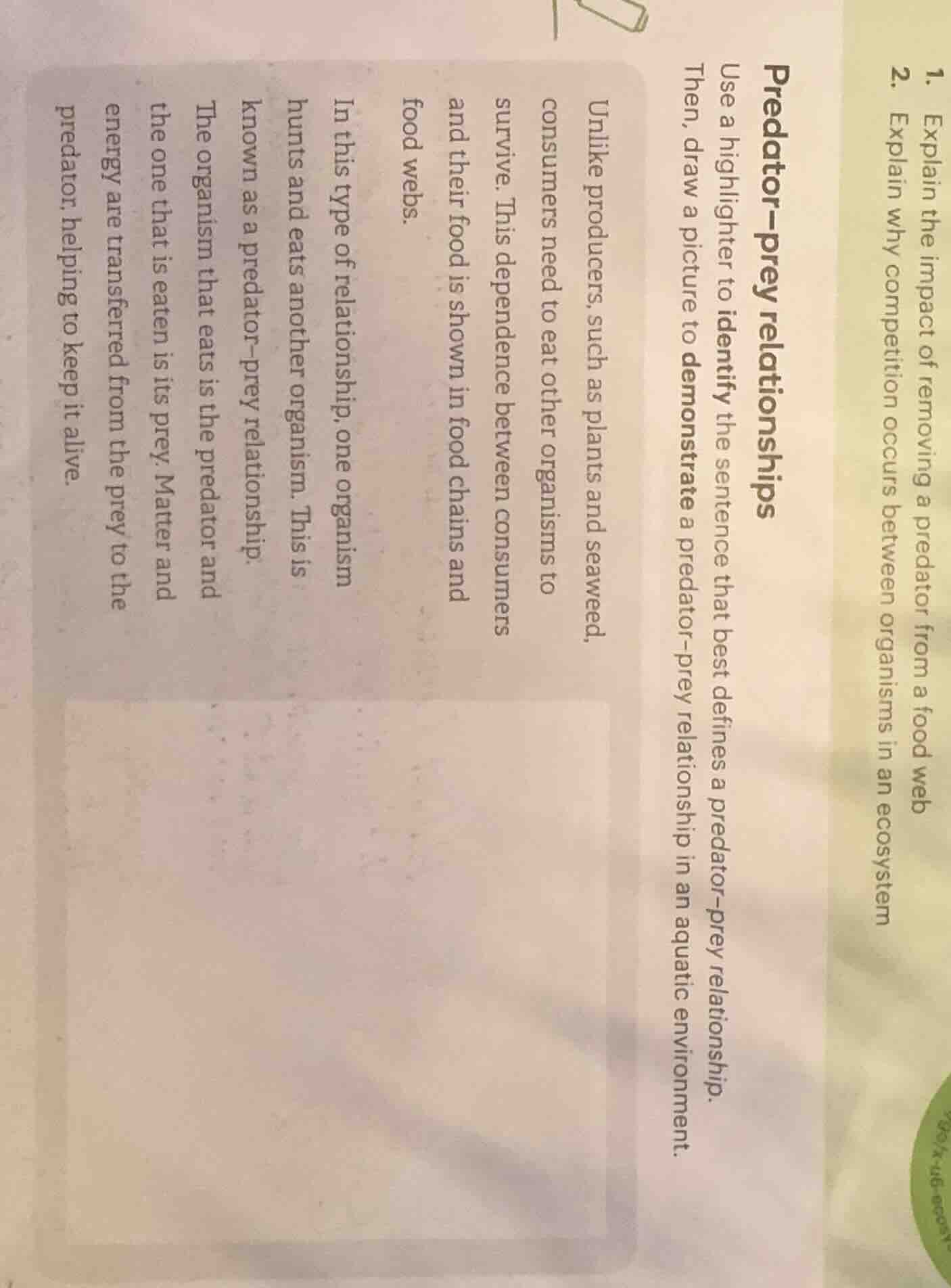
Question
predator–prey relationships
use a highlighter to identify the sentence that best defines a predator–prey relationship.
then, draw a picture to demonstrate a predator–prey relationship in an aquatic environment.
unlike producers, such as plants and seaweed,
consumers need to eat other organisms to
survive. this dependence between consumers
and their food is shown in food chains and
food webs.
in this type of relationship, one organism
hunts and eats another organism. this is
known as a predator–prey relationship.
the organism that eats is the predator and
the one that is eaten is its prey. matter and
energy are transferred from the prey to the
predator, helping to keep it alive.
- When a predator is removed from a food web, the population of its prey will increase without the top-down control of predation. This leads to overconsumption of the prey's food source, which can deplete that resource, and also creates imbalances for other species that rely on the same resources or interact with the prey.
- Competition occurs when multiple organisms in an ecosystem share the same limited resources (like food, water, shelter, or space). When these resources are not sufficient to meet the needs of all individuals, organisms must compete to access them for survival and reproduction.
- The sentence that best defines a predator-prey relationship is: "In this type of relationship, one organism hunts and eats another organism. This is known as a predator-prey relationship."
- An example aquatic predator-prey drawing: Draw a school of small fish (prey) being hunted by a larger fish like a barracuda (predator). Label the barracuda as "predator" and the small fish as "prey", with an arrow showing the energy transfer from the small fish to the barracuda.

Snap & solve any problem in the app
Get step-by-step solutions on Sovi AI
Photo-based solutions with guided steps
Explore more problems and detailed explanations
- Removing a predator removes top-down population control, causing its prey population to surge. This overpopulation leads to overgrazing/overconsumption of the prey's food source, disrupting the food web, reducing resources for other species, and potentially causing population crashes of other organisms dependent on the same resources.
- Competition occurs when multiple organisms in an ecosystem rely on the same limited resources (food, space, water, shelter) that are not enough to support all individuals, so they compete to secure these resources for survival and reproduction.
- The defining sentence: "In this type of relationship, one organism hunts and eats another organism. This is known as a predator-prey relationship."
- (Aquatic predator-prey example): A visual of a tuna (predator) chasing and feeding on a sardine (prey), with labels identifying each role and an arrow indicating energy transfer from sardine to tuna.