QUESTION IMAGE
Question
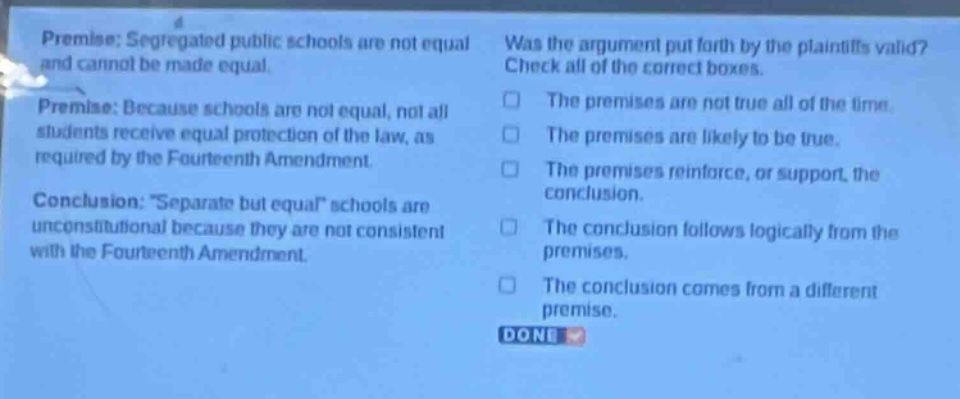
premise: segregated public schools are not equal and cannot be made equal.
premise: because schools are not equal, not all students receive equal protection of the law, as required by the fourteenth amendment.
conclusion: \separate but equal\ schools are unconstitutional because they are not consistent with the fourteenth amendment.
was the argument put forth by the plaintiffs valid?
check all of the correct boxes.
□ the premises are not true all of the time.
□ the premises are likely to be true.
□ the premises reinforce, or support, the conclusion.
□ the conclusion follows logically from the premises.
□ the conclusion comes from a different premise.
done
- Analyzing "The premises are not true all of the time": The premises about segregated schools being unequal and not providing equal protection (based on historical and legal context of segregation) are consistently true in the context of the argument, so this is incorrect.
- Analyzing "The premises are likely to be true": Segregated public schools were factually unequal (e.g., in resources, quality) and the Fourteenth Amendment requires equal protection, so these premises are likely true.
- Analyzing "The premises reinforce, or support, the conclusion": The first premise says segregated schools aren't equal, the second says unequal schools don't provide equal protection (required by 14th Amend.), and the conclusion says "separate but equal" schools are unconstitutional (since they don't meet 14th Amend. requirements). So the premises support the conclusion.
- Analyzing "The conclusion follows logically from the premises": If segregated schools are unequal (premise 1), and unequal schools don't provide equal protection (premise 2, as 14th Amend. requires equal protection), then "separate but equal" schools (which are segregated and unequal) are unconstitutional (since they violate 14th Amend.). So the conclusion follows logically.
- Analyzing "The conclusion comes from a different premise": The conclusion comes from the two given premises, not a different one, so this is incorrect.

Snap & solve any problem in the app
Get step-by-step solutions on Sovi AI
Photo-based solutions with guided steps
Explore more problems and detailed explanations
- The premises are likely to be true.
- The premises reinforce, or support, the conclusion.
- The conclusion follows logically from the premises.