QUESTION IMAGE
Question
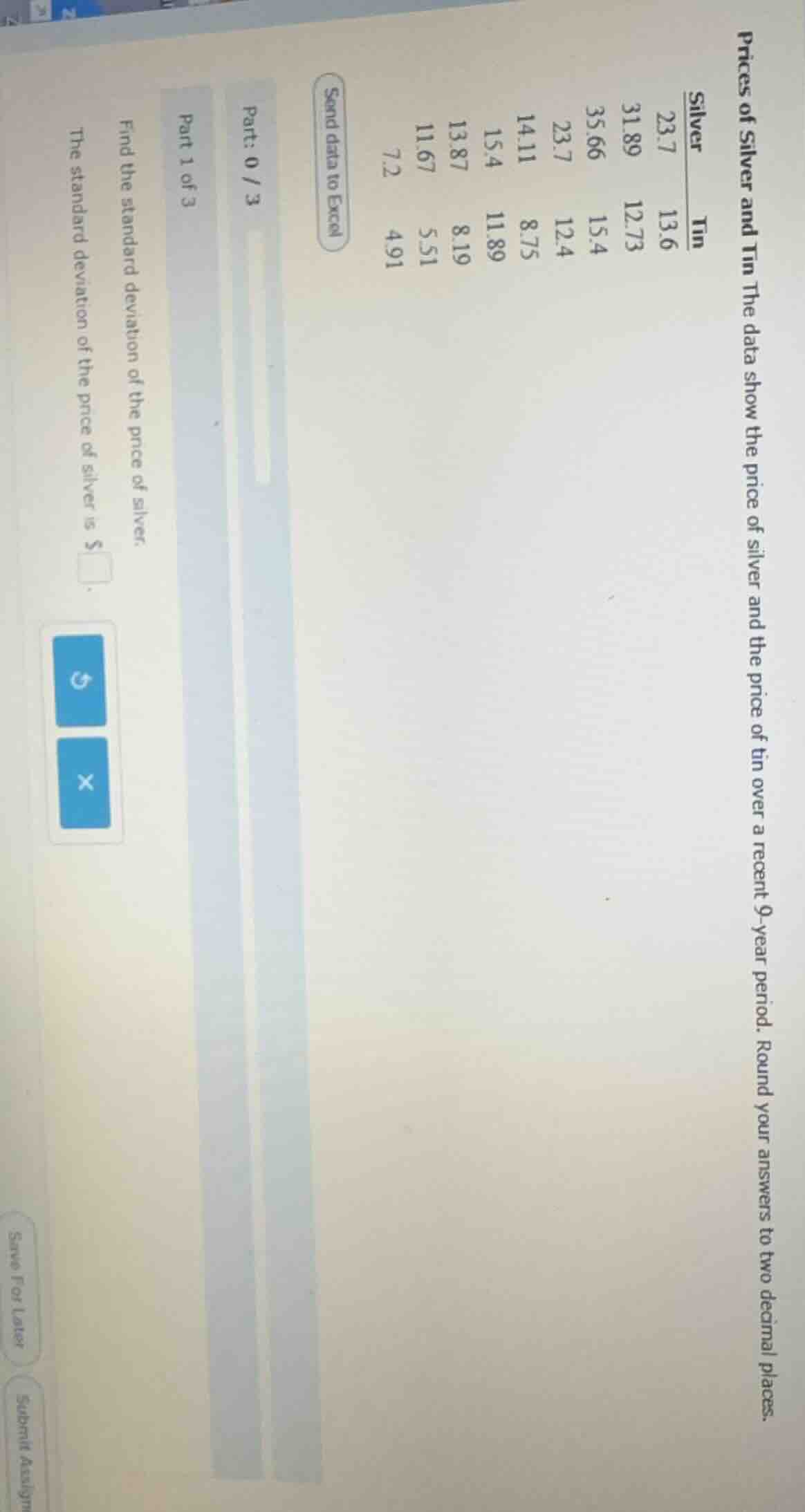
prices of silver and tin the data show the price of silver and the price of tin over a recent 9 - year period. round your answers to two decimal places. silver tin 23.7 13.6 31.89 12.73 35.66 15.4 23.7 12.4 14.11 8.75 15.4 11.89 13.87 8.19 11.67 5.51 7.2 4.91 send data to excel part: 0 / 3 part 1 of 3 find the standard deviation of the price of silver. the standard deviation of the price of silver is $
Step 1: List the data points for silver
The prices of silver are: \( 23.7, 31.89, 35.66, 23.7, 14.11, 15.4, 13.87, 11.67, 7.2 \)
Step 2: Calculate the mean (\(\bar{x}\))
First, sum the data points:
\( 23.7 + 31.89 + 35.66 + 23.7 + 14.11 + 15.4 + 13.87 + 11.67 + 7.2 \)
\( = (23.7 + 23.7) + 31.89 + 35.66 + 14.11 + 15.4 + 13.87 + 11.67 + 7.2 \)
\( = 47.4 + 31.89 + 35.66 + 14.11 + 15.4 + 13.87 + 11.67 + 7.2 \)
\( = 47.4 + 31.89 = 79.29 \)
\( 79.29 + 35.66 = 114.95 \)
\( 114.95 + 14.11 = 129.06 \)
\( 129.06 + 15.4 = 144.46 \)
\( 144.46 + 13.87 = 158.33 \)
\( 158.33 + 11.67 = 170 \)
\( 170 + 7.2 = 177.2 \)
There are \( n = 9 \) data points. So the mean is:
\( \bar{x} = \frac{177.2}{9} \approx 19.69 \) (rounded to two decimal places)
Step 3: Calculate the squared differences from the mean
For each data point \( x_i \), calculate \( (x_i - \bar{x})^2 \):
- For \( 23.7 \): \( (23.7 - 19.69)^2 = (4.01)^2 = 16.0801 \)
- For \( 31.89 \): \( (31.89 - 19.69)^2 = (12.2)^2 = 148.84 \)
- For \( 35.66 \): \( (35.66 - 19.69)^2 = (15.97)^2 \approx 255.0409 \)
- For \( 23.7 \): \( (23.7 - 19.69)^2 = (4.01)^2 = 16.0801 \)
- For \( 14.11 \): \( (14.11 - 19.69)^2 = (-5.58)^2 = 31.1364 \)
- For \( 15.4 \): \( (15.4 - 19.69)^2 = (-4.29)^2 = 18.4041 \)
- For \( 13.87 \): \( (13.87 - 19.69)^2 = (-5.82)^2 = 33.8724 \)
- For \( 11.67 \): \( (11.67 - 19.69)^2 = (-8.02)^2 = 64.3204 \)
- For \( 7.2 \): \( (7.2 - 19.69)^2 = (-12.49)^2 \approx 156.0001 \)
Step 4: Sum the squared differences
\( 16.0801 + 148.84 + 255.0409 + 16.0801 + 31.1364 + 18.4041 + 33.8724 + 64.3204 + 156.0001 \)
Calculate step by step:
\( 16.0801 + 148.84 = 164.9201 \)
\( 164.9201 + 255.0409 = 419.961 \)
\( 419.961 + 16.0801 = 436.0411 \)
\( 436.0411 + 31.1364 = 467.1775 \)
\( 467.1775 + 18.4041 = 485.5816 \)
\( 485.5816 + 33.8724 = 519.454 \)
\( 519.454 + 64.3204 = 583.7744 \)
\( 583.7744 + 156.0001 = 739.7745 \)
Step 5: Calculate the variance (\(s^2\))
Since this is a sample (we are dealing with a period of 9 years, likely a sample from a larger population), we use \( n - 1 = 8 \) in the denominator.
\( s^2 = \frac{\sum (x_i - \bar{x})^2}{n - 1} = \frac{739.7745}{8} \approx 92.4718 \)
Step 6: Calculate the standard deviation (\(s\))
Take the square root of the variance:
\( s = \sqrt{92.4718} \approx 9.616 \approx 9.62 \) (rounded to two decimal places)

Snap & solve any problem in the app
Get step-by-step solutions on Sovi AI
Photo-based solutions with guided steps
Explore more problems and detailed explanations
The standard deviation of the price of silver is \( \$9.62 \)