QUESTION IMAGE
Question
principles of the constitution
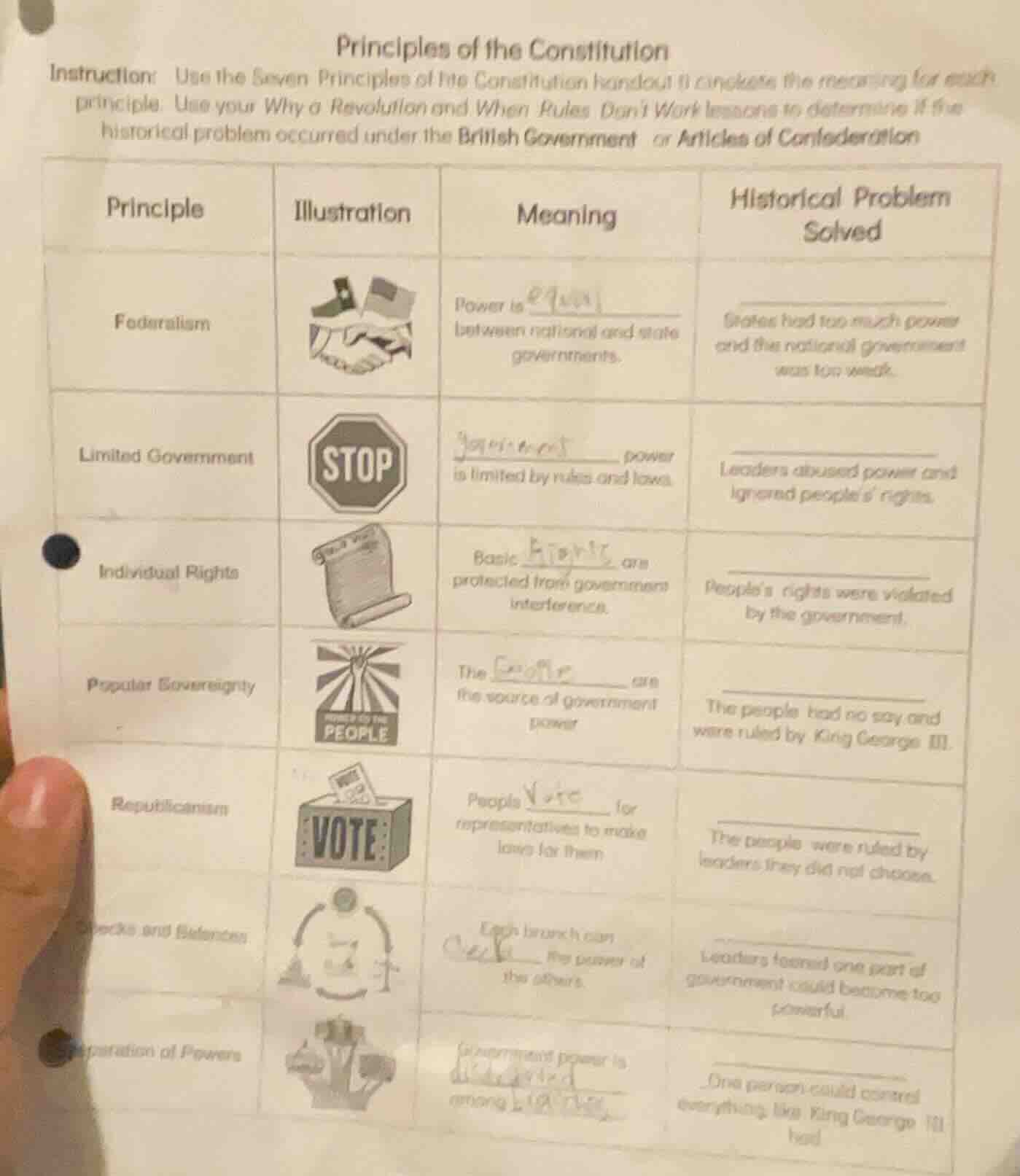
instruction: use the seven principles of the constitution handout to complete the meaning for each principle. use your why a revolution and when rules don’t work lessons to determine if the historical problem occurred under the british government or articles of confederation
| principle | illustration | meaning | historical problem solved |
|---|---|---|---|
| limited government | image of stop sign | ______ power is limited by rules and laws. | leaders abused power and ignored people’s rights. |
| individual rights | image of a document | basic ______ are protected from government interference. | people’s rights were violated by the government. |
| popular sovereignty | image with \power of the people\ | the ______ are the source of government power | the people had no say and were ruled by king george iii. |
| republicanism | image of a vote box | people ______ for representatives to make laws for them | the people were ruled by leaders they did not choose. |
| checks and balances | image of a circular flow | each branch can ______ the power of the others. | leaders feared one part of government could become too powerful. |
| separation of powers | image of three branches | government power is ____ among ____ | one person could control everything like king george iii had |
Brief Explanations
Each row is completed by defining the constitutional principle, matching it to the historical issue it solved, and identifying if the problem came from British rule or the Articles of Confederation:
- Federalism: Divides power between national/state govts; solved weak national govt under Articles of Confederation.
- Limited Government: Restricts govt power; solved abuse by British Government (King George III).
- Individual Rights: Protects basic freedoms; solved violations by British Government.
- Popular Sovereignty: People hold ultimate power; solved lack of representation under British Government.
- Republicanism: People elect representatives; solved unelected rulers under British Government.
- Checks and Balances: Branches limit each other's power; solved concentrated power risk from both, but primarily addresses British authoritarianism and unbalanced rule under the Articles.
- Separation of Powers: Splits govt into 3 branches; solved one-person rule under British Government.

Snap & solve any problem in the app
Get step-by-step solutions on Sovi AI
Photo-based solutions with guided steps
Explore more problems and detailed explanations
| Principle | Meaning | Historical Problem Solved | Source of Problem |
|---|---|---|---|
| Limited Government | Government power is limited by rules and laws. | Leaders abused power and ignored people's rights. | British Government |
| Individual Rights | Basic freedoms/rights are protected from government interference. | People's rights were violated by the government. | British Government |
| Popular Sovereignty | The people are the source of government power. | The people had no say and were ruled by King George III. | British Government |
| Republicanism | People vote/elect for representatives to make laws for them. | The people were ruled by leaders they did not choose. | British Government |
| Checks and Balances | Each branch can limit/check the power of the others. | Leaders feared one part of government could become too powerful. | Both (British Gov + Articles) |
| Separation of Powers | Government power is split/divided among 3 branches (executive, legislative, judicial). | One person could control everything, like King George III had. | British Government |