QUESTION IMAGE
Question
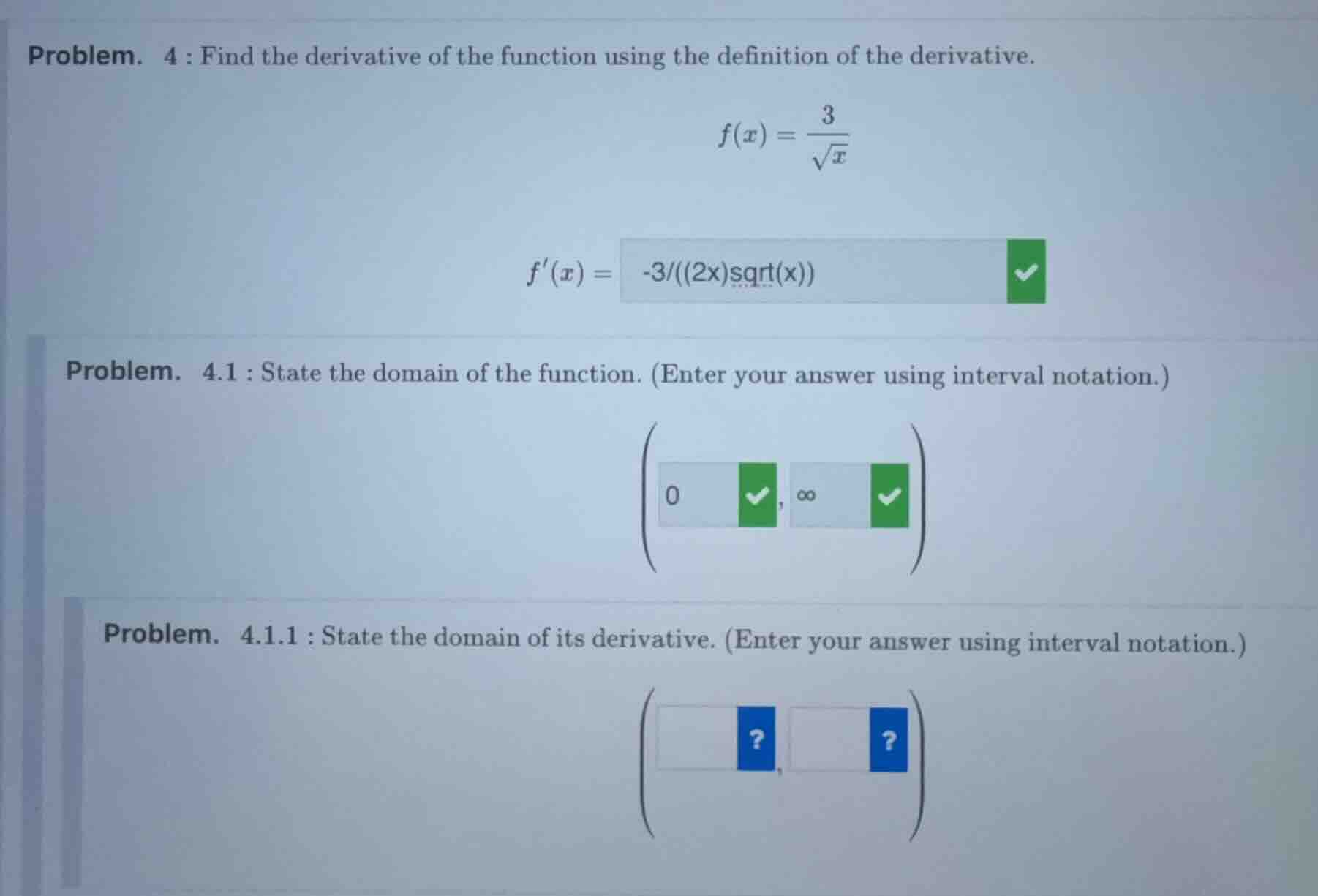
problem. 4 : find the derivative of the function using the definition of the derivative.
$f(x) = \frac{3}{\sqrt{x}}$
$f(x) = -3/((2x)sqrt(x))$
problem. 4.1 : state the domain of the function. (enter your answer using interval notation.)
$(0, \infty)$
problem. 4.1.1 : state the domain of its derivative. (enter your answer using interval notation.)
$(?, ?)$
Step1: Analyze the derivative function
The derivative of \( f(x)=\frac{3}{\sqrt{x}} \) is \( f'(x)=-\frac{3}{2x\sqrt{x}} \). We can rewrite \( f'(x) \) as \( f'(x)=-\frac{3}{2x^{\frac{3}{2}}} \) (since \( \sqrt{x}=x^{\frac{1}{2}} \), so \( x\sqrt{x}=x\cdot x^{\frac{1}{2}} = x^{\frac{3}{2}} \)).
Step2: Determine the domain restrictions
For the function \( f'(x) \), we need to consider two things: the denominator cannot be zero, and the expression under the square root (implicitly, since \( x^{\frac{3}{2}}=\sqrt{x^3} \)) must be defined for real numbers.
- The denominator \( 2x^{\frac{3}{2}} \) is zero when \( x = 0 \) (because if \( x = 0 \), then \( x^{\frac{3}{2}}=0 \)).
- Also, for \( x^{\frac{3}{2}} \) to be a real number, the radicand \( x^3 \) must be non - negative (since we are dealing with real - valued functions). But since \( x^{\frac{3}{2}} \) is in the denominator, \( x>0 \) (if \( x = 0 \), the denominator is zero, and if \( x<0 \), \( x^{\frac{3}{2}}=\sqrt{x^3} \) is not a real number because \( x^3<0 \) when \( x < 0 \) and the square root of a negative number is not real in the set of real numbers).

Snap & solve any problem in the app
Get step-by-step solutions on Sovi AI
Photo-based solutions with guided steps
Explore more problems and detailed explanations
\((0,\infty)\)